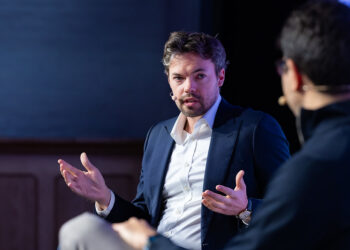
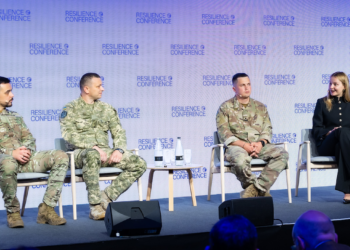
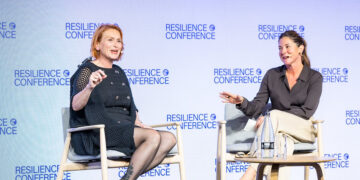
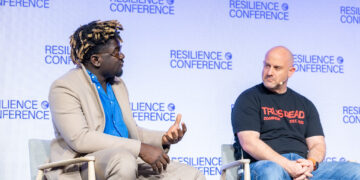
Disinformation components in kinetic Russian operations in Ukraine and Europe, along with the proliferation of AI capabilities, mean that the Russian hybrid threat is now more sophisticated and dangerous than ever before, agreed Vlad Galu and Andrii Bohdanenko, representatives of counter-disinformation start-ups, at the Resilience Conference in Warsaw this month.
According to Andrii Bohdanenko from Osavul, Russia’s disinformation campaigns are often layered with actions on the ground. “They synchronise across multiple domains—cyber, information, and physical. So if a missile strikes infrastructure, this is also an information operation.” He highlighted that disinformation spreads faster than verified data: “While you are still assessing the damage, which is real and visible, the information operation has already done its work.”
Layered kinetic-disinformation campaigns have already been used inside the EU. The vandalisation of a Holocaust memorial in Paris, likely orchestrated by Russian services, was amplified by a dedicated social media campaign, according to French authorities.
Vlad Galu from Refute underlined that while information warfare is less costly than combat, the development of AI tools has made it easily scalable: “with the advent of generative AI and AI agents, it has become dirt cheap for threat actors to create disinformation campaigns that can be very effective.”
According to Refute’s recently published report on influence campaigns in European elections, in Moldova, Russia spent €150 million to influence the vote, and in Romania, it interfered with the democratic process by “combining the bot farms and influencer networks seen previously with more sophisticated cross-border coordination and AI-assisted content production.”
European states have started creating dedicated bodies to counter foreign influence in the information sphere. France’s VIGINUM, attached to national security institutions, analyses large-scale online influence operations, aiming to track networks of inauthentic accounts and identify the actors behind them. Poland’s Ministry of Foreign Affairs now includes a ‘department of strategic communications and countering international disinformation.’
However, states’ efforts to increase the resilience of their populations against foreign influence offer no guarantee of success. As Polish MFA’s Konrad Adamowicz admitted, there are no reliable metrics to measure the spread of disinformation or, consequently, the effectiveness of counter-disinformation campaigns. “Ultimately, we will see in a couple of years whether resilience has been built.”