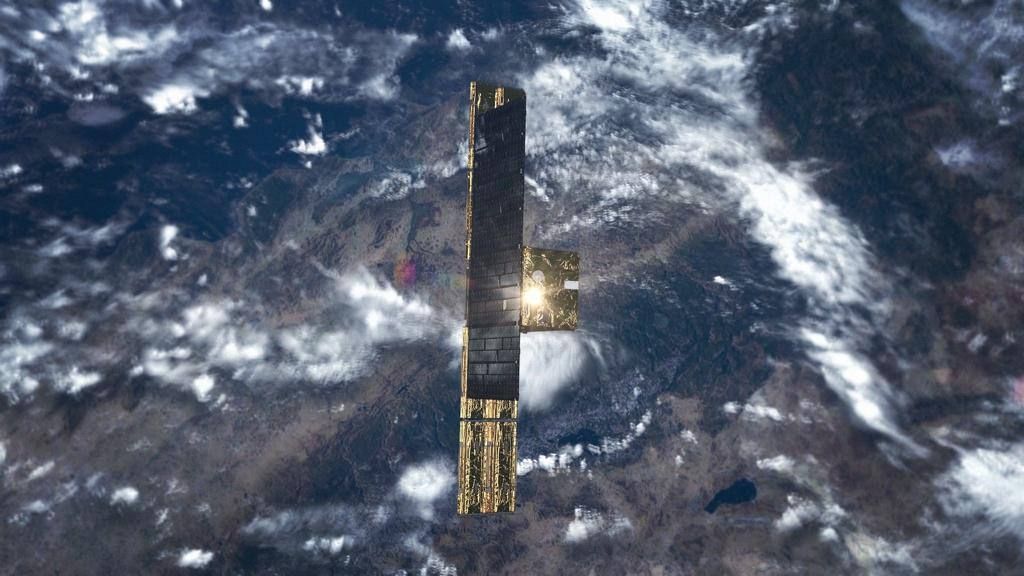
In late May, four Russian military satellites – launched just a month before – moved around ICEYE-X36, a commercial radar reconnaissance satellite from Finnish company ICEYE, matching its orbital plane.
This is no ordinary satellite. Nicknamed the ‘People’s Satellite’ – Ukraine’s population crowdfunded the purchase of its services – it provides crucial intelligence for the country’s armed forces.
“I think it’s more likely to be non-kinetic interference: trying to jam the satellite, trying to prevent communications from reaching back down, potentially intercepting data,” says Juliana Suess, who researches space security at the Stiftung Wissenschaft und Politik (SWP) in Berlin. “Ultimately, the data that ICEYE 36 is collecting could also be useful to Russia, because it’s positioned to catch imagery over Ukraine.”
The recent ICEYE incident is just a striking example of the threats to the satellite infrastructure on which European countries depend.
‘Russia has always seen the US military reliance on space as a weakness and as a vulnerability to exploit.’
Since 2014, two Russian satellites have been stalking and potentially intercepting data from European spacecraft – including military assets. The Secure World Foundation has identified a total of sixteen known or suspected incidents of threatening manoeuvres (known as RPO) by Russian military and intelligence satellites between 2014 and 2025.
“Some are what we assume are listening-in missions or signal interception. We know [Russia’s] Luch/Olymp satellites have been doing that, one of them for the last 10 years, manoeuvring close to a variety of different commercial communications satellites,” said Suess. “We’ve seen attempts to jam communications: the Germans have reported it, the Brits actually say it happens on a weekly basis.”
“They’re all non-kinetic, but we definitely see interference and attempts at disruption,” she added.
The urgent challenge for Europe is how to protect its assets in space.
“The whole Western concept of war – along with the West’s economic and critical infrastructure – is space-dependent,” said Dr John Sheldon, a founding partner at AstroAnalytica. “That is our soft underbelly.”
Western governments and militaries use services from commercial companies such as ICEYE, raising questions about the right roles for government and private companies in protecting these satellites. “This is a debate that Europe is only now starting to have,” said Sheldon.
One possible strategic avenue in this is mutual deterrence in space – that is, focusing on being able to put Russian assets at risk. However, such an approach is unlikely to be effective, Suess argues, because the Russian military is far less dependent on space.
That is partly a strategic decision.
“Russia has always seen the US military reliance on space as a weakness and as a vulnerability to exploit,” said Suess.
But it is also because of Russia’s declining space clout.
“Russia is a really strange case if you’re looking at space power status. We have really seen their space programme tank over the last couple of decades,” she added.
The country’s Earth observation satellites are quite outdated, she adds, noting that Russia has been trying to buy commercial satellite imagery since April 2022.
Early in the war, she noted, “They couldn’t get satellite imagery to confirm the hits that they thought they’d achieved, and they had to rely on pilots flying over or intercepted comms from Ukraine to confirm them.”
Rather than asking what Europe can do to ensure mutual deterrence, the question should be about how best to protect its space capabilities against threats.
“If you are a user of these systems, especially a government or a military, you need to basically make sure that those systems are up and running as long as possible in any hot water, [that they do] not collapse the moment things kick off,” said Sheldon.
To see the challenges and possibilities for making space systems more resilient, begin with the individual satellites.
There are a range of design features for individual satellites that make the overall systems more resilient. A particularly useful one is frequency hopping.
“If you have a signal jammer, they are usually set to a certain frequency range, so by changing the frequency somewhat frequently, the jammer would then also have to adapt,” said Suess. “Since they’re usually set to a certain frequency, it can help prevent consistent jamming or disruption of service.”
One challenge in designing satellites for resilience is in predicting the possible threat environment years ahead.
“Whatever you’ve given the satellite, that’s what it has to defend itself, [to] manoeuvre with,” said Suess.
There is now more of a push to do a more software-defined approach, she added, which has the benefit of potentially being modified remotely post-launch: features are built into a satellite not knowing how or if they will be of any use in the future, “but with the software tools to make use of or adapt certain capabilities.”
Another challenge is expense.
“The commercial satellite companies can do just about anything that is technically possible to protect their satellites,” said Sheldon. But the core issue for commercial providers is the costs this involves. “The problem is it almost eradicates the possibility you’re going to make a profit, because the satellite becomes so expensive to launch.”
Insurers may be an important driver in pushing commercial satellite companies to use capabilities such as frequency hopping.
“Commercial satellites now being part and parcel of military command, ISR and other structures, they’re legitimate targets, whether we like it or not, whether we admit it or not,” said Sheldon. “Insurers, if they’re going to provide coverage, will want to see measures put in place that will at least try and protect those satellites as best as possible.”
Increasing constellation resilience
Zooming out from the individual satellites, building resilient space systems is also about the constellation.
Multi-orbit constellations are more difficult to disable kinetically and less vulnerable to fears of crowding and mass debris generation that could render a certain orbit unusable.
Mass is useful, too. Larger constellations would require more equipment to take out kinetically, Suess pointed out. They also offer resilience against some kinds of non-kinetic attacks such as laser dazzling of Earth observation satellites.
But deploying more satellites in constellations only addresses certain vulnerabilities.
“It doesn’t help against signal jamming, for example, because for the most part signal jamming is directed at the receiver on the ground,” she added.
Ultimately, building resilient space systems is not just about the assets in orbit.
These systems are “not just the asset in space, it’s the entire system that supports it, which includes ground infrastructure, cloud computing, you know, overseas, sorry, over land and undersea fiber optic cabling,” said Sheldon.
“Especially in a military context, we need to have resilience and redundancy in place here on earth too, so I think at least for some systems I think we do need to have a terrestrial backup option,” particularly for navigation and communication, said Suess.
“You can affect a space system the benefits you get from a space system by exploiting any part of that system on the ground: the up-down links and the user segment,” noted Sheldon. “You’re denying your adversary its access to space, and you can do that for the foreseeable future without even touching the satellite in orbit.”