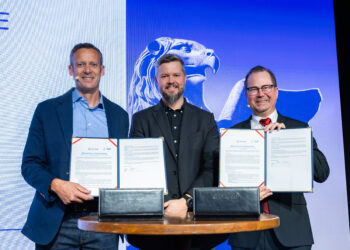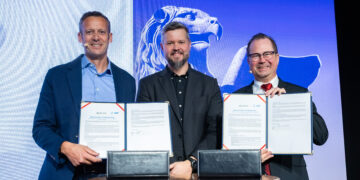
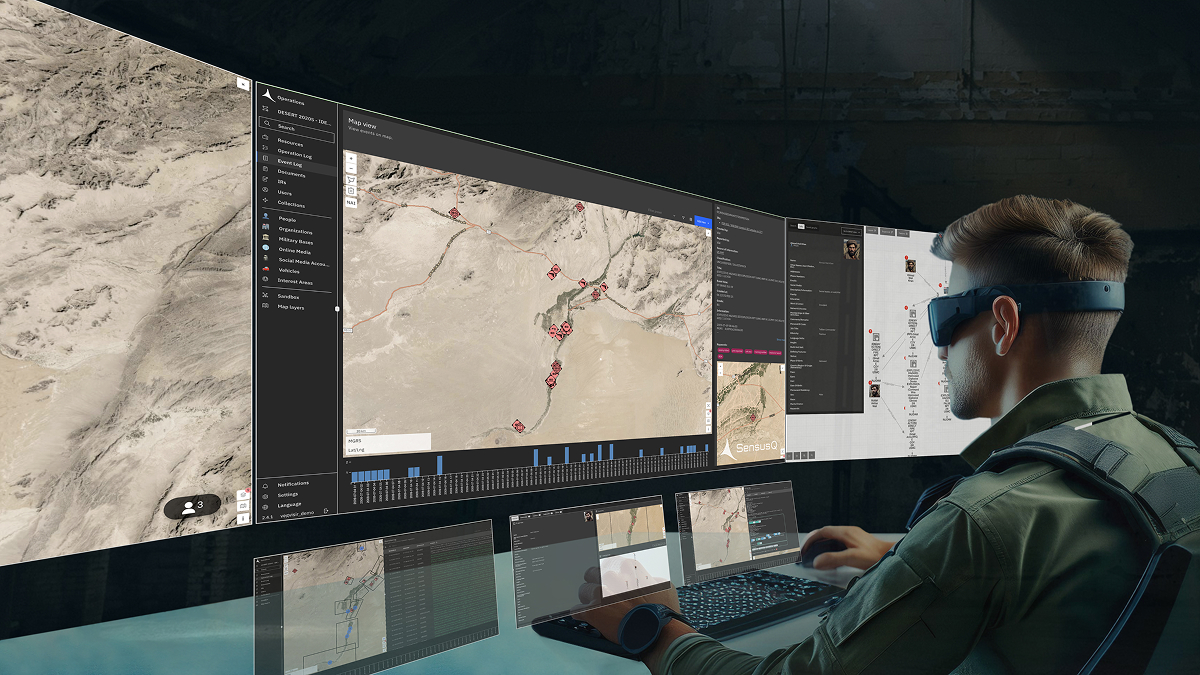
Following its acquisition of Estonian intelligence software company SensusQ, Quantum Systems is opening an official office for Estonian operations in Tallinn. This further expands Quantum Systems’ footprint in NATO’s Eastern Flank, after it opened an office in Lithuania in November 2025.
“Estonia has built an exceptional reputation for engineering excellence, software innovation, and defence technology,” said Martin Karkour, chief revenue officer at Quantum Systems, in a statement “With our Tallinn office and our acquisitions, we are strengthening the software and sensor capabilities behind our portfolio.”
The move brings together local engineering talent, software expertise and additional Estonian capabilities in electro-optical sensors, stabilised payloads and precision ISR.
The German defence neo-prime develops interoperable unmanned systems, and last week it announced a whopping $1.2 billion Series D funding round co-led by Blackstone, Noteus, Airbus, and Advent. The round values the firm at $8 billion.
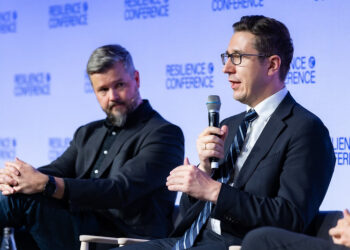
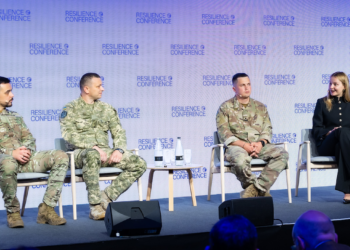
Sven Kruck, co-CEO of Quantum Systems will be joining the lineup at Resilience Conference in London 5-6 October 2026.
Vegvisir receives funding from Iron Wolf Capital
Vegvisir announced it has closed a funding round with Iron Wolf Capital. The exact amount has not been disclosed but we are told it’s a ‘low 7-figure sum’ — that is, in the low millions of Euros.
The Estonian defence technology company builds a command-and-control software layer that can be used across multiple domains. The five year-old company said it currently has sales in nine countries that include Australia, the US, and some European countries.
No stranger to Resilience Media, as we named Vegvisir in our 100 startups to watch 2026, we caught up with Vegvisir’s CEO and co-founder Ingvar Pärnamäe to chat about what’s next for the company.
Pärnamäe is by no means new to the vertical. He’s been in defence since 2002, spending 15 years in the Ministry of Defence in Estonia, ending up as the undersecretary for defence investments, serving as the National Armaments Director so he’s been on the other side of the table. After government he moved to the Estonian Defence and Aerospace Industry Association as CEO and then MD of Milworks, which focuses on the maintenance and repair of armoured vehicles.
But the initial idea for Vegvisir, he said, came from his co-founders, Kaido Petter (COO) and Raido Saremat (CPO). Both had served in Afghanistan and had experienced the isolation of being stuck in a ‘big metal box with wheels’ — your standard armoured vehicle, with limited or no visibility of what was going on outside.
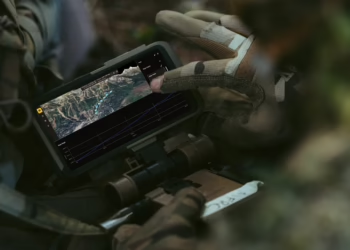
The first product Vegvisir created was a see-through armour capability, “and that sort of brought us to this world, where we are right now, where we create this full interface for whatever platforms you have on a battlefield,” he said.
The funding will fuel R&D in the next generation of its products.
“We believe that the technology itself has many, many more opportunities yet to be discovered, this is just the beginning. From a business point of view it helps us to get closer to the end users in different countries. It’s those long cycles that we have talked about in defence that needs presence from industry point of view, that you need to be close to your existing, and also potential, customers – we build those relationships and nurture our next deals in the pipeline,” he says. Vegvisir will look to hire engineers and sales people.
Pärnamäe doesn’t think that classical armoured vehicles should become obsolete, but he believes that they currently have no place in the battlefield in Ukraine. Vegvisir’s strategy looks forward to tech that is not yet ubiquitous, or in some cases not even commercially available, such as the use of robots and robotic assets on a battlefield.
“We can create this single interface visually, where you can bring all the different unmanned robotic systems together, and also you can add your classical armoured vehicles there, or you can drive remotely-operated unmanned ground vehicle from a command-and-control armoured vehicle,” he said. “It has proven to be a viable concept.”
While developing Vegvisir’s products, the team definitely aims for affordability, but Pärnamäe said that interoperability is also key and that needs investment to work.
“Interoperability has always been a major issue between allied countries in NATO and the EU, so this is also something that needs to be kept in mind, because otherwise you end up with very fragmented markets from a business point of view,” he said. “It’s even worse from a military point of view. If your equipment doesn’t talk to each other between allied countries in the future, then you run quickly into major problems,” he said, since it’s unlikely most European countries will go to war alone.
Funding in defence
The sector has seen some huge fundraising rounds in Europe lately: Quantum Systems’ $1.2 billion, Kraken’s $175 million raise, and Frankenburg Technologies’ (still in the works) €100 million round. Meanwhile, the Estonian/Latvian short-range missile company opened a factor in Riga recently.
But this is not a ‘boom’ in Europe defence tech fundraising, writes Darkstar’s Ragnar Sass: “There is only boom investing in Helsing+Quantum Systems+Stark – as these three companies alone [account for] 50%+ of ALL fundraising in the last few years!”
Pärnamäe said that even after over four years of the full-scale invasion in Ukraine, VCs are still struggling to understand the market.
“How do you know what idea is relevant five years from now, when most of the VC funds would expect some kind of exit? That’s one of the reasons why we see that capital concentrates in few champions,” he said. Some of this is the same pile-on effect, you typically see in the tech industry (cough… AI… cough).
“Many good ideas are still struggling to find investment,” he added.
NATO summit updates
During the gathering at the NATO summit in Ankara, Estonian Prime Minister Kristen Michal and Ukrainian President Volodymyr Zelenskyy signed a drone cooperation agreement.
“This means that world-leading expertise, proven in combat, will become available to us and help strengthen our defence capabilities, including air defence. It also creates new opportunities for cooperation and joint production for our defence industry. Our bilateral agreement is fully aligned with NATO’s Drone Edge initiative, under which Allies intend to invest more than USD 40 billion (€35 billion) in developing counter-drone and drone operational capabilities,” Michal said.
And in great news for overhead in the Baltics, the NATO Allies updated NATO’s air and missile defence plan.
“Estonia’s and the Alliance’s defence is continuously ensured by Allied fighter aircraft stationed in Estonia. The updated plan will provide better protection for NATO airspace, including Estonian airspace, against all types of threats by intercepting attacks and neutralising threats,” Michal explained.
Estonian-Latvian security cooperation
During the Estonian-Latvian business forum this month, the two countries signed a memorandum of cooperation that will see enhanced cooperation between the organisations responsible for managing national strategic reserves, the Estonian Stockpiling Agency (AS Eesti Varude Keskus) and Latvia’s state asset management company Possessor, as well as the planning of joint activities for the coming years.
Estonian Minister of Economic Affairs and Industry Erkki Keldo said that joint procurement, coordinated reserve planning and cooperation between the regions would allow them to save taxpayers’ money while “strengthen our negotiating position with major suppliers.”
The countries are already closely interconnected through vital services and critical infrastructure. A good example is regional energy security and natural gas storage in Latvia, which serves the interests of the entire region, he said. In the event of natural gas supply disruptions, Estonia can contribute through the LNG reception infrastructure developed at Pakri Peninsula Port.
Keldo signed the agreement with Latvian Minister of Economics Viktors Valainis.