Friday 10 July, 2026
[email protected]
Resilience Media
  • News
    • Events
    • Interview
    • Startups
    • Venture
    • Weekly Digest
  • Resilience Conference
    • Resilience Conference Warsaw 2026
    • Resilience Conference Copenhagen 2026
    • Resilience Conference London 2026
  • About
  • Guest Posts
    • Author a Post
  • Subscribe
No Result
View All Result
  • News
    • Events
    • Interview
    • Startups
    • Venture
    • Weekly Digest
  • Resilience Conference
    • Resilience Conference Warsaw 2026
    • Resilience Conference Copenhagen 2026
    • Resilience Conference London 2026
  • About
  • Guest Posts
    • Author a Post
  • Subscribe
No Result
View All Result
Resilience Media
No Result
View All Result

SFC Energy’s fuel cells are headed to Ukraine to supply troops with instant electricity

John BiggsbyJohn Biggs
July 10, 2026
in Interview, News
Share on Linkedin

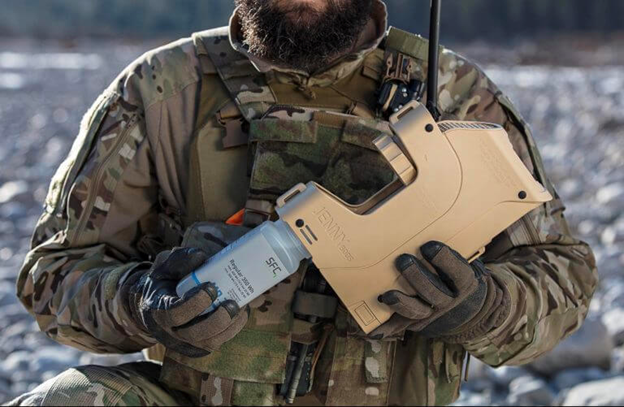
German fuel cell company SFC Energy recently announced that they are delivering approximately €42 million worth of combat-proven fuel cell systems to Ukraine, providing portable and stationary power for defence and civilian applications in a war where electricity was once impossible to supply.

You Might Also Like

Dispatches from Estonia: Quantum Systems moves in

British Army bets £2B on AI-driven training overhaul

Satellites become a growing target for grey-zone warfare

Speaking to Resilience, SFC Energy CEO Peter Podesser said the systems are designed to provide reliable power with less weight than comparable alternatives, while also reducing the signatures that can expose soldiers, vehicles, and equipment on the battlefield. Essentially, they are silent cells that run on methanol and produce power just like a battery or, more precisely, a generator.

“I would say ninety-five percent of our system is all based on a liquid fuel,” said Podesser. “Therefore logistics is also pretty easy because it’s still a widely used organic alcohol that is also easily accessible. Well, naturally you have to put it in a proper canister and lid it properly.”

Podesser explained that the devices range in size from super portable to stationary.

“You can imagine starting from something that’s man portable, which is like a water or milk bottle,” he said. “The next bigger size is like a jerry can and then larger stationary systems they can go up let’s say to let’s say the size of a Pelican case or also in nineteen inch standard industrial sizing.”

According to Podesser, SFC’s systems produce “virtually no noise and no temperature signature,” a decisive feature in an environment where heat, sound, and electronic emissions can make units easier to detect. In Ukraine, where drones, sensors, and electronic warfare are everywhere, silent power is becoming more than a convenience. It is becoming a way to stay alive.

That history matters. SFC’s defence work goes back roughly 25 years, beginning with development for German forces and with funding from the US Army. The goal was to reduce weight and shrink the form factor by combining fuel cells with batteries.

“We have been in this business as one of the pioneers, with a clear focus on stationary and portable power,” Podesser said. “Liquid fuel helps to set up proper logistics in different regions.”

“You still keep the infrastructure unchanged,” Podesser said. “The battery is there as a storage media, as well as covering the peaks, and the fuel cell is at the end of the day the lightweight silent battery charger.”

Where possible, SFC also combines the systems with solar capacity, reducing operating hours and fuel consumption. That hybrid approach is what makes the technology practical in the field. It is not a standalone science project. It is a quieter, lighter way to keep existing equipment powered without adding another loud generator to the battlefield.

Modern battlefield systems are increasingly dependent on batteries. Communications equipment, sensors, auxiliary vehicle systems, and uncrewed ground and air platforms all need power. In the past, a unit might have relied on a conventional generator, but generators make noise, produce heat, consume fuel, and create signatures that can be detected.

SFC’s systems can charge batteries, power devices directly, or serve as auxiliary power sources for vehicles. Podesser said a vehicle could operate in a silent mode without starting its engine, while still running communications and sensing equipment. For uncrewed platforms, the fuel cell can extend range or recharge batteries without creating the same detectable signature as a traditional power source.

“It’s about making it smaller and increasing the power output per form factor, so it’s easier to integrate and easier to transport. I think the structural change we see, and the driver for this kind of technology now being used in active combat situations and wars like Ukraine, is the fact that most of modern warfare is going electric, and the need for electrical energy has quadrupled or is now tenfold the level it was a couple of years ago,” he said.

Podesser said the structural change now driving demand is that “most of this modern warfare goes electric,” with the need for electrical energy having increased fourfold or even tenfold compared with a few years ago. The fuel cell technology has been developed over 20 years, he said, but Ukraine has turned the requirement into an immediate operational need.

The next step for SFC is to keep reducing size while increasing power output. Podesser also sees further hybridisation with solar and fuel, along with AI-based tools that can analyse operating data and adapt systems to specific scenarios. That could mean optimising performance around ambient temperature, hours of use, mission profile, and fuel consumption.

Deliveries to Ukraine are expected within the year. SFC is also expanding internationally, including a recently started production operation in the United States, an earlier production footprint in India for defence and border security markets, and further activity in Asia, including Singapore.

As the battlefield becomes more electric, power supply becomes part of the combat system. Batteries, sensors, drones, radios, and vehicles all depend on energy, but energy has to be delivered without making the user easier to find. SFC aims to be the first line of offense when it comes to definitively solving the energy problem.
Tags: fuel cellsgermanGermanysfcUkraine
Previous Post

Kraken becomes a unicorn, Expeditions Fund II is oversubscribed, and Quantum Systems’ Sven Kruck joins us at Resilience Conference London

John Biggs

John Biggs

John Biggs is an entrepreneur, consultant, writer, and maker. He spent fifteen years as an editor for Gizmodo, CrunchGear, and TechCrunch and has a deep background in hardware startups, 3D printing, and blockchain. His work has also appeared in Men’s Health, Wired, and the New York Times. He has written nine books including the best book on blogging, Bloggers Boot Camp, and a book about the most expensive timepiece ever made, Marie Antoinette’s Watch. He lives in Brooklyn, New York. He runs the Keep Going podcast, a podcast about failure. His goal is to share how even the most confident and successful people had to face adversity.

Related News

Dispatches from Estonia: Quantum Systems moves in

Dispatches from Estonia: Quantum Systems moves in

byFiona Alston
July 10, 2026

Following its acquisition of Estonian intelligence software company SensusQ, Quantum Systems is opening an official office for Estonian operations in...

man in green and brown camouflage uniform holding black rifle

British Army bets £2B on AI-driven training overhaul

byCarly Page
July 10, 2026

The Ministry of Defence has awarded a £2 billion contract to deliver a new AI-enabled training system for the British...

Satellites become a growing target for grey-zone warfare

Satellites become a growing target for grey-zone warfare

byPaddy Stephens
July 10, 2026

In late May, four Russian military satellites – launched just a month before – moved around ICEYE-X36, a commercial radar...

Resilience Media’s top stories from 2025

Taiwan takes aim at IP theft as it sharpens its defence stance

byHarry Saunders
July 10, 2026

In November 2025, Taiwan’s government launched an investigation into Lo Wei-jen, a longtime TSMC executive who left the company last...

Project Q unveils open source defence integration platform HYDRIS

Project Q unveils open source defence integration platform HYDRIS

byCarly Page
July 9, 2026

European defence technology company Project Q has launched HYDRIS, an open source integration and orchestration platform designed to connect sensors,...

Anduril taps UK’s Kraken to fast-track small USVs into US Navy hybrid fleet push

Kraken becomes the UK’s newest defence tech unicorn with a fresh $175M raise

byIngrid Lunden
July 9, 2026

Kraken has been one of the more visible UK defence tech startups to make waves around the world with its...

Danish-Ukrainian defence tech axis deepens as MITS Capital invests in Dropla Tech

Danish-Ukrainian defence tech axis deepens as MITS Capital invests in Dropla Tech

byLuke Smith
July 9, 2026

MITS Capital, the Kyiv-based defence tech venture firm, has made an investment in Dropla Tech. The Danish-Ukrainian startup develops edge-AI...

blue and yellow striped country flag

Ukraine 2025 defence tech investment topped $57.2M, but the ‘funded market’ is $6.8B says PitchBook

byLuke Smith
July 8, 2026

Ukraine's defense tech sector has proven its products on the battlefield. But the question for investors is whether any of...

Load More

Most viewed

InVeris announces fats Drone, an integrated, multi-party drone flight simulator

Uforce raises $50M at a $1B+ valuation to build defence tech for Ukraine

Auterion, the drone software startup, eyes raising $200M at a $1.2B+ valuation

Palantir and Ukraine’s Brave1 have built a new AI “Dataroom”

Twentyfour Industries emerges from stealth with $11.8M for mass-produced drones

Senai exits stealth to help governments harness online video intelligence

Resilience Media is an independent publication covering the future of defence, security, and resilience. Our reporting focuses on emerging technologies, strategic threats, and the growing role of startups and investors in the defence of democracy.

  • About
  • News
  • Resilence Conference
    • Resilience Conference Copenhagen 2026
    • Resilience Conference Warsaw 2026
    • Resilience Conference 2026
  • Guest Posts
  • Subscribe
  • Privacy Policy
  • Terms & Conditions
  • Mission Statement & Code of Practice
  • Press

© 2026 Resilience Media

No Result
View All Result
  • Home
  • About
  • Subscribe
  • Events
  • Guest Posts
  • Interview
  • News
  • Resilience Conference London 2026
  • Resilience Conference Copenhagen 2026
  • Resilience Conference Warsaw 2026

© 2026 Resilience Media

This website uses cookies. By continuing to use this website you are giving consent to cookies being used. Visit our Privacy and Cookie Policy.