MITS Capital, the Kyiv-based defence tech venture firm, has made an investment in Dropla Tech. The Danish-Ukrainian startup develops edge-AI explosive threat detection systems, dubbed “Blue Eyes,” and unmanned ground vehicle systems. The investment amount and valuation are not being disclosed; it will be used to help the company scale and enter more NATO-aligned markets.
“We were not looking for capital. We were looking for infrastructure,” said Viacheslav Shvaidak, co-founder and CEO of Dropla Tech in a conversation with Resilience Media. MITS Capital’s experience operating across jurisdictions, its portfolio of Ukrainian defence companies and its growing presence in Denmark make the firm an unusually good fit. (Its name is an acronym for Military Innovation Technology Solutions.)
“For a company scaling between Denmark and Ukraine, that is worth more than any check,” Shvaidak added.
As part of the partnership, Dropla Tech joined the MITS Acceleration Program, which focuses on operational scaling, NATO market entry, and access to expertise across the MITS Capital platform. It has become one of the eight companies in MITS Accelerator’s Batch 3 and the first participant from the cohort to be publicly disclosed.
“We are in deliberate scale-up mode” said Shvaidak. “Resources go into European series production capacity and the Blue Eyes software roadmap.”
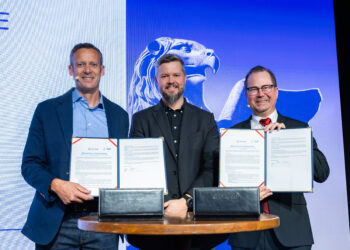
“We are excited to welcome Dropla Tech to the MITS family,” said Perry Boyle, co-founder and CEO of MITS Capital. “Viacheslav has achieved an important feat of creating a truly transnational Danish-Ukrainian defense company. We look forward to working with Dropla Tech’s team as a key pillar of MITS Capital’s mission: to defeat Russia in Ukraine and integrate Ukraine into Europe’s defense architecture.”
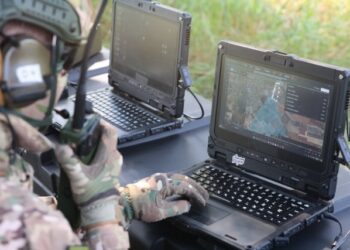
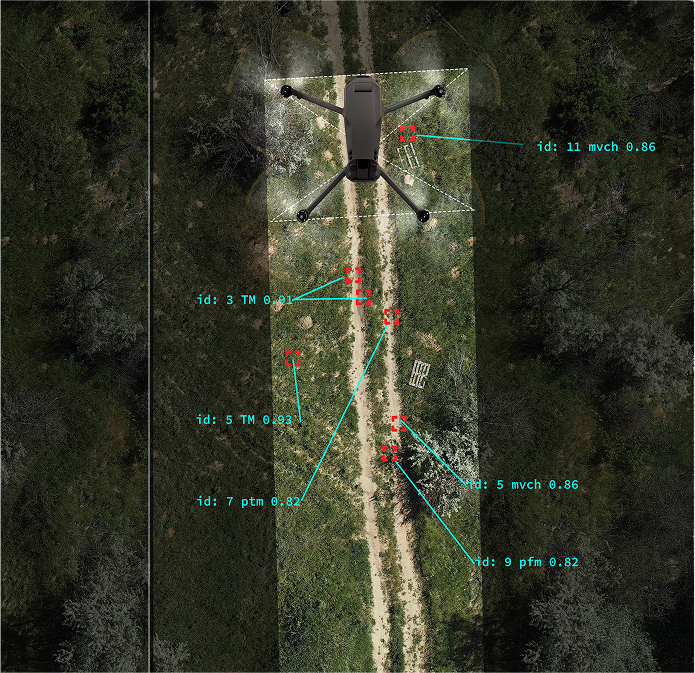
Dropla’s Blue Eyes is a UAV-agnostic edge-AI system that can detect explosives in EW and GNSS-denied environments. Systems like this are particularly relevant against remote mining and so-called “waiter” drones, where many counter-drone teams still rely on eyesight, firearms and manual search to locate and remove threats.
The company has also produced its own UGV, Logist, which can be modularly equipped for mine-clearing, vegetation clearing, sensor deployment and casevac missions. The UGV can integrate with Dropla’s vision software suite, combining sensor data with AI-enabled mission planning.
Dropla is also developing Seer, a demining C2 vehicle for UXO clearing operations. Seer integrates Dropla’s software suite and can launch both UAVs and UGVs, positioning the company not only for wartime explosive-threat detection, but also for the much longer task of demining Ukraine after the war.
An operational Seer prototype scanned 1,000 hectares in Ukraine last year, and two additional complexes are expected to come fully online next year, Shvaidak told Resilience in a statement. Dropla is prioritizing the Middle East as an export target for the system.
In August 2025, Dropla Tech secured €2.4 million from Maj Invest, the Export and Investment Fund of Denmark, Final Frontier and other investors to accelerate its edge-AI capabilities. In less than a year, the company increased the number of confirmed explosive-threat detections in Ukraine from several hundred to more than 5,000, with accuracy above 90%.
The new MITS investment comes as Denmark is moving from donor to industrial partner in Ukraine’s defense sector. In June 2024, Kyiv and Copenhagen signed an agreement to finance production of 18 Ukrainian-made 2S22 Bohdana self-propelled howitzers. The arrangement became the pilot case for what later became known as the “Danish model,” under which NATO countries finance or reimburse defense orders fulfilled by Ukraine’s own arms industry rather than supplying equipment only from Western stockpiles.
Since then, Copenhagen has built more of the institutional infrastructure around that model. In October 2024, Denmark announced the establishment of a Defence Industry Hub to promote cooperation between Danish companies and Ukrainian counterparts on military procurement projects. In March 2025, it launched a guarantee programme worth 1 billion Danish kroner, or more than €130 million, for Danish companies investing in Ukraine’s defense sector. Under the programme, the Export and Investment Fund of Denmark can cover up to 70% of capital expenditures for up to seven years.
Denmark is becoming one of the main European test cases for moving Ukrainian battlefield technology into NATO-facing production, procurement and capital structures.
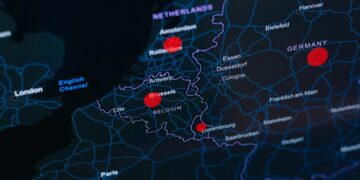
That shift is already visible. In March, Fire Point announced plans to build a solid rocket fuel plant in Denmark. In February, Ukrainian drone maker SkyFall was reported to be in talks with Denmark about opening a production facility there. MITS itself has also moved into the space. In 2025, the firm launched MITS Industries in Copenhagen, with the aim of becoming the first Danish-Ukrainian defense prime.
Dropla fits into that same emerging corridor. It is not simply a Ukrainian defense-tech startup receiving outside capital. It is a Danish-Ukrainian company trying to turn battlefield-tested Ukrainian technology into systems that can be financed, scaled, certified and sold into NATO-aligned markets. Blue Eyes has already received NATO codification, which means the system is procurable by NATO members through standard channels.
For MITS, the investment gives it exposure to a company working at the intersection of demining, AI, robotics and unmanned systems. For Dropla, the deal provides something more than capital alone: access to a platform built around Western market entry, cross-border scaling and the translation of Ukrainian wartime innovation into Europe’s defense architecture.
“With Ukrainian engineering velocity and Danish industrial capacity, Dropla is aiming to become the most advanced force-protection company in Europe,” said Shvaidak.
Story updated to describe MITS as a venture ‘firm’ rather than VC, offering other services in addition to VC investment.