

Ukraine has been a trailblazer and pace-setter in the evolution from traditional defence to ‘defence tech’. Drones, AI, autonomous ground vehicles, procurement gamification, data rooms, rapid prototyping and more have been all hatched and honed on the battlefield in its war with Russia, and they have played a significant role in how Ukraine has been able to hold its own against a much larger invader.
Now one of the key people in Ukraine’s government who helped bring all this into existence – Mykhailo Fedorov – has left the building. This week, Zelensky removed him as Minister of Defense, marking an end to seven years in government that saw him first taking leadership in digitising government services, and then, after the full-scale Russian invasion took off in 2022, an increasingly prominent role in bringing tech to bear in Ukraine’s fight.
He was only in the top defence role for six months, but the response to Fedorov’s removal has been swift and strong, underscoring the impact he’s made. As we look to see who potentially replaces him, or even if – as some believe could happen – he returns to the role or another in government, we look at the implications of the dismissal.
Reactions: ‘This is not about Fedorov himself, but what he came to symbolise’
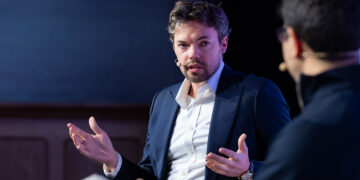
Within 24 hours of the news coming out, Fedorov held a frank press conference in an underground bunker-like garage co-opted for the occasion. It turned out to be the perfect setting for someone who had gone from prominent leader to outsider in the space of a few hours.
Against a dark backdrop, Fedorov paced and talked and took questions for more than an hour with no prompts. He covered the circumstances of his dismissal (it stemmed from serious, irreconcilable disagreements with top military officials); what he accomplished (before and during his tenure as Minister of Defence); and the state of affairs for Ukraine now (Russia will look for any weakness, Ukraine needs to clean up accountability, and do much more to keep going).
Fedorov wasn’t the only one to act fast. Protestors took to the streets across multiple cities in support of the ousted minister – a surprising turn, considering how Ukrainians largely have stood together in this war.
His dismissal has spurred rebukes from prominent individuals, too. Pavlo Yelizarov, a deputy commander of Ukraine’s Air Force who specialises in drones, stepped down from his position, describing the dismissal as a “great evil” for Ukrainian defence.
What are the implications for Ukraine?
Part of the reason for the strong reaction in Ukraine is because of what Fedorov represented: modernisation away from costly, slow-moving legacy systems, and thus a fighting chance against Russia.
“This is not really about Fedorov himself, but about what he came to symbolise: Ukraine’s ability to change the way the system works, even in the middle of a full-scale war.” said Roman Sulzhyk, founder of Resist.UA.
“Fedorov became the face of the hope that Ukraine could neutralise Russia on the battlefield, reform defence procurement, and drive many of the positive developments we’ve seen.”
Fedorov played a role in founding Brave1 and fostering the ecosystem that has seen technologists in the country pivoting to defence, he noted.
The result of the dismissal has been to leave people in government and industry “deeply demoralised,” he added. “Their concern is not about one politician – it is about whether the vision of a new Ukraine that Fedorov symbolised is still being protected.”
Controversially, it seems that people are divided on whether Fedorov was effective in removing the cloud of corruption that has hung over Ukraine for years when it comes to government procurement.
Fedorov noted in his farewell press conference that he made efforts to stamp out corruption, although this appears to be debatable. Some who have spoken to Resilience Media accuse him of simply replacing one flavour of corruption and favouritism with another. (Indeed, corruption has not magically disappeared with the start of the war with Russia. Fire Point, one of the biggest defence techs in Ukraine – maker of the missiles that Ukraine launched to attack Russian energy infrastructure at long range – is also the subject of an ongoing corruption investigation.)
“Fedorov was definitely NOT corrupt,” one prominent Ukrainian defence tech executive told Resilience Media.
But at the same time, he definitely ruffled feathers among more traditional defence players displeased with his focus on newer approaches. This cut across a number of functions.
“He wanted to stop procurement of short-range artillery because it doesn’t make sense when you have FPVs,” Eveline Buchatskiy, Managing Partner, D3 told Resilience Media. “There was resistance. He also thinks military training needs a complete reboot. He needed to expand the use of data for all decisions including the removal or promotion of commanders based exclusively on measured data and not one’s relationship with [commander-in-chief of the armed forces of Ukraine] Oleksandr Syrsky and so on.”
But while some saw enemies being created, others allege the opposite: Fedorov was eliminated in a move to consolidate Zelensky’s presidential power. In other words, he was too popular.
Some don’t believe Fedorov will go very far away from the action. “I am certain Fedorov will continue to serve and make further impact in this fight,” said Gui Wainwright CEO Occam Industries.
If the protests continue, a prominient defence tech executive predicted, it could take down Skyrsky.
What are the implications for defence tech more widely?
One of Fedorov’s earliest milestones after the start of the full-scale invasion was when he pulled in Starlink to supply troops with critical data connectivity. He was not actually in the MoD at that time, but overseeing “digital transformation” in the government, but how he stepped in to set up a critical resource for the military underscored how everyone was mobilising and pitching in at the start of the war, and how technology was the vector driving that shift.
It also pointed to something else: Fedorov understood the mutually beneficial role of working with tech companies and defence tech companies from outside of the country: Ukraine’s forces got cutting-edge systems for free (some of which didn’t work, but many that did), and in exchange those suppliers got priceless real-world users and training data to improve what they are building.
Tech people wonder how that relationship will play out with the its architect and chief proponent out of the picture.
“From where we sit in the European defence space and as Bifrost Defence, Fedorov represented something important: the first Ukrainian Defence Minister who spoke the language of asymmetric innovation rather than legacy procurement,” said Nicholas MacGowan von Holstein, the CEO of Bifrost Defence.
He highlighted the Brave1 cluster, the A1 Defence AI Centre, and the shift to competitive tenders as some of the most important developments. “These were signals to the defence tech ecosystem that Ukraine was serious about building rather than just buying,” he said.
And his influence extended beyond Ukraine, Von Holstein continued: “What Fedorov achieved on the European industrial side is arguably as significant as anything on the battlefield.” Although some of that might have developed and might continue post his departure, “it needed someone with his combination of tech fluency and political urgency to close those deals at that speed.”
One tech figure said that his departure could indeed destabilise future defence tech investment in the country.
“Ukraine’s success has a lot to do with successfully applying asymmetric tech advantage,” the person said. “We need to see how this story develops. Ukraine has an enormous ability to reset itself so I am confident a reasonable outcome will be reached again.”
The financial detail
This is another point to watch when considering what comes next for Ukraine and its defence tech landscape.
When reports first started to emerge of President Volodymyr Zelenskyy’s intention to appoint Sergii Koretski as the country’s new prime minister, they were followed by some interesting detail: the priorities would be to prepare Ukraine for the winter, and to make deals with international partners. This underscores how vital money will be in the equation.
In a recent column here on Resilience Media, Said D. Werner and David Marks explained how credit ratings were the quiet indicator of how well a country was performing in a war. This also applies to Ukraine, they wrote:
“In Ukraine, we are seeing the same principle unfold in real time. The war is not, and not merely because of drone technology, a simple war of attrition,” they note. “It is a financing race. The side that can maintain access to capital markets, transfer payments and credit lines for longer will determine the outcome.”
Ukraine, as it happens, just last week became one of eight countries to sign on as a future shareholder of the new Defense, Security and Resilience Bank started by Canada for allies to source private capital to finance defence and resilience efforts. It lays the groundwork potentially for whoever takes on the minister role next not just to be visionary in identifying what direction technology is moving, but increasingly how to convince lenders to back it on Ukraine’s behalf.