
Drones need carbon fibre, buildings need cement, and shells need TNT — meet the startups helping Europe to make its own


Drones need carbon fibre, buildings need cement, and shells need TNT — meet the startups helping Europe to make its own
Technology and industrial sovereignty have never been as urgent as they are right now, with Russia’s invasion of Ukraine laying bare what decades of dependency have obscured.
A continent grown reliant on Russian gas has limited options when the taps are turned. And years of allowing its defence industrial base to atrophy has made it near-impossible to replenish the weapons stockpiles the region has been donating to Kyiv. Those two are lessons that the Middle East conflict has only underlined.
But it’s not just about industrial infrastructure. When the Trump administration sanctioned the International Criminal Court (ICC) in May 2025, its chief prosecutor lost access to his Microsoft email account, demonstrating how foreign-controlled software can be turned against the institutions that depend on it.
In June, that same vulnerability surfaced in the AI space: global access to a powerful AI model from Anthropic was abruptly suspended on US government orders, then later restored, raising concerns among policymakers about what would happen if a system they had built critical services on went dark permanently.
These episodes point to the same underlying problem. Europe has built much of its way of life on inputs it doesn’t control, be that energy, cloud infrastructure, or large language models (LLMs).
Less discussed, perhaps, are the physical materials that everything is built from — the carbon fibre in a drone’s airframe, the explosives inside an artillery shell, or the cement substitutes poured into a data centre’s foundations.
Speaking at the NATO Summit Defence Industry Forum in Ankara on July 7, NATO Secretary General Mark Rutte brought that concern to the centre of the alliance’s agenda, unveiling a multinational project on “defence-critical raw materials,” with allies committing to pool efforts on sourcing, storing, transporting and managing supply.
“For our defence to remain ready and strong, we need our industrial base and our supply chains to be resilient and secure,” Rutte said at the time. “This means we need a stable supply of materials and companies and components across critical sectors, regardless of potential shocks or disruptions”
While a slew of efforts are already underway to reduce Europe’s reliance on software and services from Big Tech, the same push is playing out in the materials realm, where a crop of European upstarts are working to produce or recover the physical inputs that Europe currently depends on others to supply.
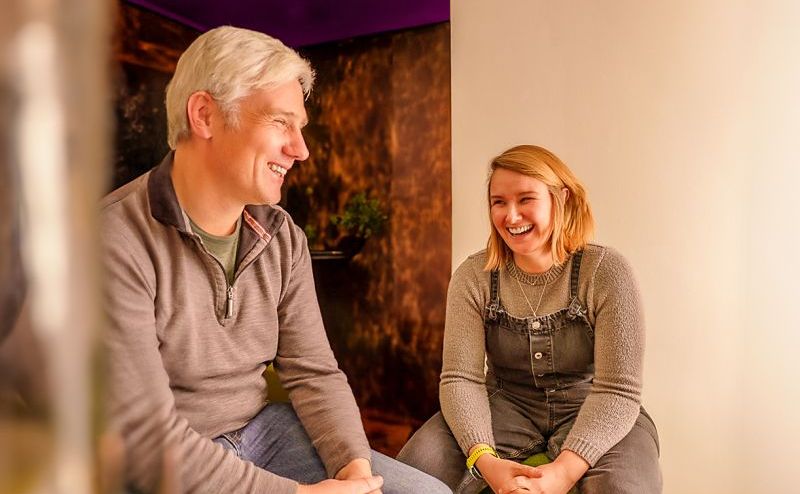
Shortly after Rutte’s announcement, Uplift360, a Luxembourg- and Bristol-based advanced materials company, signed an eight-year agreement with Luxembourg’s Directorate of Defence, positioning itself as a strategic materials partner to the country’s armed forces.
Uplift360, at its core, is a “deep chemistry” startup that produces carbon fibre by stripping the resin out of composite waste — think: offcuts from drone manufacturing, end-of-life helicopter blades — and recovers the fibre inside. The business model runs in two directions: defence organisations currently pay to have composite waste incinerated, and Uplift360 says it can in many cases take it away for less than half that cost, though costs related to logistics and processing mean it isn’t totally free to collect. The recovered fibre is then sold back into the same supply chain from where the waste originated.
“This is a win-win for everyone involved,” Uplift360 co-founder and CEO Sam Staincliffe explains to Resilience Media.
Uplift360 raised a €7.4 million seed round in February, with notable backers including Nato’s very own Innovation Fund, and is currently scaling up its pilot facility in Bristol ahead of a move to industrial production. While there is a strong environmental aspect to its technology, insofar as it’s helping to recycle material that would otherwise be landfilled or incinerated, it’s the sovereign angle that is driving real government interest.
Yuriko Backes, Luxembourg’s minister of defence, said in a statement at the time of its Uplift360 deal that the agreement was all about “maximising resource efficiency” and bolstering its “resilience and environmental protection.”
“Robust supply chains are the bedrock of our necessary defence industrial ramp-up,” she said. “Our defence readiness depends on it.”
Europe currently sources carbon fibre from a mix of allied and less-allied markets — China, the US, South Korea and Japan among them — and Staincliffe argues the exposure runs deeper than the relationship alone. “The challenge, even when you have really strong allied relationships with materials, is they can’t control access routes, both air and sea,” she says. “So if there are geopolitical shocks, they can’t necessarily ensure that materials supply to Europe, even where we have friendly relations.”
The raw material, or “feedstock,” for Uplift360’s process comes largely from defence itself. Primes and OEMs have made significant progress in cutting waste from their manufacturing processes, but composite offcuts are an unavoidable byproduct of the work.
“When you’re handling composites, it’s really impossible to get that down to nothing,” Staincliffe says.
There is also a regulatory dimension that Staincliffe says is starting to shift. Once a material is classified as waste, it must be handled in a specific and heavily controlled way, which makes it harder to move and reintroduce into the supply chain. Some countries are looking at whether recovered composite material could be reclassified as a secure material rather than waste, while industry efforts are moving in a similar direction: the European Circular Composites Alliance‘s Aerospace and Defence Working Group is exploring how composite materials from manufacturing offcuts and end-of-life aircraft can be kept in productive use.
And it’s this broader shift in thinking that that Uplift360 is banking on.
“If something isn’t waste, it’s a lot easier to move it around and put it back in the supply chain,” Staincliffe says. “And that benefits them, benefits us, benefits the environment because we’re keeping everything in circulation, and it benefits security.”
On the question of whether recovery can replace imports entirely, Staincliffe is clear it cannot — nor does she think it necessarily should. “The key is about ensuring that you have multiple areas that are strong,” she says. “Virgin material production, regenerated or secure material production — all of these areas need to remain strong, and they need to be working well together. I don’t see a future where any one of those things is going to take over completely.”
The Luxembourg agreement is, in that sense, all about building one of those areas from scratch. “Luxembourg, like a lot of nations across Europe, has recognised the threat of not controlling their material supply chain,” Staincliffe says.
Zooming out, perhaps the most interesting aspect of what Uplift360 does is that it takes material others consider worthless and puts it back to work as part of Europe’s sovereignty push. As the old adage goes, one person’s trash is another’s treasure — and it’s a dynamic that runs through much of the materials sovereignty story, including that of Paebbl, a Rotterdam-based company that’s synthesising a key component of cement.
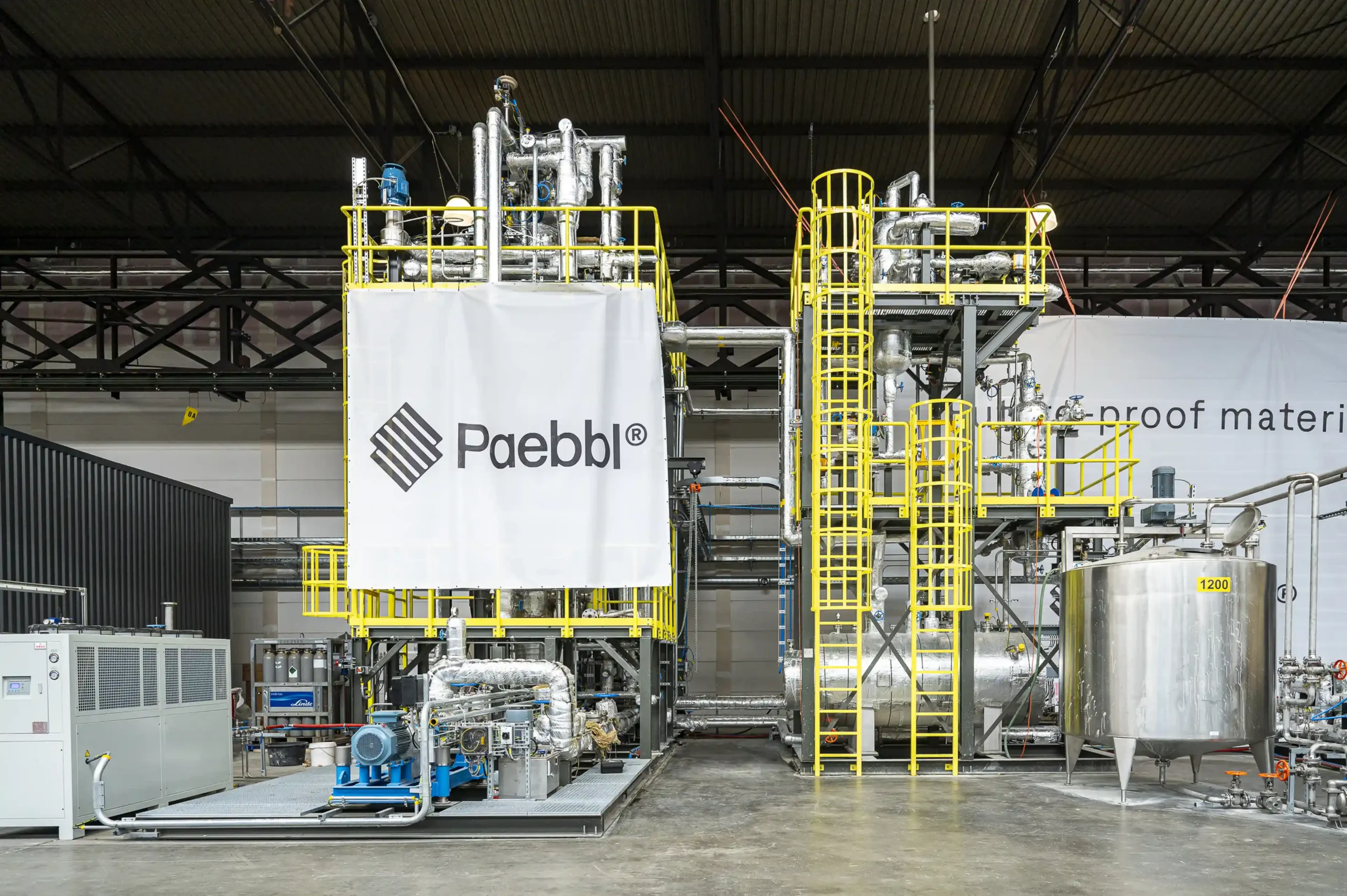
The cement industry has long relied on industrial byproducts — fly ash from coal-fired power stations or slag from blast furnaces, collectively known as supplementary cementitious materials (SCMs) — to partly replace the carbon-heavy cement in concrete. Cheap, abundant and considered waste by the industries that produced them, these materials became an essential ingredient in low-carbon construction across Europe. But as the continent phases out coal and transitions its steelmaking away from blast furnaces, that supply is diminishing. A recent study published in the journal Developments in the Built Environment found that EU fly ash supply alone is forecast to fall from around 8.5 million tonnes in 2025 to near zero by the mid-2040s, with blast furnace slag heading in the same direction.
On the flip side, countries where coal and steel production continue at volume — China and India in particular — still generate these materials in abundance. According to Mordor Intelligence, Asia-Pacific accounts for nearly half of global SCM market value, while domestic output in Europe and North America is shrinking by around 3 million tonnes annually. Replacing a dwindling domestic supply with one situated on the other side of the world would leave Europe no more secure than before.
Paebbl’s answer is to manufacture a synthetic SCM from scratch, reacting captured CO2 with crushed silicate rock through a process it describes as accelerated mineralisation: a technique inspired by the way rock naturally absorbs carbon from the air over geological timescales, compressed into hours. The rock itself is either quarried from abundant natural deposits or sourced from mining waste streams — another instance of industrial leftovers being put back to work. The CO2 ends up chemically locked into a stable mineral, and the resulting powder is Paebbl’s product.
The company raised a $25 million Series A round in 2024, with notable backers including Amazon’s Climate Pledge Fund and construction giant Holcim, and it’s currently operating pilot and demonstration plants in Rotterdam ahead of its first commercial-scale facility. In June, Paebbl launched Rebond 300, the latest version of its product, which it claims carries an independently verified carbon footprint of -149 kg CO₂ per tonne — meaning every tonne produced removes more carbon than the manufacturing process emits.
For Paebbl co-founder and co-CEO Andreas Saari, the company is every bit a supply chain story as it is a climate tech one. Concrete is the world’s most widely used construction material, and the inputs that go into it — whether for a data centre, bridge, or military base — need to come from somewhere. So why not create it locally?
“Cement companies and concrete companies who have historically bought these legacy SCMs, they see the trend,” Saari tells Resilience Media. “They know that they can no longer rely on these material streams as a future-proof solution.”
Paebbl’s product is, ultimately, made from CO2 and rock, both of which are abundant in Europe. But Saari sees a bigger opportunity than simply plugging a supply gap. Having developed the technology here, he argues, Europe has a chance to own a category that the rest of the world will eventually need too. “The technology is in Europe,” he says, “so it’s also a chance for Europe to build and fund and scale up a technology that will become an export asset ultimately.”
The demand side is already taking shape. Among Paebbl’s customers is AWS, which has used its material in a data centre in Spain. Paebbl has also deployed its product at the Port of Rotterdam, whose maritime and logistical significance makes it a natural fit for a material pitched upon supply-chain resilience.
But Saari’s demand argument extends well beyond data centres and ports. Climate change itself, he argues, is a concrete story — rising sea levels mean more coastal defences, more floods mean more rebuilding, more wildfires mean more reconstruction. And then there is the more immediate pressure of geopolitical unrest. “We will have to keep expanding and fixing our infrastructure,” he says. “And, unfortunately, the more there is geopolitical unrest, whether it’s just for defence purposes or actual rebuilding purposes, we’re going to be using lots of concrete.”
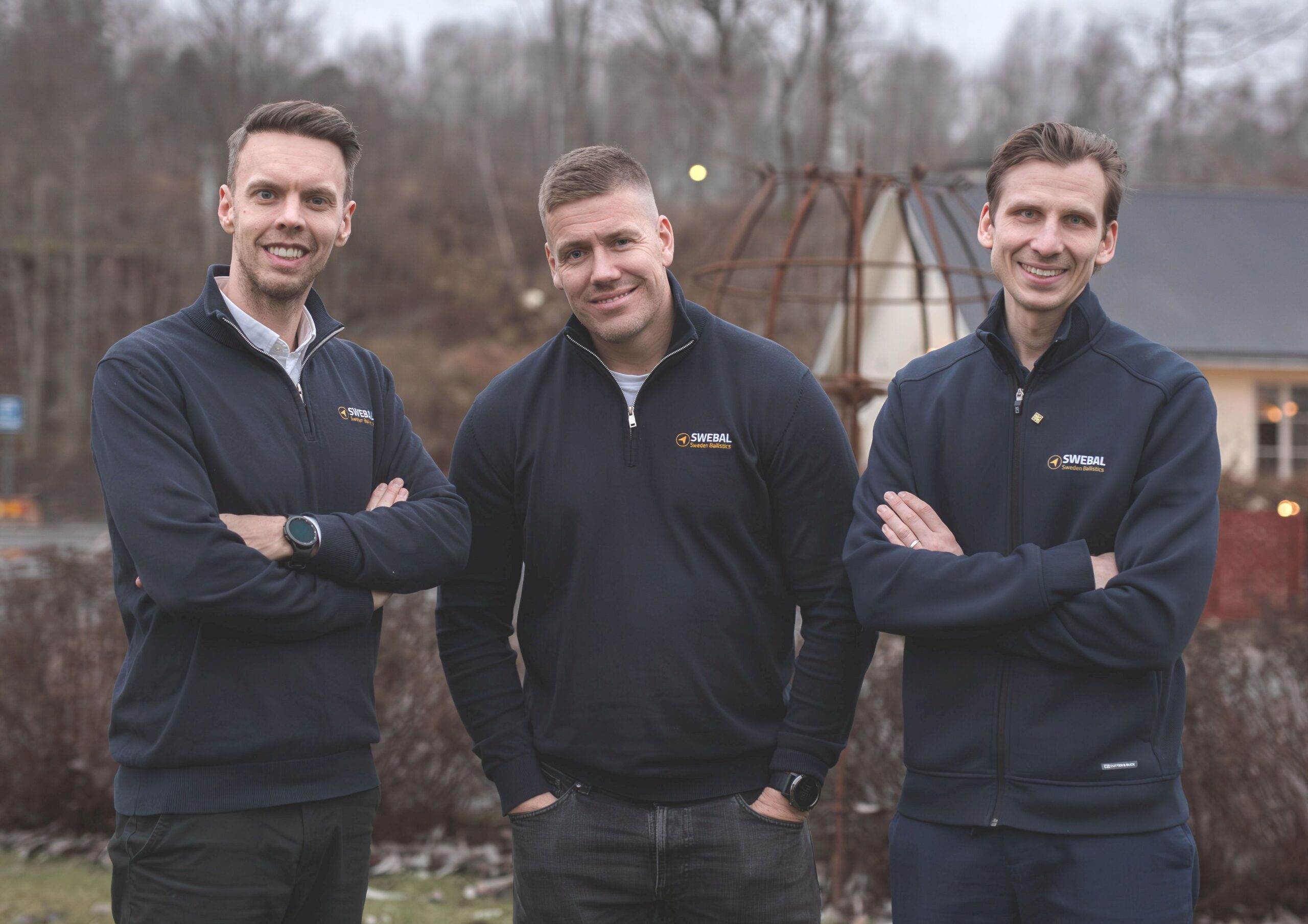
If Paebbl and Uplift360 represent the quieter end of the materials sovereignty push, Swebal operates at the noisier end: the Swedish startup is building one of the first new TNT production facilities in Europe in decades.
Trinitrotoluene, better known as TNT, sits at the heart of modern munitions — artillery shells, aerial bombs, mines. Europe effectively has a single NATO-standard producer: Nitro-Chem in Poland, whose capacity has been reported at up to 12,000 tonnes per year, with a significant share already committed under long-term contracts. The gap has been filled with imports from Asia, a dependence that Swebal co-founder and CEO Joakim Sjöblom says leaves Europe exposed.
“Several of these sources sit in non-allied countries, which means they can easily be disrupted or withheld,” he tells Resilience Media. “If Europe wants credible deterrence, it needs to be war-ready. And in a serious conflict scenario, sourcing critical materials from the other side of the world is not a position you want to be in.”
Swebal raised €30 million in May, some five months after winning environmental approval for a new plant in Nora, Sweden. The plant is scheduled to hit full-scale production by 2028, and could produce up to 4,500 tonnes of TNT annually. But what makes it notable beyond the volume is what goes into it: Sjöblom says the entire supply chain — from the North Sea crude behind its toluene feedstock to the ammonia used for nitric acid — is sourced domestically.
“There’s no point at which we’re quietly relying on input from far overseas,” he says. “The whole chain is European.”
When Rutte announced the NATO critical raw materials project in July, Sjöblom was paying close attention. He welcomes the initiative, but points to some of its limits. Among the commitments allies made was to jointly “acquire, store, transport and manage stockpiles of defence critical materials, components and recycled products” — but Sjöblom argues that without production capacity behind it, even the best-managed stockpile has a ceiling.
“Stockpiling on its own only buys you time,” he says. “A stockpile runs out. If you don’t have production capacity behind it, that’s all you’ve bought — time, not resilience. You need both.”
The permitting timeline is its own lesson in how slowly the system moves. Despite the EU’s Defence Readiness Omnibus — a package designed to fast-track approvals for defence projects — Sjöblom says the paperwork hasn’t moved any faster in practice.
“The urgency is there in the political conversation, but this has yet to translate into faster permitting,” he says.
There’s no ignoring NATO’s role in all of this. Beyond policy decisions, the alliance’s own venture fund, the NATO Innovation Fund (NIF) has been assembling a portfolio of companies working at precisely this intersection of materials, manufacturing and defence capability — and increasingly, those companies are finding each other.
Tekever is a Portugal-founded drone maker that has been putting down deep manufacturing roots in the UK, committing £400 million to domestic production and landing a place among the companies shortlisted for Project NYX, the RAF’s autonomous wingman programme. Building cutting-edge drone systems at that kind of volume requires a domestic ecosystem of specialist manufacturers, and that is where iCOMAT comes in. The Gloucester-based composites manufacturer, creator of a novel fibre-steering process that produces lighter, stronger aerospace structures at industrial speed, last month signed an MoU with Tekever as part of Tekever’s broader UK manufacturing expansion.
Notably, both companies are NATO Innovation Fund portfolio companies. Stuart Donovan-Holmes, iCOMAT’s head of defence business development, whose background includes stints at Airbus and the UK Ministry of Defence (MoD), says NIF does actively make introductions across its portfolio where it sees a potential fit. However, it generally stops there.
“What I think they do well is then step back and allow the companies themselves to work out whether there is a genuine technical or commercial reason to work together,” he explains to Resilience Media. “A shared investor can open a door, but the relationship still has to make sense on its own merits.”
While the Tekever and iCOMAT tie-up is perhaps more of a manufacturing sovereignty story than a materials one, Donovan-Holmes argues it is a mistake to separate the two.
“You could secure all the carbon fibre Europe needs tomorrow, but that doesn’t automatically give you sovereign defence capability,” he says. “You still need the machines, factories, people and qualified processes to turn that material into aircraft, drones, missiles or satellites, and then you need to be able to do that at the rate the customer actually requires.”
The scaling question, he argues, is where Europe remains most exposed.
“You can have access to the material and know how to make the product, but still find yourself exposed if demand suddenly increases and you cannot produce enough of it,” he continues.
And so that gets to the nub of the sovereignty question, and what Donovan-Holmes calls “sovereignty as a chain.”
“Access to materials matters, manufacturing capability matters, and the ability to scale that manufacturing is what turns both into useful industrial capacity,” he says.
The NATO Innovation Fund’s portfolio spans the full length of that chain, from companies securing the raw inputs to those building the manufacturing systems that make them operational. In October last year, David Ordonez, a senior associate on NIF’s investment team, went on record around that exact point, pointing to the strategic importance of advanced materials manufacturing to the alliance.
“In the physical world that we live in, having the capability to access the most advanced materials and to manufacture them at scale defines the difference between an advanced nation and a lagging nation,” Ordonez said.
