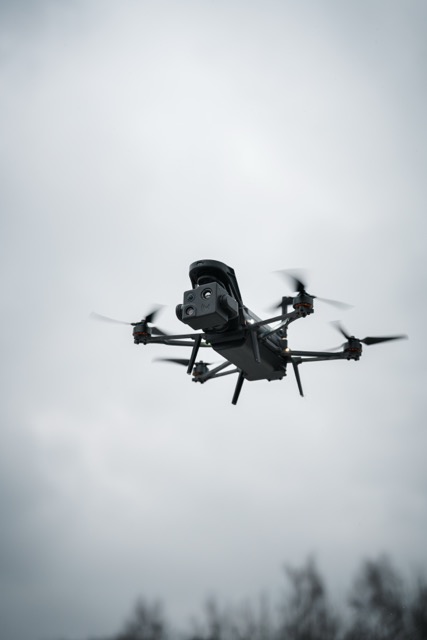
Danish-Lithuanian unmanned aerial vehicle manufacturer MNP Technologijos, operating under the Monopulse brand, has raised over €2 million.
The funding will allow for expansion of Monopulse’s production capacity, research and development, and to accelerate the company’s entry into additional markets, including Germany, France and the Netherlands.
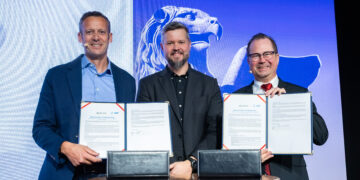
The round is led by Coinvest Capital and includes angels from Lithuanian Business Angel Network (LitBAN) and Plug and Play Ventures. Monopulse disclosed that €560,000 was invested by business angel syndicate NGL Ventures together with 68 individual business angels. The funding comes after Monopulse announced €1.12 million in funding in November 2025.
“We invest first and foremost in teams, and the Monopulse team brings together a rare combination of deep engineering expertise and a strong understanding of what the military needs today. The company’s products also have clear civilian applications, so we believe that within the next few years, Monopulse could become an integral part of Europe’s defence supply chain – a company that allies turn to not because it is Lithuanian, but because it is the best,” said Viktorija Trimbel, managing director of Coinvest Capital.
Founding Monopulse
Founded in 2021 by Justas Poderys and Alexander Vesterhauge, the startup was a little before its time. Its original concept was to make drones for search and rescue at sea.
Poderys comes from a telecommunications engineering academic background, and his interest in drones developed some years later. After finishing a PhD at Technical University of Denmark, he took a job at Scandinavian defence contractor Therma as a command-and-control (C2) systems engineer. This was his first foray into military technology. After three years at the company, his attention turned to drones.
This was pre Russia’s full-scale invasion of Ukraine, and when he pitched the idea to colleagues, it didn’t set anyone else’s interest alight. It was considered “toys for boys,” he told Resilience Media. Undeterred, he pursued his idea as a side gig in partnership with Vesterhauge.
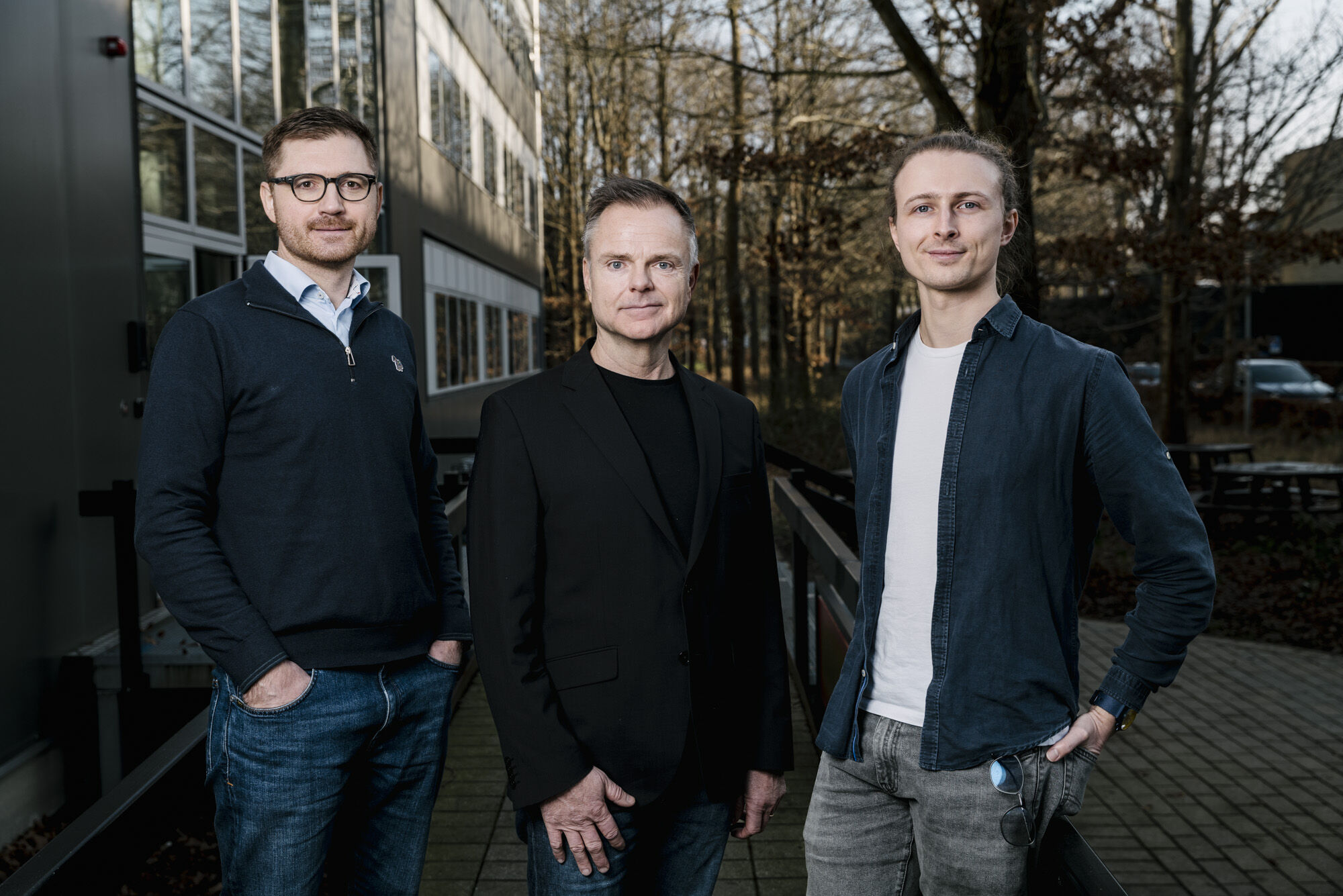
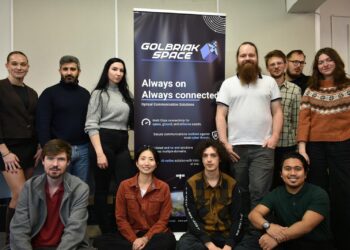
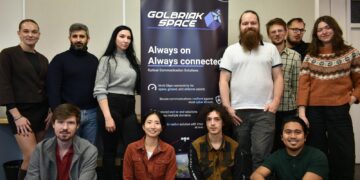
- Justas Poderys, Jakob Knutssøn and Alexander Vesterhauge
“We started seeing some initial traction for using drones for search and rescue at sea, and we decided to jump ship and start the company,” he said. However, that took another unexpected turn. “Nine months into it, [business] all died out because the second phase of the Ukraine war started, and absolutely nobody was interested in drones for [sea] search and rescue.”
So they pivoted to where people were paying attention: drones for surveillance over land. “It wasn’t a big pivot for us, but basically we dropped everything we were doing for naval, search and rescue, and started doing eye in the sky flying cameras,” he said.
Like other startups in the space, Monopulse started going to Ukraine regularly to test to validate its ideas.
“The first couple of tests were a complete disaster,” he admitted. “We were a team of engineers, and when we went there, the feedback was, ‘Hey guys, this is shit. We don’t need all these bells and whistles. We need something extremely simple, reliable.'” He said they were advised to “do one thing well.”
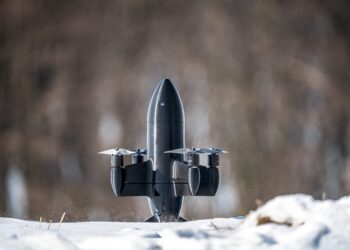
They put that feedback in their back pocket — something Ukraine soldiers implore others to do when building, too — and they returned home and made changes to the product. With several more back and forth feedback sessions, the Falcon, Monopulse’s flagship product, finally took flight.
“We started selling, and people were buying, and the rest is history,” he said. “We had almost €3 million in revenue [in 2025], and are looking to maybe double it this year.”
Poderys was speaking to Resilience Media from Camp Valdemar in Latvia, a multinational base where Danish troops were on exercise. Having access to an environment like this for testing is important to the growth of a defence tech company like Monopulse.
Poderys said the relationship came about as a result of “a lot of trust.” The startup is essentially given “full permission” to use the military base, even while remaining formally at “guest rights,” he added.
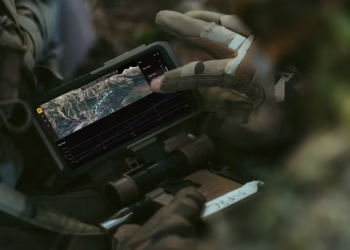
“We live with soldiers, we eat with them, we go on their day-to-day duties with them, we see how they’re using the drones. We talk about improvements, what they want, what they need – it’s a result of three-ish years of very close collaboration,” he said.
Falcon MK3S
Monopulse says its Falcon MK3S is manufactured exclusively in countries friendly to Lithuania, ensuring the security and resilience of the company’s supply chain. It designs and manufactures all major components in-house.
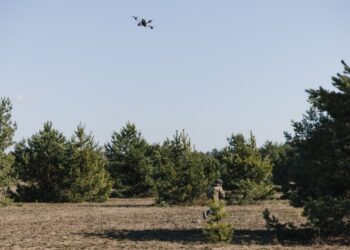
The unmanned aircraft is designed for surveillance and reconnaissance missions — no munitions, Poderys confirmed. They are equipped with multiple cameras, including those with night vision capabilities. Advanced communication systems ensure that operators can maintain control of the aircraft even in the event of GPS signal interference.
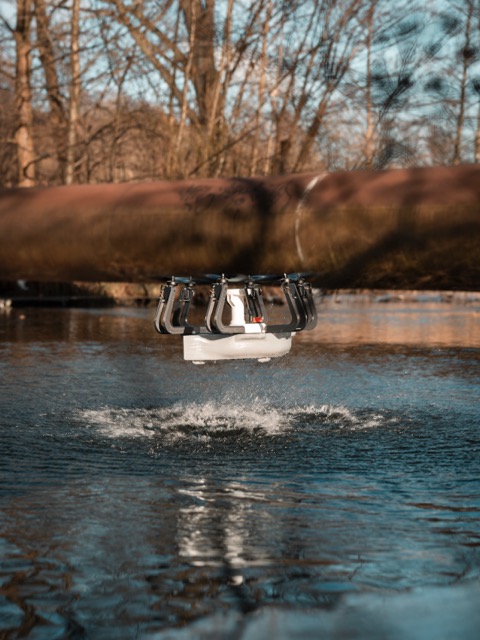
- Hydrohex drone
The company is also developing a separate unmanned platform it calls HydroHex, which is operational both in the air and on water.
To note, Monopulse does not actually sell directly to the Ukraine military. Its paying customers are NATO Western militaries as the drones are at a higher price point due in part to its supply chain, since it avoids Chinese parts.
The camera sensors are Sony from Japan and the motors come from Taiwan.
“The rest is all designed and built in house,” Poderys said. “Very early on, we decided that what we wanted to build was an IP portfolio and a customer portfolio.”
“Three four years ago a lot of people were looking at me saying Justas, you are reinventing the wheel. Why don’t you just buy off the shelf?” he said. “But now it’s paying off handsomely. We invested so much in actually building everything in-house – capability, knowledge and know-how.”