Over the past few years, Europe has seen a remarkable growth of the defence tech sector, with several start-ups reaching exorbitant valuations. Are we in a bubble? As one Ukrainian officer mockingly put it at Resilience Conference last week, if he wanted to use the right buzzwords and put together a nice Power Point presentation, he could have a company worth $1.5 billion.
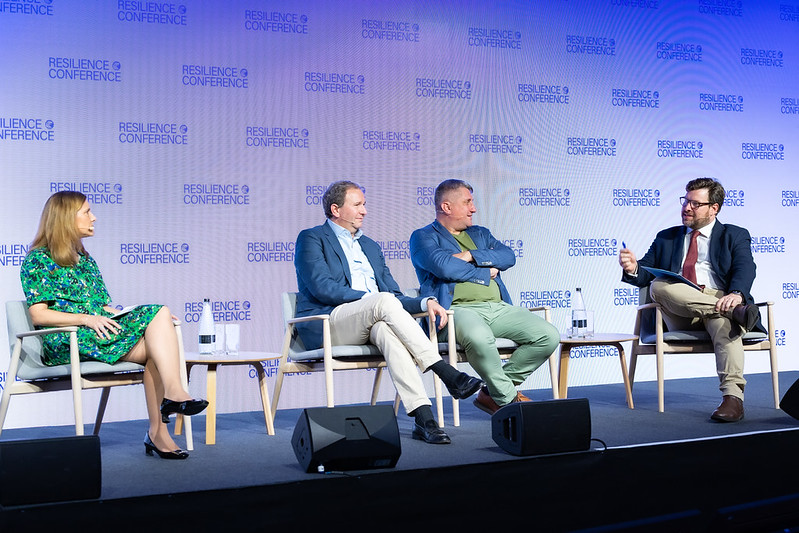
Meanwhile, on stage at the conference, a panel of European investors also tried to answer the question of whether the sector has floated into bubble territory.
Daniel Rudnicki Schlumberger, head of JP Morgan’s Security and Resiliency Initiative in Europe, the answer is a hard no. He said that while one could find arguments supporting such a thesis, relatively speaking, the funding raised by the defence tech industry on the continent is still very small. (A recent report that Resilience Media co-produced with Dealroom estimates the amount raised this year to be €10.5 billion.)
Schlumberger added that military technology spending by European states still constitutes a negligible portion of their GDP, around 0.02%, he estimated. (Indeed, average defence spend in the EU is around 2.2% of GDP, according to the World Bank, with spend on technologies like drones or autonomous systems a tiny fraction of that.) He compared that to defence technology spending in the US, which he said is fifteen times higher relative to GDP: at 0.3%. All this suggests that defence tech is still a nascent industry, especially in this corner of the world.
Roman Sulzhyk, who manages fund and company builder Resist.UA, agreed with this assessment. Instead of a bubble, he suggested that the mood among European institutional investors was growing acceptance, rather than euphoria, about defence tech investment.
Speaking from Ukraine’s perspective, Sulzhyk was wary of a bubble understood as a “one off” investment into Ukraine that was only dependent on the boom in Ukrainian defence technologies. The goal, he said, was to turn current inflow into “transformative capital.”
He added that if investors realise that it is consistently possible to turn a profit in Ukraine with local founders, “we will change the perception of Ukraine as this corrupt un-investable country and we’ll be able to attract the real capital that we need after the war.” Corruption remains an ongoing issue for some backers, although the conference and activity coming out of Ukraine these days show that things are slowly evolving.
According to Gwen Billon from PJT Partners, there is a turn toward defence companies overall among a wider scope of investors, including those able to deploy bigger capital, for valuations “north of $10 billion.” She listed PJT’s criteria for investment in a European defence tech startup. It includes not only a backlog of signed government contracts, but also the scalability of the company and ability to grow beyond its domestic market, and potentially beyond Europe, too.
This could be why Schlumberger predicted that the next opportunity in defence investment will be in the upstream — that is, from sectors that contribute to defence overall, such as manufacturing. Component producers and manufacturing innovators could face fewer export and scale-up limitations, he noted. And that is in addition to the rising demand from manufacturers for components sourced more locally as well.