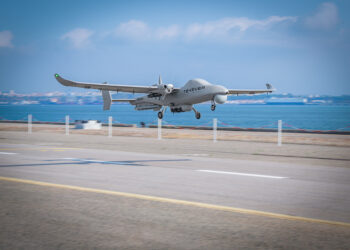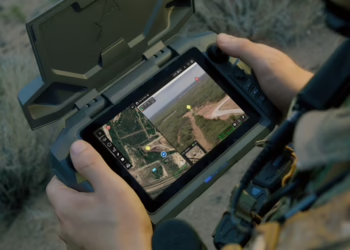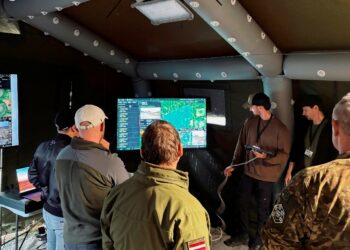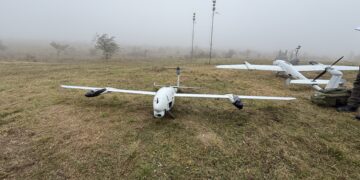
Allies in NATO earlier this year committed themselves to collectively spending $40 billion over the next five years on counter-drone technologies and training, and now NATO has laid out the pathway for procurement from a vetted set of vendors to meet that goal. The organisation says it has selected solutions from five defence companies to become available as part of the snappily-titled “Counter-Unmanned Aircraft Systems Marketplace.”
The companies hail from a range of geographies and include venture-backed startups as well as primes: Alta Ares from France; Axon Enterprise and Northrop Grumman from the United States, Operational Solutions Limited (OSL) from the UK (which is owned by Denmark’s Terma); and Quantum Systems from Germany.
NATO noted that the five were selected after vetting and testing 16 companies covering a mix of static, transportable and on-the-move systems (detailed at the end of this post) — and no, it didn’t name who didn’t make the cut.
It is not clear if further vendors will be added to the list over time, although it’s like that they will be: NATO said that there will be ongoing competition to ensure that the marketplace has the most up to date solutions.
All solutions have been built “on experience gained through NATO, national innovation activities and operational exercises,” it said. Selected capabilities have already been deployed in Allied countries and in Ukraine, it added.
The selection and subsequent marketplace are the latest developments in NATO’s Drone Edge, which itself was an initiative announced in July 2026 during the NATO Summit to improve the Alliance’s air defences in light of the “threat picture” from Ukraine, the Middle East and Eastern Flank incursions.
Key to that response is not only identifying suitable C-UAS systems, but speeding up procurement within the $40 billion targets.
At a time when procurement cycles remain a stubborn bottleneck after successful pilots or other tests, this will give these five potentially a smoother ride to the next level of engagement: actual contracts.
NATO Communications and Information Agency (NCIA) will be managing the marketplace.
A tender reduction
If this set-up could be described as a marketplace, an important detail to note is that this particular marketplace is a closed one.
Unlike open marketplaces where any vendor can be listed to be discovered, the set up for NATO’s C-UAS project is more akin to the Drone Dominance initiative from the US’s Department of War.
NATO said it has allocated €3.1M to fund further testing needed by nations or NATO commands, although the aim is to create a channel for NATO allies to procure solutions without any further tender process. Would-be buyers have access to ‘suitable solutions to urgent operational requirements,’ with framework contracts valid for 18 months at a minimum.
The scenarios that NATO used to put the companies to the test are not unlike those that might be encountered in real-world situations, and they were set up to test where NATO thinks the C-UAS systems might most likely be used. (Note: a recent trip we took to a testing event for Quantum Systems ran through scenarios that sounded a lot like these; now that we see them on this list, maybe we know why that was the case.)
- The “Point Protection” scenario focuses on enhancing the protection of a specific high-value asset or location – such as a military installation, critical infrastructure or command post – through effective detection, tracking and response.
- The “Area Protection” scenario focuses on the protection of a larger geographical area up to 3km in diameter, such as an airbase, logistics hub or military installation, through coordinated sensors and countermeasures against drone threats.
- The “Border Protection” scenario extends monitoring and protection across a 20 km border segment through persistent surveillance, early detection, tracking and coordinated responses.
- The “Convoy Protection” scenario focuses on the protection of moving military convoy up to 300-meter length, travelling at speeds of up to 50 km/h, through mobile C-UAS capabilities capable of detecting, tracking and responding to threats while on the move.