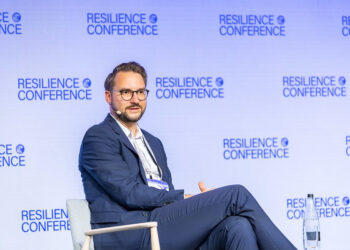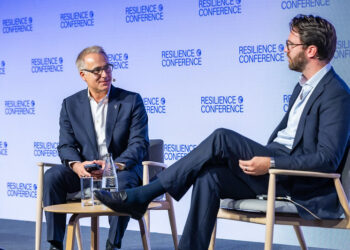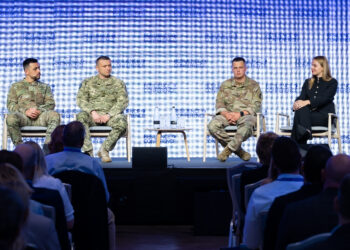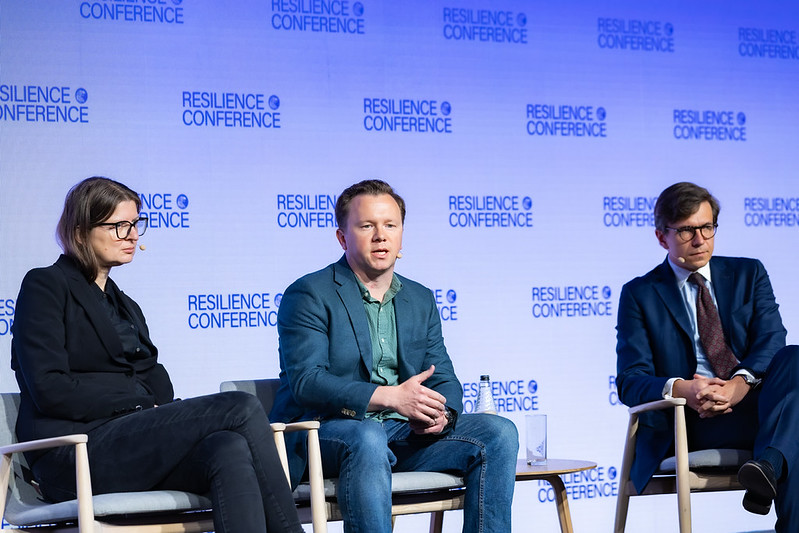
Europe lacks late-stage capital and government risk appetite for building defence-tech companies, agreed investors on the Resilience Conference stage in London.
“When you look at growth-stage investments into defence tech companies in Europe, leads in all cases were Americans,” said Expeditions’ Fund Mikolaj Firlej, adding that largest European funds have restrictions on what they can invest in.
According to Estonian investor Kart Siilats, what Europe needs is not more capital, but a new way of thinking about how it should be invested: “pension funds should change their attitude, and governments and sovereign wealth funds can show the way here,” she said.
Firlej noted that the government intervention should not come down to state-led investing, but to taking more risks as a buyer, particularly by directly contracting new technologies after prototyping them, with follow-on contracts.
“There’s a blueprint for this coming from the US,” Firlej pointed out, and highlighted key elements of the Department of War’s approach to innovation: wider scope of prototyping and research, allowing follow-on contracts, and introducing a Defence Innovation Unit (DIU) “that actually works.”
In recent years, European governments have introduced their own versions of the US DIU, but none have repeated the success of the American accelerator. “We have many DIU in Europe which are only ‘DIU’ by name,” lamented Firlej.
Speaking from his experience across the pond, Chris Morales from Point72 Ventures added that the advantage of the Department of War over European defence administrations is the communication between the government and investors about the “directions of defense programs and spending,” which means that there will be coordination between companies backed by capital and the demands of the military.
Venture capital is also not excluded from the questions of sovereignty. According to the European investors at the panel, American capital still has a role to play on the Old Continent, but domestic alternatives should exist. Mikolaj Firlej said that he wouldn’t go as far as saying that European founders should not accept American funds. “We’re still allies,” he said. However, he wished for a time when Europeans could “sit at the table with American (Funds) and be able to beat them to give funders the better offer.”
According to Kart Siilats, “American money is only a good thing,” but for her, it’s important that European defence-tech start ups keep their headquarters in Europe, and funds can influence such an outcome.
Mikolaj Firlej spoke about the need for scanning foreign defence investments, as well as having a trusted network of funds. “It is very easy to plant intelligence operations in venture capital, through multiple leads, and extract really valuable data,” he said, mentioning capital linked to countries such as Russia and China.