Last week, the news feeds of Western defence tech were excited about a press conference held by President Zelensky. Speaking to a group of selected media outlets on the 21st of June, he announced the launch of the Build with Ukraine framework, enabling the export of the Ukrainian defence technologies to partner countries. If this plan comes to pass, the three year long ban on Ukrainian defence tech exports will cease.
Many members of the Ukrainian defence tech ecosystems have long lobbied for this decision. Tech Forces in UA, an association of leading manufactures of innovative weapons for Ukraine’s defenders, spent past two years advocating this policy. ‘We welcome the fact that this topic is currently in the focus of the Ukrainian leadership’, Kateryna Mykhalko, Director-General of the coalition, told Resilience Media.
At the same time, most, if not all, of them had no warning about the upcoming announcement. Yet, not everyone got overexcited by the decision. Andrew Poberezhniuk, the cofounder of drone detection startup Kara Dag Technologies, said his reaction was ‘measured’, mostly because he believes this to be an organic decision, ‘the next logical step in our story’.
Even if almost no details got leaked into the public, the program was certainly long in the making. In late April, Anna Gvozdiar, Deputy Minister for Strategic Industries, told an audience at the Invest in Bravery summit that the ministry was working closely with its partners to map out export scenarios. Despite many complications along the way, Gvozdiar was clear that ‘this issue will be solved very soon.’
Two weeks later, in mid-May, Danish Minister of Defence, Troels Lund Poulsen, told the Danish newspaper Berlingske that the government was ready to let Ukrainian weapons producers set up production in Denmark. This remark would not be of major significance, if not for the extremely strong ties between the Danish government and the Ukrainian defence industry. While most Western states exported their finished defence products to Ukraine, the Scandinavian country funded the production in Ukraine. Although Denmark was not alone in doing this, the approach became known as the Danish approach.
It is not without a reason that Minister Poulsen made his May announcement. By mid-June he was already in a position to argue that ‘in the coming months we will be ready to roll the red carpet out for Ukrainian defence companies who will produce drones and other defence equipment here in Denmark.’
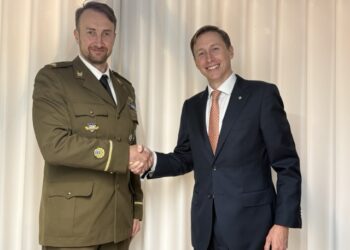
The timing of the announcement by Zelensky was not arbitrary. It came three days before NATO’s 34th summit in the Hague, at the sidelines of which Poulsen met his Ukrainian counterpart Rustem Umerov. The two signed a Build with Ukraine agreement which will enable cooperation between Danish and Ukrainian defence companies, as well as allowing Ukrainian companies to start producing in Denmark. At this occasion Umerov disclosed that the framework was first formally presented to Ukraine’s partners at the Ukraine Defense Contact Group meeting on the 4th of June.
After the NATO summit Umerov rushed back home and held a meeting with the press. The minister confirmed that the first factory in Denmark will go online in the coming months. The United Kingdom and Norway were also mentioned as the potential partners under the Build with Ukraine umbrella. Umerov said that his ministry is working to create a legal basis for the framework and has already submitted a draft law to the parliament. As of June 30th, no such draft is to be found on the website of the parliament. Resilience Media contacted the Ministry of Defence for further details.
In the meantime, it is safe to assume that this draft will address many technical questions that concern Build with Ukraine. These regulations are ‘the most vulnerable spot in the whole story of export launch,’ Poberezhniuk believes. He hopes that there will be enough ‘political will’ to transform the initial statements into ‘transparent and clear mechanisms which will organise export without redundant bureaucracy or corruption’.
Despite these uncertainties, the general outline of the program appears to be emerging. An educated guess: exports of defence technologies will only happen to those countries with which separate Build with Ukraine agreements have been signed. Therefore, the Ukrainian diplomatic corps may play an important role in supporting these arrangements. Resilience Media contacted the Ministry of Foreign Affairs for further details.
One may only speculate about the contents of the Danish-Ukrainian treaty, but it will certainly not be the last. President Zelensky has already announced that soon he will be speaking to European leaders about joint ventures in defence. It seems that the respective ministries of defence will be the partners for those foreigners interested in putting capital behind Ukrainian production lines abroad.
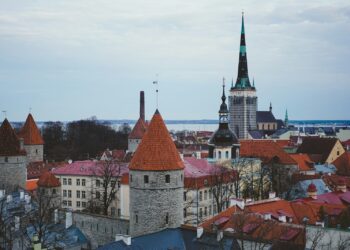
For Ukrainian defence tech producers, such as Poberezhniuk of Kara Dag Technologies, these developments did not change too much. Their companies spent months preparing for some version of this decision. Kara Dag Technologies showed their drone detectors to foreigners both at public events, such as the Latitude59 conference in Estonia, and at closed-doors events organised by The NATO Centre of Excellence for Counter Improvised Explosive Devices. As Build with Ukraine develops, Ukrainian defence tech companies will continue to focus on foreign markets as a future opportunity.