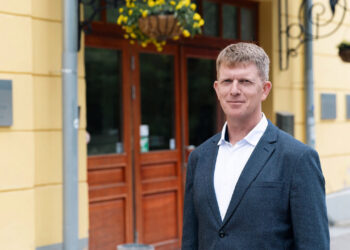
Resilience Media sat down recently with Paul Kwan, Managing Director at General Catalyst to discuss GC’s mission to protect democratic societies and build a secure, tech-powered future. From backing innovators like Anduril and Helsing to hosting the GC Resilience Games and co-founding defence accelerator Valinor, they’re driving modernisation in critical sectors while shaping global policy through the GC Institute. This interview has been condensed for clarity and length.
Setting the Scene
Resilience Media (RM): Paul, thanks for chatting with us! We wanted to speak with you as you are clearly interested in this sector. Can you tell us more about the kind of things you’re doing personally to support resilience, defence, and security?
Paul Kwan (PK): On the personal front, we’ve been very proactive in supporting military and government leaders as they transition out of service by providing education and immersion into tech and venture. I’ve been co-teaching a class at Stanford University on national security and tech innovation and recently, we’ve been hosting the GC Resilience Games – a physical and mental well-being workshop to bring together veterans and tech founders across the US. Everyone on our team at GC has a deep personal passion in this market and we’re privileged to work alongside multiple colleagues who served in the most elite teams in our military, worked in national security or directly supported our government with technology.
RM: When and why did General Catalyst start to look at ‘resilience’ as a concept and sector?
PK: Our first ‘resilience’ investment was 20 years ago when we acquired BBN, a defence contractor which built a breakthrough gun-detection system that protected soldiers from enemy snipers. That experience gave us the confidence to invest in Anduril’s initial funding round seven years ago when defence tech investing was out of favour. More recently, we saw the changing world order whereby every country must now re-assess their own technological sovereignty in critical industries like defence, industrials, energy. Great power competition requires countries to build more resilience through technology and AI. We also include healthcare and fintech in our resilience thesis as they are equally critical societal industries.
RM: Do you have any specific innovation or technology areas you are prioritising in this field?
PK: We’re investing across defence, industrial and energy markets, and we invest at all stages and check sizes. What matters more to us than the thematic area or the particular area is the team behind it. These markets are really hard to crack and you need to find founders who are crazy enough to expand the art of the possible, who have the ability to collaborate with government and partners, and who are committed to building responsibly. These markets aren’t like traditional software or consumer where there are thousands of startups; sometimes we have to start our own companies at GC or roll up several companies into one (we call that a venture buyout in contrast to traditional private equity buyouts).
The General Catalyst Portfolio
RM: Could you share some specific examples of companies or projects within General Catalyst’s portfolio that are making a tangible impact on global resilience, defence, and security?
PK: In defence, we are one of the largest investors in Anduril and Helsing, which are leading the modernisation of the US and European militaries, respectively. We’ve invested in several AI for defence software companies like Vannevar Labs who are seeing strong growth. We invested early in Applied Intuition, the leader in modern software for the global automotive industry, which is also expanding into US and Allied defence. In industrials, we’ve invested in Samsara, the leader in industrial IOT, and Re:Build Manufacturing, as well as Cobot – a leader in collaborative robotics. We have a focus on “software for hardware”: companies like PhysicsX in the UK, Nominal and Tractian in the US, who are helping industrial and defence companies build or operate hardware products more effectively.
RM: How does General Catalyst view climate tech and environmental innovations as part of its broader mission for resilience and security? What other sectors do you feel fall under the topic of Resilience?
PK: We include energy resilience and security in our resilience strategy. We recently announced a very large investment into Pacific Fusion, a moonshot to build fusion in a more cost-effective manner. We’ve invested in Charm Industrial, for decarbonisation, and Fever, in Sweden, which integrates distributed energy assets with software and machine learning to optimise energy distribution. More broadly, we think of healthcare and fintech as other resilience sectors to modernise, given that both are critical to society and there is scope for both to benefit much further from technology transformation.
General Catalyst Institute
RM: You have launched the General Catalyst Institute, what is it and how does it fit a VC business model?
PK: Our mission is to promote global resilience by backing transformative technologies and shaping public policy that advances our societal impact. The Institute’s work builds off General Catalyst’s deep expertise in identifying and incubating breakthrough technology companies to advocate for solutions that can scale. The Institute is global in scope and partners with private and public sectors in the US, UK, EU, India, and leading global capitals. Our focus areas are AI, healthcare, defence and intelligence, and manufacturing — the building blocks of national and global resilience. The team is led by Teresa Carlson, former head of Amazon AWS Worldwide Public Sector, and Maryam Mujica, former government relations head for Booking.
Horizon Scanning
RM: Looking ahead, what emerging trends or technologies do you believe will be transformative for the resilience and defence sectors next?
PK: There’s a lot of focus right now on defence tech which is much-needed but there’s a much larger defence industrial base that needs modernising globally. So we spend as much time looking at next-gen defence tech as we do looking at ways to transform how tech, defence and industrial companies design, manufacture, operate and scale their operations, including energy requirements. On defence tech itself, it’s easy to focus on autonomous systems and AI tech, but the modern battlefield is truly multi-domain and spans land/sea/air assets, operations, cyber, space, supply chain, information warfare and economic warfare, so we think a lot about how we modernise every level of this battlefield.
RM: What role do you think VC funding should play in bolstering national or global security?
PK: Venture capital, and the innovation economy broadly, has an obligation to support national security as well as resilience. This is perhaps obvious given the return of great power conflict, war, geo-political and societal stress, and inflationary / interest rate volatility. But that’s why we think it’s vital to invest now in modernising societal systems like healthcare, defence, industrial, energy and fintech. When we first invested in Anduril years ago, defence tech was shunned by many investors and now it’s one of the most active sectors. Venture capital as an asset class — and its LPs — are beginning to understand that promoting and protecting safe and democratic society is at the core of responsible innovation.
RM: Dual-use technologies can sometimes require close government cooperation for scaling effectively. How does General Catalyst facilitate connections between portfolio companies and government entities to support this scaling process?
PK: This gets to the greatest challenge for innovators building for government. We already discussed GC Institute and why we need to help partner with public policy on technology adoption. More tactically, selling into defence requires a level of patience, relationship building, ability to gain access to actual use cases and requirements, and depth of understanding around how defence tech is acquired and deployed, that is daunting for most startups. Startups often forget that the DoD or any European MoD are not businesses and they don’t care about profits nor how great one’s tech is; their mission is to defend and deter their country from adversaries. So to engage effectively as an innovator in defence tech, at GC we have a number of advisors from the military and intelligence community, as well as government go-to-market leaders on our team. This problem of selling into government is so acute that we launched our own defence accelerator platform called Valinor, led by Julie Bush, former SVP Federal at Palantir, to help accelerate capabilities into defence and government, in partnership with Anduril, Palantir and Helsing.
Global Expansion
RM: You just merged with La Famiglia and Venture Highway, which are established venture funds based in Germany and India, respectively. What do you want to accomplish with these mergers?
PK: If you want to transform global industry then one must be a global local firm and we’re very lucky to have been able to partner with La Famiglia and Venture Highway. We have a shared sense of mission and together we have the platform and scale to realise that mission. We’ve already begun backing and supporting the very best founders in Europe and India together.
RM: Paul, thank you so much for your time. Last question: do you see value in cross-border collaboration between portfolio companies and defence organisations in NATO and BRIC countries, despite potential geopolitical tensions? Could you provide examples where General Catalyst has facilitated such partnerships?
PK: We believe that cross-border collaboration is essential in today’s changing world order where every country has to re-globalise and re-assess partnerships. In India, we have co-hosted a US India tech event called the Sangam Summit that brings together business, tech and policy makers. We’ve invested in Alsym, a next-gen battery startup, and JEH Aerospace, modern manufacturer of aerospace parts, where we helped bring in both Indian and US strategic partners to help scale those businesses. In Europe, both GC and our defence portfolio companies are engaging with military and government leaders on how best to rapidly modernise capabilities.