Brave1 has blazed a trail in Ukraine with a platform to source and back defence technology innovations, fast-tracking them to the front-line fight against Russia – a game-changer that has sped up innovation by connecting technologists and startups already in Ukraine directly to would-be users of their hardware and services.
Now, the Ukraine government is taking that template on the road with up to €50 million in support from Europe and €50 million from Ukraine itself.
BraveTech EU – a new partnership between Ukraine’s Brave1 defence tech cluster, the European Commission and the European Defence Agency – will be running DefTech Forges, accelerator-style bootcamps that will culminate in competitions. Interested startups can apply now. Winners will receive €120,000 in funding and the chance to test their products in front of military end users (and potential buyers).
The partnership represents a significant evolution. After years of the EU providing a range of support to Ukraine (€104 billion+ to date) in the form of monetary aid, procurement, and funding for dual-use development to support reconstruction among other programmes, this is the first time that it is putting money into a fast-track programme to back defence tech startups.
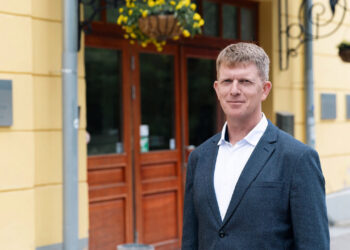
“This is the fastest funding possibility the EU has ever made available for the defence industry,” said Martin Jõesaar, program officer for the EU Defence Innovation Office in Kyiv, speaking to Resilience Media at Kyiv Defence Tech Week, where the news was unveiled.
Why now? Ukraine’s wartime experience has shown that conventional EU defense investment channels are too slow for the pace of innovation required in contemporary conflict, Jõesaar said. (The same does not go for individual countries that have their own programmes for backing defence tech startups.)
DefTech Forge was developed in response, he added, drawing on the Brave1 model.
To start, BraveTech EU is calling for applications from startups and mentors for “phase 1” of the partnership: a series of DefTech Forge events across Europe. The first two are planned for France 1-5 June, and Estonia 3-7 June.
DefTech Forge is not a typical bootcamp or accelerator designed for early-stage ideas. Instead, BraveTech EU is looking for startups, scale-ups and SMEs whose products are at technology readiness level (TRL) 4 or higher – that is, the solutions should be beyond basic concept and able to demonstrate component- or system-level validation in a laboratory environment. Part of the aim is to put mature prototypes into realistic conditions and provide direct feedback from military end users.
Approximately 10 to 15 companies will be selected to compete in each event. The top three winners will each receive €125,000 to support further prototype development.
Applications for the first phase for the Estonia and France Forges are open until 10 May, with selected participants announced 20 May. (Apply here.)
Later this year, “phase 2” will test and evaluate selected technologies under conditions similar to those encountered in Ukraine.
Compared to the 12-figure sums in aid that have been supplied to date to Ukraine for its war effort from the EU and other countries, the BraveTech EU project is modest.
The European Commission has proposed up to €50 million from the EDF and EUDIS for the initial phase. But Jõesaar said that the Ukraine’s matching €50 million, which the EC had described as aimed at “amplifying the impact of joint investments,” would only be released after Ukraine evaluates the results of the initial DefTech Forge events.
The full sum includes €35 million for the second phase from the European Commission and EDA — a sum that was agreed and signed at the end of April.
Each DefTech Forge will draw startups out from specific regional ecosystems, but also from specific areas of focus.
The Estonia Forge, for example, will focus on offensive and resilient unmanned air systems for contested environments. This will also include autonomous strike drones, terminal guidance, EW-resistant navigation and links, modular battlefield adaptation, and multi-drone sensor-to-shooter integration.
The France Forge, meanwhile, will focus on ground-based systems for force protection, perimeter defense and close-combat support, including counter-UAS, remote and automated weapons, tactical UGVs, distributed sensor networks, EW-resilient ground systems and counter-mobility capabilities.
While Ukraine and Russia dance around the idea of at least a pause in fighting, if not a longer resolution, the BraveTech EU effort seems to underscore how the appetite to develop the next generation of Europe’s defences will not be sated quite yet.
The plan is to run the Defence Tech Forges every 4 months over the next 3 years and to look at how to grow other forms of EU funding for later-stage defence tech startups.
“We are now doing fast track innovation support [because] technology development speed has multiplied over the last years,” Jõesaar told Resilience Media. “And the amount of funding needed for this has also increased.” He added that in addition to BraveTech EU, the EU is considering how to speed up larger amounts of funding “on a bigger scale.”