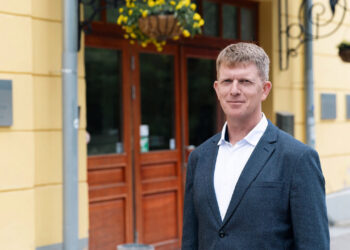

Agris Kipurs is the co-founder and CEO of Origin Robotics, a Riga-based defence tech startup specialising in advanced autonomous unmanned aerial weapons systems. By deploying advanced drone technology for munition delivery and guidance, Origin Robotics enhances strike precision while significantly reducing costs. Founded in response to the invasion of Ukraine, the startup has rapidly demonstrated its effectiveness, with its flagship system, BEAK, already deployed by the Latvian and Ukrainian Armed Forces.
Trump’s recent NATO cold shower highlights the pressing need for Europe to stand on its own feet when it comes to defence. Public sentiment across the continent is shifting in favour of greater military investment, yet political action remains slow.
Another wake-up call for Europe. That’s how many are framing the latest statements from U.S. President Donald Trump on the war in Ukraine and NATO. But how many wake-up calls does Europe need? From Crimea in 2014 to the full-scale invasion of Ukraine in 2022, from energy crises to supply chain vulnerabilities, Europe has been repeatedly warned that its defence strategy is inadequate.
It’s time to move beyond alarms and act.
The cost problem in asymmetric warfare
The U.S. spends over $800 billion annually on defence (around 3.5% of its GDP), while combined European NATO members spend significantly less—around $400 billion (roughly 2% of collective GDP). The U.S. military can afford high-end solutions. Europe, with tighter budgets, needs a different approach.
Instead of expensive centralised systems, Europe should prioritize decentralization. Small, networked autonomous systems that can be quickly deployed and adapted to new threats should be the focus.
Cost asymmetry is one of the biggest issues in modern warfare. Drones are cheap to build but expensive to stop. Many air defence systems still use high-cost missiles to destroy low-cost targets. A Shahed-136 loitering munition—used by Russia and Iran—costs around $150K–$200K. A single Patriot missile to intercept it can cost $3–4 million. Meanwhile, Ukraine deploys thousands of FPV drones, often costing just a few hundred dollars, to disable multi-million-dollar systems.
This is where Europe has an opening. While the U.S. can afford high-cost tools, European countries must be more resourceful. We can skip over legacy systems and focus on cheaper, more relevant tech. Europe could spend $800 billion on traditional weapons or a fraction of that on modern systems and still achieve similar results.
Countries like Poland, Finland, and the Baltics are preparing for asymmetric warfare by investing in drones and mobile strike capabilities instead of relying only on heavy armor. Smart spending on drone interceptors, precision-guided munitions, and AI targeting can level the playing field without overspending.
Wartime improvisation is not a strategy
One of the main lessons from Ukraine is how fast militaries adapt when faced with existential threats. Commercial drones were turned into surveillance tools. Loitering munitions reshaped battlefield dynamics. Cheap, mass-produced systems became force multipliers.
But wartime improvisation is not a strategy. Professional militaries can’t rely on short-term hacks. They need systems that work under structured, repeatable conditions. The problem with many wartime fixes is that they’re reactive, not long-term.
For example, the early battlefield use of drones was basic: strap an explosive to a quadcopter and drop it on a target. It worked—for a while. But these makeshift bombers struggled with jamming, precision, and safety. The next step is clear: purpose-built, precision-guided weapons using AI and computer vision.
That’s the direction Europe needs to take. Not just retooling what’s available, but building systems for today’s threats.
Loitering munitions—kamikaze drones—have become a key tool in modern war. They deliver precise strikes without risking a pilot. But they have a limitation: once used, they’re gone.
A small infantry unit might carry one or two. After that, they’re out of air support.
That’s why we’re seeing a shift toward reusable platforms. Systems like the MQ-9 Reaper already offer this capability to larger militaries. Smaller, man-portable versions could let forward units operate with continuous air support—no need for big drones or central command.
For smaller European countries, that’s a game changer. It gives them autonomy that used to be reserved for advanced air forces.
Europe’s defence industry is slow. Procurement cycles stretch for years or decades. But the pace of modern war—especially drone warfare—demands speed.
Right now, European militaries are in a transition phase. They see the value of drones and electronic warfare. But procurement still leans toward tanks, artillery, and manned aircraft.
There’s growing investment in autonomous systems, AI targeting, and cyber capabilities. But to make those investments count, procurement has to be faster. Militaries should be buying systems they can use now—not waiting years for full development.
We’ve seen that smaller countries can have an outsized impact with the right tech. Ukraine has shown that asymmetric warfare isn’t about numbers. It’s about using innovation well.
If Europe pays attention, it won’t need another wake-up call. It’ll already be ready.