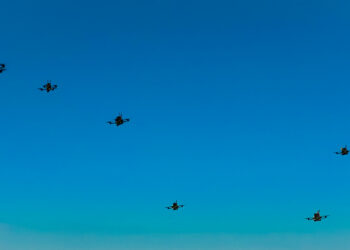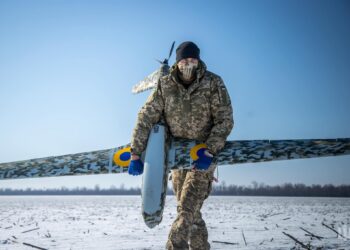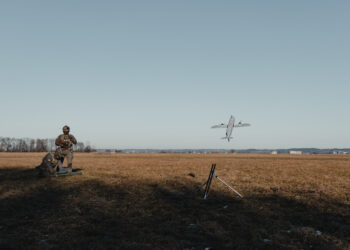

Modern conflict has pushed autonomous machines into some of the most hostile operating environments. Drones are intercepted mid-flight, ground robots are abandoned under fire, and naval systems drift beyond recovery.
When those physical systems are compromised, however, it’s not the metal or motors that hold the greatest value, but the software and data inside them — the navigation logic, swarm coordination and embedded intelligence that provide the tactical advantage.
Securing that intelligence before systems reach the field is the focus of a new partnership between Leeds-based embedded security startup Periphery and Midgard Dynamics, a Ukrainian defence robotics engineering company. The two companies have signed a global deal to integrate Periphery’s military-grade AI threat management software directly into Midgard’s autonomous systems.
Locking down the logic
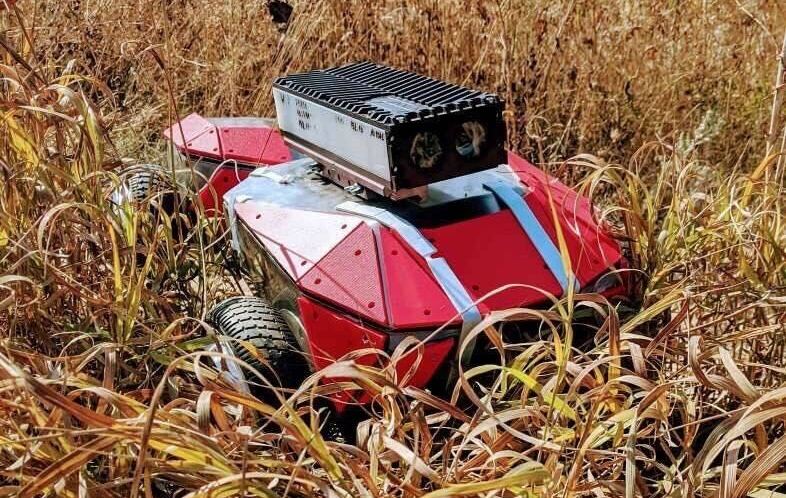
Midgard Dynamics has spent more than a decade developing navigation, sensor, communications, and drone swarm technologies for defence applications. In recent years, its systems have been tested in live operational environments where adversaries attempt to intercept, jam, or seize hardware.
This is where Periphery enters the fray, hardening those systems at the firmware level before deployment. Its AI-powered threat management model is condensed and stored directly on the device itself, forming part of a security architecture designed to prevent unauthorised access or extraction of sensitive code.
“This on-device protection prevents IP loss and tampering, as well as speeding up compliance timelines, enabling devices to reach the market faster,” Periphery co-founder and CEO Toby Wilmington explained to Resilience Media.
The risk of sophisticated actors exploiting captured or reverse-engineered systems is far from fantasy. Military drones and autonomous platforms are built around proprietary navigation algorithms, communications protocols and embedded control systems — the blueprints for how they perceive, coordinate and act. When an adversary gains access to that software, they can analyse, replicate or even improve on the original design.
‘We are surrounded by thousands of robotic systems, and recent experience shows that any toy or amateur drone can be reprogrammed to become a lethal weapon.’
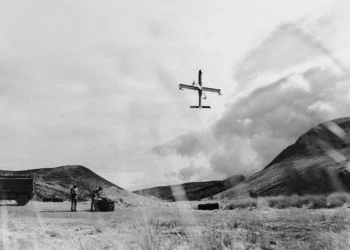
A high-profile example came in December 2011, when Iranian forces captured a U.S. Lockheed Martin RQ-170 Sentinel surveillance drone and brought it down largely intact; Tehran later claimed to have studied aspects of its systems and produced derivative designs. Iran’s state media later broadcast video footage it said was extracted from the captured drone itself — showing imagery recorded by the aircraft’s onboard sensors — underscoring that a downed platform can yield sensitive technical insight as well as operational data.
Such incidents show what’s at stake: software and sensor data are strategic assets that adversaries can exploit long after the physical system has fallen into their hands.
“Evolving threats on a global scale from malicious actors, including nation states, have made critical infrastructure and defence technologies prime targets, and their protection is a matter of national security,” Wilmington said. “In contested environments, like warzones, precious IP is more vulnerable than ever, and exposed or captured devices can grant opponents the ability to easily replicate capabilities, or understand how to exploit or disable other devices.” Wilmington has some experience of this preceding Periphery: he previously worked for BAE Systems in cybersecurity and helped build NATO’s incident response capabilities.
‘Sovereign resilience’
Ukraine has become a key testing environment for autonomous systems. One common approach has been to take inexpensive drones, modify them, and then rapidly deploy those modified systems at scale. The line between consumer robotics and weaponised systems has narrowed, said Midgard’s founder and CTO, Dr Anton Varavin. As such, protecting the software inside these platforms is now as important as building the hardware itself.
“We are surrounded by thousands of robotic systems, and recent experience shows that any toy or amateur drone can be reprogrammed to become a lethal weapon,” Varavin said. “The new challenge is protecting the one thing that distinguishes a home assistant from an effective weapon: a small piece of code or data. Our experience in creating effective robotic combat systems, and our partner Periphery’s undisputed expertise in information security, make it possible to create a barrier that will separate our peaceful life with robots from the systems of war.”
For Periphery, Midgard represents its first publicly announced partnership, though the company says it is also working with global OEMs across mobility, energy, aerospace, defence and medical sectors.
As autonomous systems proliferate across modern battlefields, the strategic advantage could lie in who can protect the intelligence embedded inside them. Hardware may be recoverable, or at least can be built again. Code, once exposed, is not.
“This partnership ensures that Midgard’s systems and partners are secure-by-design, and resilient in deployment,” Wilmington said. “The outcome is sovereign resilience, autonomous platforms that cannot be easily replicated, subverted, or turned against their operators.”