Tuesday 23 December, 2025
Resilience Media
  • About
  • News
  • Resilience Conference
  • Guest Posts
    • Author a Post
  • Subscribe
No Result
View All Result
  • About
  • News
  • Resilience Conference
  • Guest Posts
    • Author a Post
  • Subscribe
No Result
View All Result
Resilience Media
No Result
View All Result

MI6 warns of Russia’s grey zone tactics; space as a battleground; and Europe’s latest security mega round

Digest 52: Quantum Systems has a week of partnerships and acquisitions, Skana introduces its Alligator, and we report from the Deftech Hackathon in Estonia

Leslie HitchcockbyLeslie Hitchcock
December 22, 2025
in Weekly Digest
Share on Linkedin

Good afternoon from the team at Resilience Media

The rollercoaster of geopolitics continues this week. The most credible plan yet for peace in Ukraine was presented and will be rejected by Putin. Continuing its mixed signals on foreign policy, the USA agreed to sell $11B in weapons to Taiwan. The UK Chief of Defence Staff, Air Chief Marshal Sir Richard Knighton and Chief of the Secret Intelligence Service (MI6), Blaise Metreweli, both made speeches indicating that the UK is under attack now, and facing a future war in Europe.

You Might Also Like

Digest 51: Lithuania declares Security Emergency as ICEYE, Nu Quantum lead defence tech funding surge

Digest 50: EU needs control, not sovereignty; Inside the drone revolution; and donate to our Ukrainian brigade fundraiser

Digest 49: Keen raises €150M fund, Erica Dill-Russell and Mike Pompeo join Kraken, and Helsing and Stark open UK factories

Metreweli emphasised how “Russia is testing us in the grey zone with tactics that are just below the threshold of war. It’s important to understand their attempts to bully, fearmonger and manipulate, because it affects us all.” The grey zones Metreweli was referring to include “Cyberattacks on critical infrastructure. Drones buzzing airports and bases. Aggressive activity in our seas, above and below the waves. State-sponsored arson and sabotage. Propaganda and influence operations that crack open and exploit fractures within societies.”

She didn’t mention space, but yesterday Resilience Media contributor, Paddy Stephens examines the potential of that domain to be exploited via grey zone warfare.

“Space is, in many ways, the ideal domain for grey zone operations and activities, because there are a lot of things you can do that fall below the threshold of overt conflict,” Todd Harrison, a Senior Fellow at the American Enterprise Institute and expert on defence and space policy, told Paddy.

Read more in in our Dispatches from Taipei section below.

Concerningly, Sir Richard’s speech suggested that while the UK military can learn lessons from Ukraine, a Russian war with NATO would be inherently different in practice. His logic was that NATO has a completely different military, complete with the fighter jets and artillery Ukraine lacked when Russia mounted its full-scale invasion. This meant that Ukraine had to default to things like drones to make up for these deficiencies, but NATO would not have to.

This misses the point that Russia has now evolved its military tactics and doctrine in response to Ukraine’s innovations. A war between Russia and NATO would be more like Ukraine because Russia would use the new methods they have learned in Ukraine against us. These are innovations NATO militaries have still not adopted — and worryingly seem to think they might not need to. The sluggish start for UKDI which we reported on last week suggests our politicians may not fully understand the changing nature of war and technology happening right in front of their faces.

Italian cybersecurity startup Exein closed another €100M which puts their valuation around €700M. “Cybersecurity needs to be decentralised and embedded on devices we all use every day because the nature of the threat has fundamentally changed,” Gianni Cuozzo, CEO, said. “We’re seeing more attacks on infrastructure and physical systems, not just on services or websites. When attackers target firmware, the damage isn’t just digital. It becomes physical.” More on that in our Funding Announcement section below.

Elsewhere on Resilience Media:

  • Skana wants to shore up coastal defence with amphibious vessel for shallow waters
  • CHAOS Industries joins U.S. Army G‑TEAD Marketplace
  • Quantum Systems picks up Fernride to move into autonomous land vehicles
  • And Quantum Systems teams up with Frontline to mass-produce Ukrainian combat drones in Germany
  • DefHack takes defence tech to the streets

Got a tip, funding announcement, or news? Send it our way. I’ll be back in your inboxes next week.

-Leslie Hitchcock, co-founder and Publisher, Resilience Media


Welcome to the grey zone of warfare in space

The war-fighting domain is increasingly extending into space. With it come new applications of a familiar authoritarian playbook: salami-slicing of red lines, service disruption, intimidation – and plausible deniability. Welcome to the age of greyzone space operations.

“Space is, in many ways, the ideal domain for grey zone operations and activities, because there are a lot of things you can do that fall below the threshold of overt conflict,” Todd Harrison, a Senior Fellow at the American Enterprise Institute and expert on defence and space policy, told Resilience Media. “You have a whole suite of non-kinetic forms of space attack that can and have been used without triggering escalation or overt conflict.”

Experts highlight a broad range of space capabilities that could be used for greyzone activities.

One category is electronic, targeting satellites as information systems. It includes cyberattacks, radar jamming and interference in GNSS systems like GPS. Keep reading here.


Exein, the embedded security startup, nabs €100M at ~€700M valuation

Malicious hackers — backed by adversary states like Russia and China or organised crime — are cracking complex cryptography by weaponising artificial intelligence and advanced computing power. And a major target for worming their way in to attack is not just the cloud, but the tens of billions of connected devices that are being used by individuals and organisations. One way to fight that is through embedded security: solutions built directly into the very chipsets that connect those devices to data networks.

Exein — one of the startups building that embedded tooling — is today announcing significant funding, underscoring the focus on the approach and its own traction in the market and the impact it’s having on companies in sectors like energy, healthcare, defence, automotive, aerospace, industrial automation, semiconductors and robotics.

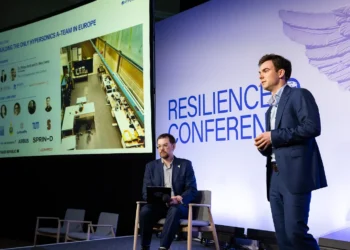
The startup out of Rome, Italy has secured €100 million in a mix of equity and debt, roughly in a 50:50 split, according to Gianni Cuozzo, the CEO who co-founded the company with Gerardo Gagliardo, CFO and Giovanni Alberto Falcione, CTO (pictured above with Cuozzo centre). Read the rest here.


On Our Radar

In this secret missile factory, Ukraine is ramping up its domestic arms industry

US House passes bill to bolster Europe’s defence, in apparent rebuke to Trump’s foreign policy strategy

Local Spies With Lethal Gear: How Israel and Ukraine Reinvented Covert Action

Opinion | America’s Military Needs a Culture Shift

Gambit Cyber Raises $ 3.4 M Seed round

The New Martial Plan: Back to the Future for Private Capital

Previous Post

How Swebal plans to rebuild Europe’s TNT supply

Next Post

Stark and TDW accelerate loitering munition readiness with successful live warhead test

Leslie Hitchcock

Leslie Hitchcock

Leslie Hitchcock is a seasoned media executive and co-founder of Resilience Media, an independent publication dedicated to the defence of democracy and the intersection of startups, security, and defence technology. With nearly two decades of experience in the tech industry, she has been instrumental in shaping conversations around innovation and resilience in the face of global challenges. Prior to founding Resilience Media, Leslie served as the Director of Events at TechCrunch, where she led the production of the renowned TechCrunch Disrupt conferences across major tech hubs including New York City, San Francisco, London, and Berlin, as well as a suite of events in Nairobi, Lagos, Seoul, and Tel Aviv. Her tenure at TechCrunch solidified her reputation for curating impactful events that bridge the gap between technology innovators and investors. In 2024, recognising the growing need for a dedicated platform to address the evolving landscape of defence and security, Leslie co-founded Resilience Media alongside Dr. Tobias Stone. The initiative was launched during the inaugural Resilience Conference in London, aiming to foster collaboration between the tech sector and national security communities. Resilience Media has since become a pivotal resource, offering in-depth analysis, founder profiles, and policy discussions pertinent to the defence tech ecosystem.

Related News

Digest 51: Lithuania declares Security Emergency as ICEYE, Nu Quantum lead defence tech funding surge

byLeslie Hitchcock
December 11, 2025

Good afternoon from the team at Resilience Media As predicted, December has certainly not been a slow news month. This...

Digest 50: EU needs control, not sovereignty; Inside the drone revolution; and donate to our Ukrainian brigade fundraiser

byLeslie Hitchcock
November 29, 2025

Good afternoon from the team at Resilience Media Yesterday we launched a fundraiser with Help99 to help rebuild a Ukrainian frontline air defence lab....

Photo from Teemu Seppala

Digest 49: Keen raises €150M fund, Erica Dill-Russell and Mike Pompeo join Kraken, and Helsing and Stark open UK factories

byLeslie Hitchcock
November 21, 2025

Good afternoon from the team at Resilience Media Greetings from Helsinki where the startup conference name lived up to the...

SECWAR ARSENAL OF FREEDOM FULL SPEECH screenshot via Department of War Youtube channel

Digest 48: Pete Hegseth bets on agile defence tech, Knownsec leak unmasks China’s cyber arsenal, and our latest dispatch from Taipei

byLeslie Hitchcock
November 14, 2025

Issue 48: Pete Hegseth proclaims Pentagon's pivot toward startup defence procurement, a major leak reveals China's cyber arsenal, and how...

Illustration by Bryce Durbin, Resilience Media

Digest 47: The lesson from Haraka Storm: Europe’s defence startups must be allowed to stumble if they’re ever to stand ready

byLeslie Hitchcock
November 6, 2025

Issue 47: While our adversaries test weapons in live combat, we debate optics. Plus, guest posts from Will Stone, UK...

Helsing’s Torsten Reil, General Catalyst’s Jeannette zü Furstenberg, and Tom Mackenzie of Bloomberg on stage at Resilience Conference 2025

Digest 46: What Netflix’s ‘A House of Dynamite’ gets right, according to defence experts

byLeslie Hitchcock
October 30, 2025

Good afternoon from the team at Resilience Media I watched A House of Dynamite last weekend and I was brought to tears...

General Sir Richard Barrons, Grace Cassy, and Shashank Joshi on stage at Resilience Conference 2025

An Outsider Takes the Helm: Rupert Pearce Named UK Armaments Director

byLeslie Hitchcock
October 23, 2025

Good afternoon from the team at Resilience Media Late last week, the UK Ministry of Defence announced the appointment of its much-needed...

Uwe Horstmann, CEO of Stark (photo courtesy Project A)

From VC to CEO – Uwe Horstmann Takes Reins at Stark

byLeslie Hitchcock
October 16, 2025

Good afternoon from the team at Resilience Media We were aware that Uwe Horstmann has been de facto CEO of Stark for at least the...

Load More
Next Post
Photo credit Stark Defence

Stark and TDW accelerate loitering munition readiness with successful live warhead test

Resilience Media’s top stories from 2025

Most viewed

UK launches undersea surveillance programme to counter growing Russian threat

Scout Ventures GP Brad Harrison talks about funding the future of defence

Skana wants to shore up coastal defence with amphibious vessel for shallow waters

Helsing teams up with Kongsberg to boost its space strategy

Exein, the embedded security startup, nabs €100M at ~€700M valuation

Welcome to the greyzone of warfare in space

Resilience Media is an independent publication covering the future of defence, security, and resilience. Our reporting focuses on emerging technologies, strategic threats, and the growing role of startups and investors in the defence of democracy.

  • About
  • News
  • Resilence Conference
  • Guest Posts
  • Subscribe
  • Privacy Policy
  • Terms & Conditions

© 2025 Resilience Media

No Result
View All Result
  • About
  • News
  • Resilence Conference
  • Guest Posts
  • Subscribe
  • Privacy Policy
  • Terms & Conditions

© 2025 Resilience Media

This website uses cookies. By continuing to use this website you are giving consent to cookies being used. Visit our Privacy and Cookie Policy.