Wednesday 6 May, 2026
[email protected]
Resilience Media
  • About
  • News
  • Resilience Conference
    • Resilience Conference Warsaw 2026
    • Resilience Conference Copenhagen 2026
    • Resilience Conference London 2026
  • Guest Posts
    • Author a Post
  • Subscribe
No Result
View All Result
  • About
  • News
  • Resilience Conference
    • Resilience Conference Warsaw 2026
    • Resilience Conference Copenhagen 2026
    • Resilience Conference London 2026
  • Guest Posts
    • Author a Post
  • Subscribe
No Result
View All Result
Resilience Media
No Result
View All Result

Report: Nordic defence money is going into space and quantum while the shells come from abroad

John BiggsbyJohn Biggs
November 25, 2025
in News
Photo by Raphael Andres on Unsplash

Photo by Raphael Andres on Unsplash

Share on Linkedin

According to the new Nordic defence tech report from Dealroom and Danske Bank, the region’s defence and dual-use startup ecosystem is now worth about 5.4 billion dollars, almost five times more than in 2019. VC investors have put in roughly 1.7 billion USD since 2019 across more than 150 companies.

You Might Also Like

Estonia is setting up a new ‘rare drone’ tech testing lab to ease the European bottleneck

UK commits £46.5M to accelerate drones and air taxis while introducing national ID system

Two Critical Frontiers: Maritime and Air Defence at Resilience Conference Copenhagen

The report notes that “the EU and Nordic countries are sharpening their defence and dual-use technology strategies, aligning industrial policy, innovation funding, and security goals.”

On the surface, that looks like a success story. Nordic governments are raising defence budgets, talking about stockpiles, resilience, and NATO readiness. The startup side seems to be waking up in parallel.

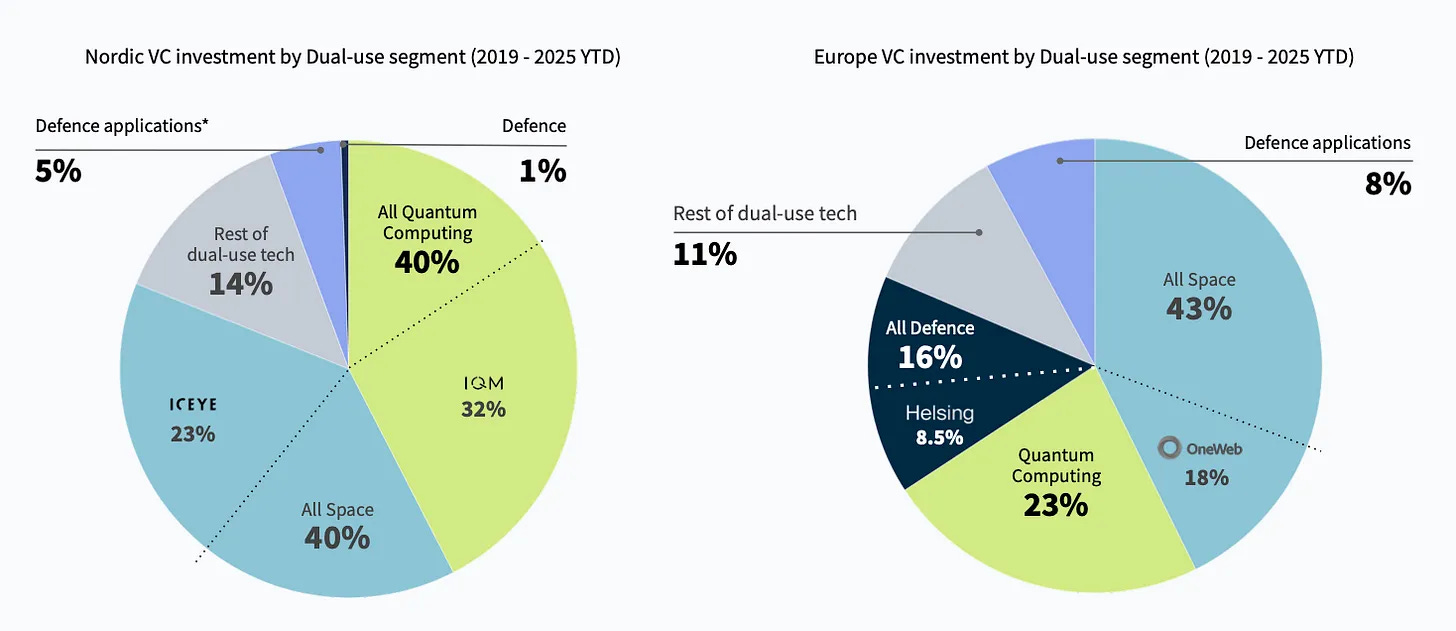
Look a little closer and a different story appears. Most of that private money is not going into what generals are actually asking for. Around 80 percent of VC funding since 2019 has gone into space and quantum, with only a thin slice going into core defence systems. The charts show the Nordics spending about 40 percent of dual-use VC on space and another 40 percent on quantum, while pure defence gets around 6 percent when you count defence and defence applications. Europe as a whole spends a much larger share on core defence technology such as weapons, sensors, and command systems.
658f3d51-e3a3-48e0-8993-e60e29a5c6b2_1468x636.png.webp

In other words, the Nordics are building satellites and quantum stacks while buying artillery shells and air defence from abroad. That is a strategic choice, but it is also a risk. Space and quantum are long-horizon bets. Ammunition, drones, and ground systems are what Ukraine burns through every day.
2b7b2dd8-6291-4464-b407-a0fd735d00bc_1038x704.png.webp

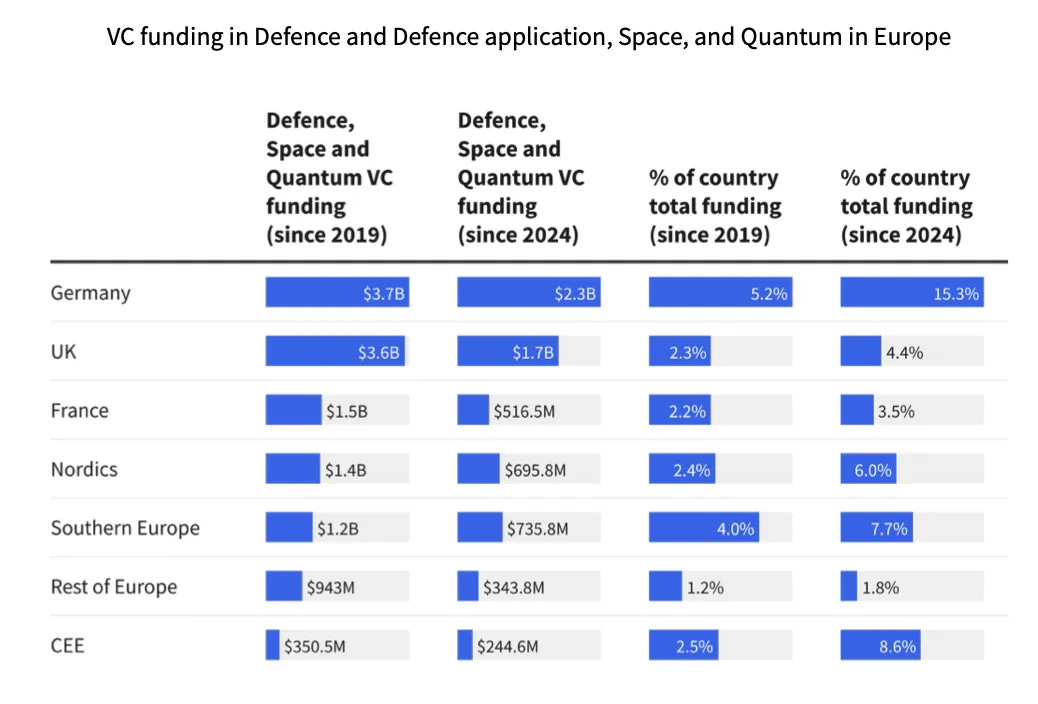
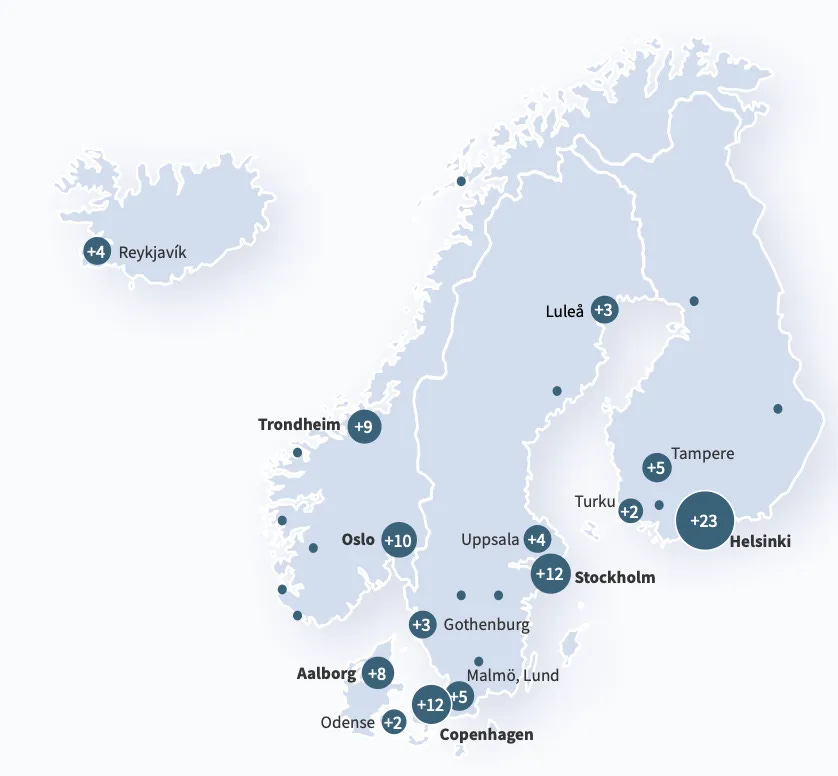
Per capita, the region looks strong. The Nordics now lead Europe on defence and dual-use VC per head, with Finland way out in front. Finland and Denmark also sit at the top of the European tables for quantum investment, and Finland has turned itself into a serious space player, with major rounds for firms such as ICEYE and IQM. The geographic spread is also telling. Helsinki, Stockholm, Copenhagen, Aalborg, Trondheim, and Oslo form the main cluster, with Aalborg and Odense in Denmark showing the pull of local universities and legacy defence industry.
a23630c5-0310-4a45-a9a9-3b42f53ef678_838x776.png.webp

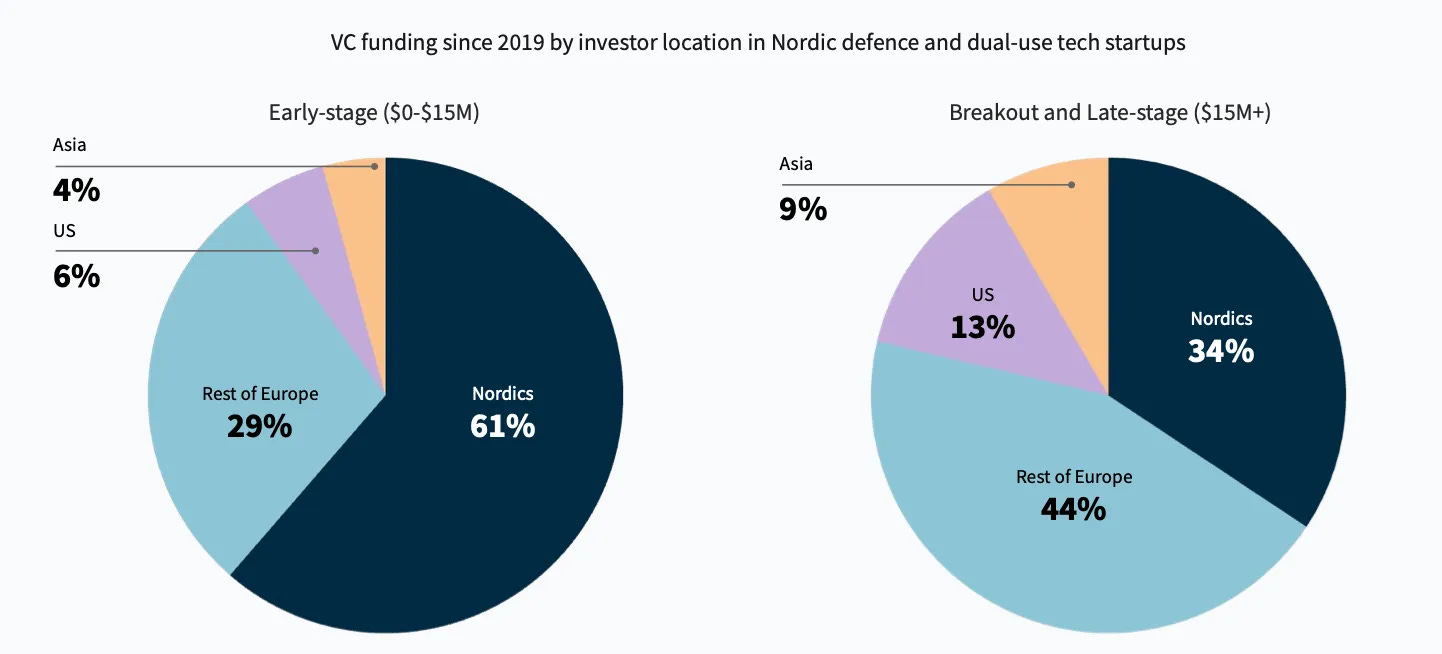
On the investor side, the report shows a clear shift. Nordic funds supply more than 60 percent of early-stage capital in the sector. Once rounds get larger than 15 million dollars, that share drops to about a third, and European and US funds move in. New specialist funds such as Final Frontier, T|Y|R, Varangians, and others are trying to change that, but they are young and still raising their own capital.
 

72b91db7-5e58-4de3-9a8b-5535591259ca_1442x654.png.webp

The trend lines are positive. Yet the structure of the market is still out of sync with the security debate in European capitals. If the Nordics want to be taken seriously as defence producers, not just as high-minded suppliers of quantum chips and satellite data, a larger share of private money will have to flow into hard military capability. That means munitions, counter-drone, air defence, and training systems that match NATO’s actual war plans, not only its strategy papers. That said, this report points to a surprisingly good start for a set of countries that are now waking up to real threats on their eastern borders.


Tags: NordicsReports
Previous Post

Rheinmetall and VR-maker Varjo team up to build low-cost, easy-to-deploy training simulators

Next Post

Terma buys UK-based OSL to sharpen European counter-drone coverage

John Biggs

John Biggs

John Biggs is an entrepreneur, consultant, writer, and maker. He spent fifteen years as an editor for Gizmodo, CrunchGear, and TechCrunch and has a deep background in hardware startups, 3D printing, and blockchain. His work has also appeared in Men’s Health, Wired, and the New York Times. He has written nine books including the best book on blogging, Bloggers Boot Camp, and a book about the most expensive timepiece ever made, Marie Antoinette’s Watch. He lives in Brooklyn, New York. He runs the Keep Going podcast, a podcast about failure. His goal is to share how even the most confident and successful people had to face adversity.

Related News

Estonia is setting up a new ‘rare drone’ tech testing lab to ease the European bottleneck

Estonia is setting up a new ‘rare drone’ tech testing lab to ease the European bottleneck

byFiona Alston
May 6, 2026

Estonia has unveiled plans for a new lab designed to test the next wave of defence technology, a facility that...

black and gray quadcopter drone

UK commits £46.5M to accelerate drones and air taxis while introducing national ID system

byCarly Page
May 5, 2026

The UK government has committed nearly £50 million to accelerate the deployment of drones and advanced air mobility systems, while...

Two Critical Frontiers: Maritime and Air Defence at Resilience Conference Copenhagen

Two Critical Frontiers: Maritime and Air Defence at Resilience Conference Copenhagen

byLeslie Hitchcock
May 5, 2026

As Europe’s security environment evolves, two domains are becoming increasingly central to how capability is built and deployed: maritime defence...

Occam raises €3M to advance autonomous drone systems

Europe greenlights defence tech funding in new Brave1 partnership

byLuke Smith
May 5, 2026

Brave1 has blazed a trail in Ukraine with a platform to source and back defence technology innovations, fast-tracking them to...

UK MoD tests British-built anti-Shahed system in Jordan

UK MoD tests British-built anti-Shahed system in Jordan

byJohn Biggs
May 5, 2026

The UK Ministry of Defence has tested its British-built Skyhammer interceptor missile system in Jordan, a trial that demonstrates the...

Waiv Robotics

Launching drones at sea has a landing problem. Waiv Robotics thinks it’s solved it.

byPaul Sawers
May 5, 2026

Operating drones offshore has long been constrained by one glaring issue: the landing surface refuses to stay still. Vessels move...

Spiral Hydrogen raises €2.7M to pilot its new hydrogen tech at the Port of Rotterdam

Spiral Hydrogen raises €2.7M to pilot its new hydrogen tech at the Port of Rotterdam

byFiona Alston
April 30, 2026

Estonian-Dutch dual-use startup Spiral Hydrogen will be taking its centrifugal bubble-free electrolysis technology from the lab to the Port of...

Report maps Russia’s hybrid war on Poland

Report maps Russia’s hybrid war on Poland

byJohn Biggs
April 30, 2026

A new report from Defence24 has outlined the role of Russia in a number of cyberattacks and acts of sabotage....

Load More
Next Post
Terma buys UK-based OSL to sharpen European counter-drone coverage

Terma buys UK-based OSL to sharpen European counter-drone coverage

NATO and Ukraine launch joint initiative to fast-track battlefield innovation

NATO and Ukraine launch joint initiative to fast-track battlefield innovation

Most viewed

InVeris announces fats Drone, an integrated, multi-party drone flight simulator

Uforce raises $50M at a $1B+ valuation to build defence tech for Ukraine

Auterion, the drone software startup, eyes raising $200M at a $1.2B+ valuation

Palantir and Ukraine’s Brave1 have built a new AI “Dataroom”

Senai exits stealth to help governments harness online video intelligence

Twentyfour Industries emerges from stealth with $11.8M for mass-produced drones

Resilience Media is an independent publication covering the future of defence, security, and resilience. Our reporting focuses on emerging technologies, strategic threats, and the growing role of startups and investors in the defence of democracy.

  • About
  • News
  • Resilence Conference
    • Resilience Conference Copenhagen 2026
    • Resilience Conference Warsaw 2026
    • Resilience Conference 2026
  • Guest Posts
  • Subscribe
  • Privacy Policy
  • Terms & Conditions

© 2026 Resilience Media

No Result
View All Result
  • Home
  • Subscribe
  • About
  • Events
  • Guest Posts
  • Interview
  • News
  • Resilience Conference London 2026
  • Resilience Conference Copenhagen 2026
  • Resilience Conference Warsaw 2026
  • Startups
  • Venture
  • Weekly Digest

© 2026 Resilience Media

This website uses cookies. By continuing to use this website you are giving consent to cookies being used. Visit our Privacy and Cookie Policy.