Sunday 3 May, 2026
[email protected]
Resilience Media
  • About
  • News
  • Resilience Conference
    • Resilience Conference Warsaw 2026
    • Resilience Conference Copenhagen 2026
    • Resilience Conference London 2026
  • Guest Posts
    • Author a Post
  • Subscribe
No Result
View All Result
  • About
  • News
  • Resilience Conference
    • Resilience Conference Warsaw 2026
    • Resilience Conference Copenhagen 2026
    • Resilience Conference London 2026
  • Guest Posts
    • Author a Post
  • Subscribe
No Result
View All Result
Resilience Media
No Result
View All Result

Uwe Horstmann Takes the Reins as Stark CEO

After months of speculation, the Berlin-based defence tech startup confirms that the founder of its seed investor Project A is in charge

Ingrid LundenbyIngrid Lunden
October 16, 2025
in News
Share on Linkedin

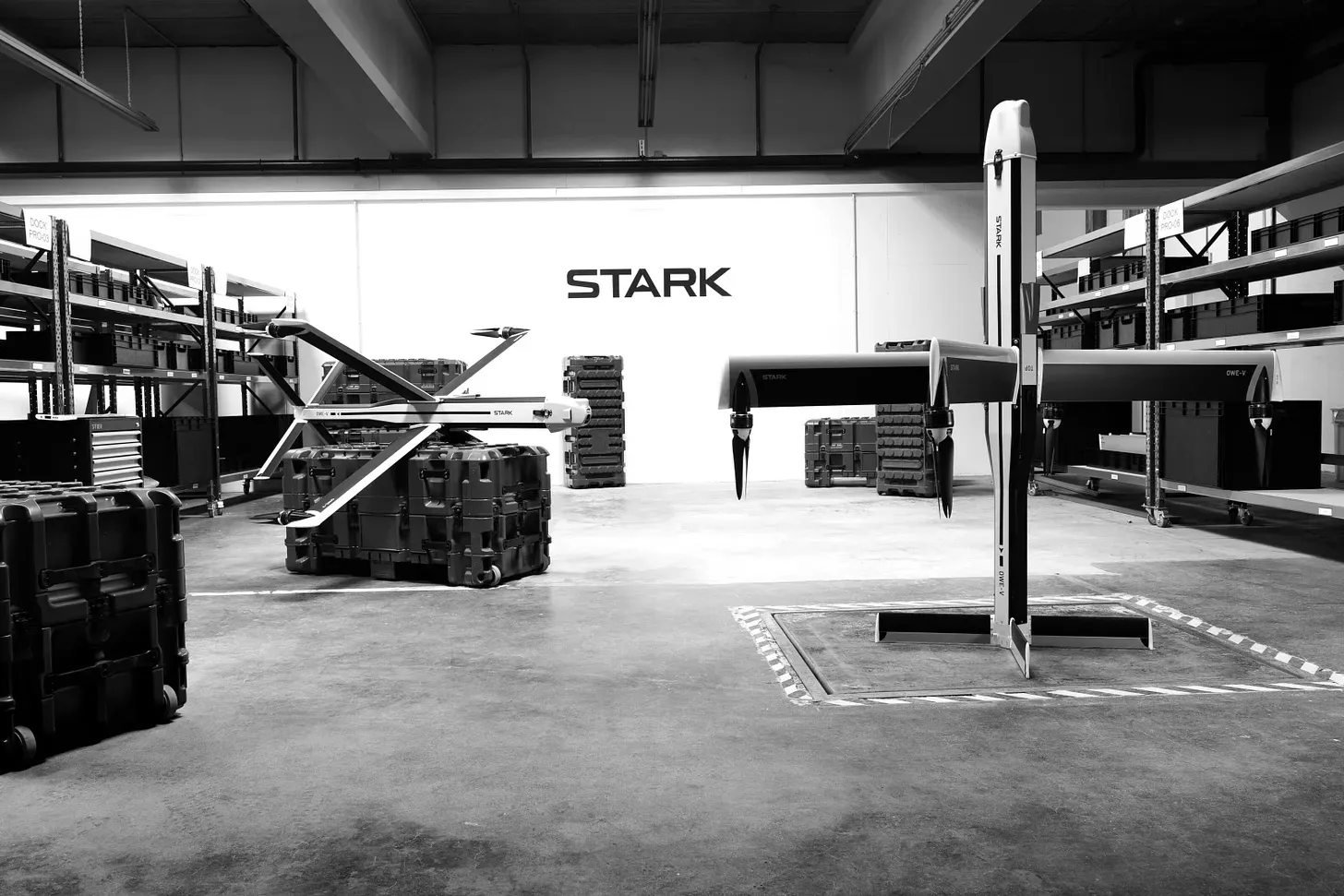
Stark — the Berlin-based producer of strike drones and related software that quietly raised $62 million earlier this year without a CEO on board — has finally announced an official head. Uwe Horstmann, the founder of defence VC Project A (one of the earliest investors in Stark), is now its CEO.

You Might Also Like

Spiral Hydrogen raises €2.7M to pilot its new hydrogen tech at the Port of Rotterdam

Report maps Russia’s hybrid war on Poland

Report: Europe’s reliance on imported energy and technology presents both risk and opportunity

Rumors of Horstmann taking the helm have been swirling since earlier this year; Stark declined to confirm or deny them to Resilience Media at the time.

Stark was founded by Florian Seibel, who is the CEO of another defence tech company, Quantum Systems. Seibel once said he founded Stark after the German government requested Quantum Systems to develop weaponised versions of its surveillance aircraft (outside the scope of Quantum Systems). Seibel was something of a de facto spokesperson for Stark prior to the $62 million fundraise. Notably, he is not mentioned at all in the announcement of Horstmann’s appointment.

Stark is using the news of Horstmann’s ascendancy to confirm some of its investors publicly for the first time: Sequoia, the NATO Innovation Fund, In-Q-Tel (the investment arm of the CIA) and Project A are all named as backers.

Investors not mentioned but previously confirmed to us by a source at the company include Thiel Capital, Döpfner Capital, and Joe Lonsdale’s firm 8VC. We’ve asked the company about this and will update as we learn more.

Stark’s rise is coming within a larger sea change in Europe. We are seeing a massive wave of defence and resilience-tech startups emerging in the region propelled by geopolitical forces and a rise of technological advancements in areas like artificial intelligence.

War in Europe; a change in how superpowers like the US want to engage in the region when it comes to defence and economic relationships; and the spectre of other superpowers like China are all forcing ministries of defence to rethink and expand their military capabilities. The imperative is to do so with new generations of more advanced weapons and systems to match (and exceed) the capabilities of adversaries.

“Advances in AI, decades of underinvestment, and a changing geopolitical landscape mean there is a clear, urgent ‘why now’ for a modern defence company in Europe,” Luciana Lixandru, a partner at Sequoia Capital, said in a statement.

In Europe in particular, the war in Ukraine has focused a lot of minds on how ready the region is to face a wider conflict. That is driving a lot of R&D, procurement and overall strategy.

Stark is very much a product of that. It has been around for less than two years, but in that time it’s picked up significant traction by positioning itself and its products in the eye of the storm.

That has included deploying Virtus, which it calls its flagship loitering munition, into Ukraine, where it’s been used in reconnaissance and strike missions. It’s also built Vanta, an unmanned surface vessel, that has yet to be deployed but has been publicly demonstrated, which is one step in that direction. Minerva, its command and control software, works across air, sea, and land, and it powers both Virtus and Vanta.

It’s also pitching itself as an acquirer and a company that is willing to bet capital on its focus: that has included investing in “thousands of warheads to ensure delivery of a fully certified

European loitering munition before 2027.” It’s also establishing a production facility in the UK.

“What STARK has achieved in just 18 months is only the beginning,” said Horstmann in a statement. “Europe’s security depends on those who can deliver and that’s exactly what STARK will continue to do.”

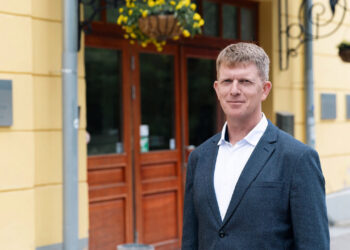
Uwe Horstmann (credit: Project A)

Horstmann has been a longtime figure in tech in Germany, but not in defence tech per se. He started his career in 2007 at Rocket Internet, the e-commerce startup incubator that initially gained a reputation as a “clone factory” for building dozens of companies on models forged first in the US (some of those were eventually acquired by their US counterparts; some became large companies in their own right).

He shifted to enterprise-related startups when he co-founded the seed investor Project A in 2012, investing in dozens of companies across categories like fintech, supply chain tech, and autonomous tech before taking a more focused turn to resilience and defence tech. Project A was one of the earliest investors in Stark.

Stark said that Horstmann, who is currently a partner at Project A, will continue to “remain active” in Project A’s investment activities, “ensuring STARK’s strong ties to Europe’s venture ecosystem.” We have also asked Stark and Horstmann what that means. At its most optimistic, there is potential for smaller companies to work within Stark’s ecosystem to get to market faster. However, it’s unclear how he and the companies will handle any potential conflicts of interest between those portfolio companies and Stark. We have asked the question and will update with any response we receive.

Tags: GermanyProject AStarkUwe Horstmann
Previous Post

NATO Turns to Oracle and Druid Software for Secure Battlefield 5G Connectivity

Next Post

From VC to CEO – Uwe Horstmann Takes Reins at Stark

Ingrid Lunden

Ingrid Lunden

Ingrid is an editor and writer. Born in Moscow, brought up in the U.S. and now based out of London, from February 2012 to May 2025, she worked at leading technology publication TechCrunch, initially as a writer and eventually as one of TechCrunch’s managing editors, leading the company’s international editorial operation and working as part of TechCrunch’s senior leadership team. She speaks Russian, French and Spanish and takes a keen interest in the intersection of technology with geopolitics.

Related News

Spiral Hydrogen raises €2.7M to pilot its new hydrogen tech at the Port of Rotterdam

Spiral Hydrogen raises €2.7M to pilot its new hydrogen tech at the Port of Rotterdam

byFiona Alston
April 30, 2026

Estonian-Dutch dual-use startup Spiral Hydrogen will be taking its centrifugal bubble-free electrolysis technology from the lab to the Port of...

Report maps Russia’s hybrid war on Poland

Report maps Russia’s hybrid war on Poland

byJohn Biggs
April 30, 2026

A new report from Defence24 has outlined the role of Russia in a number of cyberattacks and acts of sabotage....

Line illustration showing trucks, cars and a cyclist, alongside a wind turbine, solar panel, power lines, buildings and a data centre, depicting energy infrastructure

Report: Europe’s reliance on imported energy and technology presents both risk and opportunity

byPaul Sawers
April 29, 2026

Europe’s reliance on external technology and infrastructure faces growing scrutiny, as policymakers and industry leaders confront the risks of depending...

Weekly Digest: The mystery of the British unicorn – the story of our dealings with Roark Aerospace

Inside the case of Roark Aerospace: The British defence unicorn no one can verify

byIngrid Lunden
April 28, 2026

On Boxing Day 2025, we received a press release from Roark Aerospace. The UK startup, which makes anti-drone systems, reported...

German military uniform (Touko Aikioniemi from Unsplash)

Europe’s armed forces are too reliant on US cloud providers, report finds

byPaul Sawers
April 28, 2026

Europe’s defence systems depend heavily on US cloud infrastructure, leaving key military functions exposed to potential service disruptions during geopolitical...

UNIVITY raises €27 million to build a 5G satellite constellation that can expand European communication networks

UNIVITY raises €27 million to build a 5G satellite constellation that can expand European communication networks

byJohn Biggs
April 24, 2026

UNIVITY has raised €27 million to transition its space-based telecom infrastructure from a demonstration phase to an early industrial stage....

Jacek Siewiera: a future NATO conflict will be fought against civilian targets

Jacek Siewiera: a future NATO conflict will be fought against civilian targets

byResilience Media
April 24, 2026

The wars in Iran and Ukraine have underscored how civilian infrastructure will become a feature of future conflicts. And Poland’s...

Sten Tamkivi: Poland’s defence start-ups should be seen as future GDP drivers

Sten Tamkivi: Poland’s defence start-ups should be seen as future GDP drivers

byResilience Media
April 24, 2026

Sten Tamkivi, a partner at Plural and an early Skype executive, joined Resilience Media publisher Leslie Hitchcock on stage during...

Load More
Next Post
From VC to CEO – Uwe Horstmann Takes Reins at Stark

From VC to CEO – Uwe Horstmann Takes Reins at Stark

Face to Face with Mykhailo Fedorov: Ukraine’s Plan for AI on the Frontline

Face to Face with Mykhailo Fedorov: Ukraine’s Plan for AI on the Frontline

Most viewed

InVeris announces fats Drone, an integrated, multi-party drone flight simulator

Uforce raises $50M at a $1B+ valuation to build defence tech for Ukraine

Auterion, the drone software startup, eyes raising $200M at a $1.2B+ valuation

Palantir and Ukraine’s Brave1 have built a new AI “Dataroom”

Senai exits stealth to help governments harness online video intelligence

Twentyfour Industries emerges from stealth with $11.8M for mass-produced drones

Resilience Media is an independent publication covering the future of defence, security, and resilience. Our reporting focuses on emerging technologies, strategic threats, and the growing role of startups and investors in the defence of democracy.

  • About
  • News
  • Resilence Conference
    • Resilience Conference Copenhagen 2026
    • Resilience Conference Warsaw 2026
    • Resilience Conference 2026
  • Guest Posts
  • Subscribe
  • Privacy Policy
  • Terms & Conditions

© 2026 Resilience Media

No Result
View All Result
  • Home
  • Subscribe
  • About
  • Events
  • Guest Posts
  • Interview
  • News
  • Resilience Conference London 2026
  • Resilience Conference Copenhagen 2026
  • Resilience Conference Warsaw 2026
  • Startups
  • Venture
  • Weekly Digest

© 2026 Resilience Media

This website uses cookies. By continuing to use this website you are giving consent to cookies being used. Visit our Privacy and Cookie Policy.