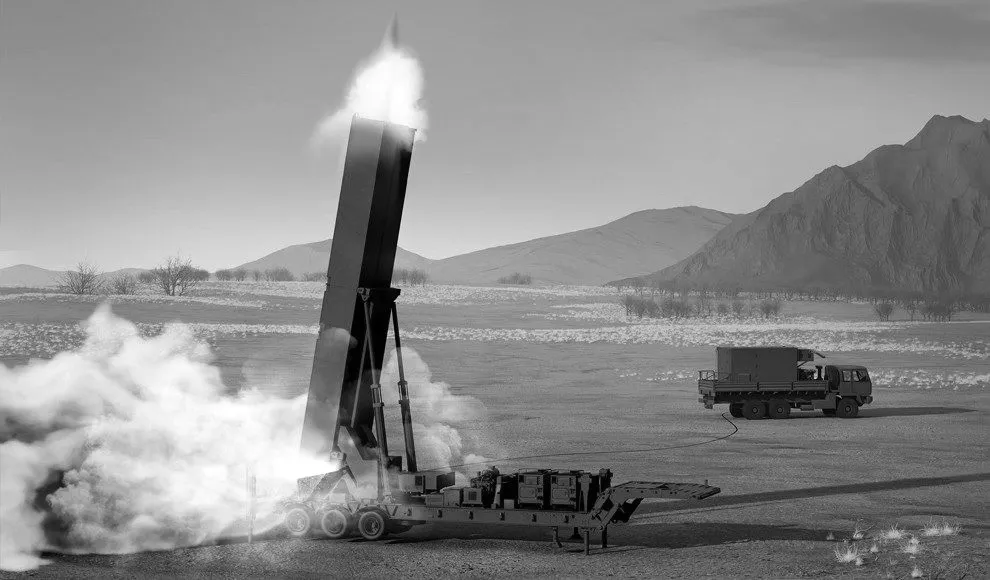
Hypersonic missiles – weapons that can travel and be manoeuvred within the atmosphere at 5X or more beyond the speed of sound (Mach 5 and higher) – have taken on a growing presence in the defence strategies of countries like China and Russia.
While there has been a healthy dose of skepticism about the technology due to cost and reliability, others think otherwise. The US is estimated to have poured some $10 billion into its hypersonic programme, and in the UK, observers are questioning whether the country should have its own hypersonic strategy in the form of missiles and interceptors against the hypersonic artillery of its adversaries.
UK deterrence against hypersonic missiles today is primarily addressed through nuclear weapon-armed Trident submarines. But adversaries’ successful deployment of hypersonic missiles on the battlefield raises concerns that the country is being left behind in a new arms race.
And crucially, hypersonic missiles can be armed with nuclear or conventional warheads, which adds a worrying dynamic to nuclear strategy.
Conservative backbench peer Lord Farmer raised concerns about the state of the UK’s hypersonic missile programme in the House of Lords in March, citing Russia and Iran using hypersonic weapons respectively in Ukraine and Iran.
“The IISS (International Institute for Strategic Studies) reported that integrated air and missile defence is an ‘ambition’ but ‘not the reality’ in Europe and that ‘the UK does not have the capability’ to defend against a concentrated intercontinental ballistic missile attack,” Farmer said.
The concern comes at a time when the UK military is under particular scrutiny in the wake of the war in Ukraine.
The House of Lords’ International Relations and Defence Committee produced a report a year ago, Ukraine: a Wake-up Call, which criticised overreliance on NATO partners for the UK’s defence. “[This] means our defences are ‘negligible’ and we urgently need to increase investment in integrated air and missile defence,” he added.
The report also described the UK’s air defence systems as “hollowed out,” which the peers deemed “deeply concerning.”
Ministry of Defence (MOD) Minister of State Lord Coaker however confirmed that hypersonic was indeed on the radar: “The Ministry of Defence, in collaboration with NATO allies, through AUKUS pillar 2 and with other international partners, is working on hypersonic and counter-hypersonic weapons programmes.
Government engages private sector on hypersonic missile and anti-missile research
A government source told Resilience Media that the MOD acknowledged that hypersonic capabilities exist currently in other countries and already pose a credible threat.
Investment in hypersonic capabilities by allies and adversaries, in addition to the early use of hypersonic missiles in current conflicts, are strong indicators that hypersonic missiles will continue to feature in future warfare, the source added.
Currently in the UK, the country’s Missile Defence Centre (MDC) commissions and delivers the Missile Defence Science and Technology programme, which undertakes research in all aspects of defending against ballistic and hypersonic missiles.
There are two key MOD procurement frameworks that let suppliers bid for contracts in either countering the threat of hypersonic weapons, or contributing to work which could lead to the building of a sovereign hypersonic missile capability.
The first of these, the framework for Science and Technology Oriented Research and Development in Missile Defence (STORM), manages the delivery of research covering activities to counter threats including hypersonic missiles.
The second, the £1 billion Hypersonic Technologies and Capability Development Framework (HTCDF), is intended to accelerate development of the UK’s hypersonic strike capability and to provide a route to market for future operational elements of hypersonic and adjacent technologies, the government source said.
The country has also had some recent breakthrough in research, with the government recently completing a hypersonic propulsion test in collaboration with industry and the US government. The MoD said that the system it’s developing could power a “cutting-edge hypersonic cruise missile concept.” The work included 233 test runs at a range of hypersonic speeds.
Hypersonic weapons likely to pose threat to deployed UK forces – researcher
While there some alignment about the potential threat around hypersonic weapons, what is the current threat for the UK?
According to Douglas Barrie, a senior fellow for Military Aerospace at IISS, the focus today is more on what the impact might be for deployed forces rather than UK territory itself. The hypersonic missile inventories of the UK’s adversaries pose a “limited potential threat at the moment in terms of homeland defence,” he told Resilience Media.
In these still-early days of hypersonic weapons, a range of weapons might be described as “hypersonic missiles,” he added.
“In terms of what is covered by the term ‘broad phrase hypersonic (Mach 5+) weapons’ – I’d include hypersonic boost glide systems, hypersonic cruise missiles and aero-ballistic missiles,” Barrie said.
An example of a hypersonic boost glide system is Russia’s Avangard RS-SS-19 mod 4 Stiletto. These are in production and have been tested but do not appear to have been used in live scenarios. In fact, no hypersonic cruise missiles are confirmed to be in service, but China is “aggressively pursuing this capability,” according to Barrie.
Aero-ballistic missiles include Russia’s Kinzhal RS-AS-24 Killjoy. Russia claimed its first use of a Kinzhal missile in March 2022, striking an underground Ukrainian arms depot, according to the BBC.
“Only a small number of the Russian Avangard missiles have been introduced into service as yet,” Barrie said. “These are more likely to have US targets as a priority.”
The Avangard has also been referred to as Project 4202 and Yu-74, and it has a range of more than 6,000 kilometres and can hit Mach 20 (6.8 km/s), according to the Centre for Strategic and International Studies’ Missile Threat Project.
As for who is making them, in Russia and China, hypersonic weapons have been designed and built by their state-controlled military-industrial complexes. Iran claims to have produced a hypersonic missile in the Fattah-2, but Western analysts cast doubt on this.
With the UK still in research and framework phase, in the west, US primes Lockheed Martin, Raytheon and Northrop Grumman are all producing hypersonics.
Startups in the space include Hermeus (which will be speaking at our upcoming Resilience Conference), Castelion (which reportedly is close to closing a $350 million round, after raising $100 million earlier this year), X-Bow (backed by Lockheed Martin and others), plus companies like Hypersonix, Hypersonica and Stratolaunch in the wider hypersonics ecosystem.
There are a range of sub-categories of hypersonic weapons, and there does not appear to be a wide proliferation of named designs within those categories.
On top of this, secrecy around the development of the missiles makes it difficult to approximate volumes of units produced, or even cost.
Lockheed Martin’s Dark Eagle, a long-range hypersonic weapon being developed for the US Army, is estimated to cost $41 million per unit. Others are being estimated, critically, at $100 million (versus $1 million for a cruise missile that can go the same distance). Even before the US has entered full-scale production of any hypersonic weapon programme, analysts estimate that it’s already poured $10 billion in the field.
Those who believe that hypersonics are part of the future are still bullish, despite the costs. “Mach 5-plus weapons… will likely be introduced more widely into service and as such should not be ignored,” said Barrie. “They will also pose a growing threat to any deployed UK forces.
“The UK has arguably underinvested in elements of air and missile defence for some considerable time,” he continued, “of which the capacity to engage hypersonic glide vehicles, cruise missiles or aero-ballistic missiles is part.”
He also told RM that the UK’s “ability to engage left of launch [prior to the threat system being launched] should be a core element of air and missile defence,” and said “very high speed weapons would be a useful tool in contributing to such a capability.”
Domestic hypersonic missile capability ‘beyond dreams of MOD’ – security advocate
There are plenty of ways that the hypersonics industry is being held back, say observers.
The Defence and Security Forum (DSF) is a think tank which engages with public and policymakers “to build a strong, stable, secure future,” according to its website.
DSF founder and president Lady Olga Maitland told Resilience Media that she doesn’t see hypersonic missile attacks against the UK happening any time soon, but she nevertheless believes the country should have the capability to fight back.
“This country has been woefully under-resourced on everything to do with missile defence and the idea of hypersonic missiles is quite beyond anybody in this country to even think about,” she said.
Maitland said that the defence establishment is not thinking about hypersonic missile defence “at all” but that they should be.
“The ghastly thing is that we’ve been cutting back on defense spending for decades. It’s not a recent thing, and the idea of having our own hypersonic missiles is beyond the dreams of the Ministry of Defence,” she said.
“I don’t see hypersonic missiles landing on our shores. I don’t see them descending on Buckingham Palace. But I do think we have to show that we have resilience and deterrence to fight back on every kind of attack.”
Industry group ADS, which represents 1,600 businesses aerospace, defence, security and space, notes a dearth of funding in the UK for startups working at the cutting edge of technologies like hypersonics.
Although the government is likely to make hypersonics a “key element” of the upcoming Defence Investment Plan, said a spokesperson for ADS, “the UK has been somewhat slow to develop homegrown hypersonic capability, and funding has not always been directed in a way that supports domestic innovation.”
That might not be helped by the very detail that is part and parcel of how the most innovative defence technology is developed, the spokesperson added.
“The true extent of these capabilities will always remain classified, ensuring they continue to serve as an effective and credible deterrent.”