100 investors to watch 2026 100 investors to watch 2026 100 investors to watch 2026
Monday 23 November, 2026
[email protected]
Resilience Media
  • News
    • Events
    • Interview
    • Startups
    • Venture
    • Weekly Digest
  • Resilience Conference
    • Resilience Conference London — Oct 2026
    • Resilience Conference Copenhagen — May 2026 (PAST)
    • Resilience Conference Warsaw — Apr 2026 (PAST)
  • Launch
  • About
  • Guest Posts
    • Author a Post
  • Subscribe
No Result
View All Result
Resilience Media
No Result
View All Result

Deterrence lies in production capacity and cognitive warfare

"NATO as an alliance is the ultimate entity for scaling in defence."

Resilience MediabyResilience Media
February 28, 2025
in Events, Interview, Resilience Conference
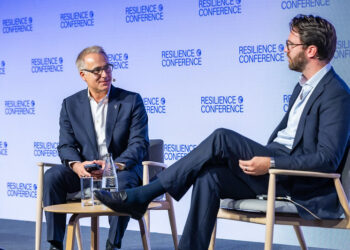
LtGen (ret.), Dr. Dennis Gyllenspore, Chairperson, NATO DIANA; Major General Edward Vaughan, Executive Director, Joint Rapid Acquisition Cell on stage in Munich. Photo credit MSC/Alexander Koerner

LtGen (ret.), Dr. Dennis Gyllenspore, Chairperson, NATO DIANA; Major General Edward Vaughan, Executive Director, Joint Rapid Acquisition Cell on stage in Munich. Photo credit MSC/Alexander Koerner

Share on Linkedin

The fireside chat, “Defence Production is the New Deterrence” featured LtGen (ret.), Dr. Dennis Gyllenspore, Chairperson, NATO DIANA; Major General Edward Vaughan, Executive Director, Joint Rapid Acquisition Cell. It was moderated by Colonel Glenn McCartan USMC, DIU Representative to U.S. European Command, Defense Innovation Unit. Excerpts from the full panel, which you can watch on our Youtube Channel, are below.

You Might Also Like

USIL Therapeutics passes initial NATO procurement assessment as it develops radiation exposure treatments

Michigan wants to turn its automotive manufacturing power into a defence industry advantage

Canada’s Dominion Dynamics is building a combat drone for the arctic

The Future of Defence Tech Manufacturing & Innovation, was presented by the US Defense Innovation Unit and Munich Security Conference Tech & Innovation Thursday, sponsored by Boston Consulting Group, and powered by Resilience Media.

Risk and Deterrence

Major General Edward Vaughan:

If we don’t invest in startups that are doing the things we need to be deterrent or to be victorious in war … who absorbs the risk of that lack of investment of that non decision? …On behalf of the population, the government absorbs that risk. So when there’s a lack of decision, lack of [venture capital] investment, they shift the risk to the government, but the risk becomes risk of attack, strategic risk, kinetic risk, however you want to characterise it. A government has the ability to reduce its strategic risk by reducing barriers to investment.

If on the other hand, a venture capital firm says we’re going to invest in this company, it’s very low TRL [Technology Readiness Level], they don’t have any sales yet by our metrics, it’s really a bad risk decision on our part, but we’re going to do it anyway. What just happened? That investment firm just took risk from the government and said we’re going to absorb some of that risk. We’re going to take risk from the population and the government. The risk of attack, we’re going to take that on and invest in deterring that attack.

LtGen (ret.), Dr. Dennis Gyllenspore:

Here’s a lesson for us from the government side, talking about regulation. We have a risk averse culture when it comes to procurement with the mindset that we will have all the requirements specified before we can enter into a contractual relationship with the company. But the world moves faster and technology moves faster. So we have to accept that some of the procurements that we are doing will not be successful. The gadget won’t work as intended, but that’s okay. Absence of success is not failure.

NATO and Defence Industry Evolution

Dr. Gyllenspore: I would argue that NATO as an alliance is the ultimate entity for scaling in defence. Remembering that the Article 5 stipulates that if one country’s being attacked, the other 31 will step in and help out. And that’s scalability at its very essence. … When it comes to the government side, NATO is doing quite a lot and has done so for many years in terms of standardisation, interoperability, multilateral programs for procurement to allow nations to procure at scale and also efficiently. And that will obviously continue. We have a procurement agency that could also help out on the procurement side. Having said that, there’s a lot more to be done.

DIANA and Department of Defense

General Vaughan on three things that have worked for the DoD with regard to manufacturing and scaling:

Multi-year procurement. Congress has authorised the DoD to do multi-year procurements that provide enough certainty to get over that valley of death of runway funding. The next one’s called ‘facilitisation’. What it means is that the government invests in your new facilities so that you can improve your infrastructure to help increase and scale production capacity to the next level. And the third one is investing in long lead time supply chain items. So if we know we’re going to ask you to do a million of these or 10,000 of these next year and we know that these are your [supply chain] bottlenecks, we can invest early in those [items] and have them ready for you.

Dr. Gyllenspore:

Ecosystems of innovation. What I see happening over the next five years is that we will be able to build a strong fabric of innovation, connecting what is now a couple of islands and making sure that there is connectivity so that we can be more agile. Because if we have a fundamental challenge now or in the future that we need to address, we need to come together much quicker. I mean, just to take an example, now we are struggling in alliance with subsea or undersea infrastructure, critical infrastructure that has been sabotaged and we need to find solutions. And that requires thinking input from various parts of the innovation ecosystem.

Build a much stronger culture of innovation. I think in many ways countries have a culture of innovation, but not in the defence area. And to bridge that gap now is a challenge and we need to be reaching out much more from the defence community to meet and engage with innovators. I think that DIANA is one of those vehicles that will help us.

Deliver capabilities. There are so many opportunities that stem from new technology and bright creative minds, sometimes overconfident, but that we need that.

Tags: Dennis GyllensporeEdward VaughanNATO DIANAResilience Conference
Previous Post

Western governments are not reacting to the threat of war quickly or clearly; will startups step in?

Next Post

Making the Case for a Defence, Security, and Resilience Bank

Resilience Media

Resilience Media

Start Ups. Security. Defense.

Related News

USIL Therapeutics passes initial NATO procurement assessment as it develops radiation exposure treatments

USIL Therapeutics passes initial NATO procurement assessment as it develops radiation exposure treatments

byJohn Biggs
November 20, 2026

Luxembourg-based USIL Therapeutics has passed the initial vendor registration assessment of the NATO Support and Procurement Agency (NSPA), giving the...

Michigan wants to turn its automotive manufacturing power into a defence industry advantage

Michigan wants to turn its automotive manufacturing power into a defence industry advantage

byJohn Biggs
November 20, 2026

  Michigan has spent decades building cars, trucks and industrial equipment. Now the state wants to use that manufacturing capacity...

Canada’s Dominion Dynamics is building a combat drone for the arctic

Canada’s Dominion Dynamics is building a combat drone for the arctic

byJohn Biggs
November 12, 2026

Canada's Arctic is cold. Temperatures can fall to minus 60 degrees, satellite communications are unreliable and much of the territory...

US-based XTEND wants to become the operating system for military robotics

US-based XTEND wants to become the operating system for military robotics

byJohn Biggs
November 11, 2026

Military drones are becoming cheaper, more capable and easier to manufacture. But as armies race to deploy hundreds of thousands...

Quantum Systems CFO discusses Ukraine partnerships

Quantum Systems CFO discusses Ukraine partnerships

byStanislaw Naklicki
November 5, 2026

Quantum Systems’ CFO Jonas Jarosch sat down with Jack Wang from Project A to discuss Quantum’s partnerships with the Ukrainian...

Europe’s defence tech industry is moving toward consolidation, say investors

Europe’s defence tech industry is moving toward consolidation, say investors

byStanislaw Naklicki
November 5, 2026

Lakestar’s Chris Magazzeni (pictured above, right) sat down with Resilience Media editor-in-chief Tobias Stone during our London conference in October,...

Following the US blueprint for building European defence tech 

Following the US blueprint for building European defence tech 

byStanislaw Naklicki
November 5, 2026

Europe lacks late-stage capital and government risk appetite for building defence-tech companies, agreed investors on the Resilience Conference stage in...

Vermeer’s Brian Streem tells the story of how he went from cinematography to building GPS-denied navigation for Ukraine

Vermeer’s Brian Streem tells the story of how he went from cinematography to building GPS-denied navigation for Ukraine

byStanislaw Naklickiand1 others
October 16, 2026

Going to film school might just get you running a drone software company. At least that’s what happened to Brian...

Load More
Next Post
Making the Case for a Defence, Security, and Resilience Bank

Making the Case for a Defence, Security, and Resilience Bank

Breaking New Ground: How AI-Driven Manufacturing is Transforming Defence

Breaking New Ground: How AI-Driven Manufacturing is Transforming Defence

Top stories

Tiberius says it’s successfully tested Sceptre munitions that behave like more costly missiles
European Defence

Tiberius, the munitions startup, becomes the latest defence tech unicorn, raising $85M at a $1B valuation

November 16, 2026
Atmos space cargo visual
European Defence

Atmos and MBDA link up to give Europe deep strike capability from space

November 18, 2026
OpenAI, facing a cybersecurity lawsuit in the US, is working with NATO… on cybersecurity
Cyber

OpenAI, facing a cybersecurity lawsuit in the US, is working with NATO… on cybersecurity

November 17, 2026
Satellites become a growing target for grey-zone warfare
News

ICEYE lights a rocket under its satellite business, offers €2.05B for launcher company Avio

November 17, 2026

Resilience Media is an independent publication covering the future of defence, security, and resilience. Our reporting focuses on emerging technologies, strategic threats, and the growing role of startups and investors in the defence of democracy.

  • About
  • News
  • Resilence Conference
    • Resilience Conference Copenhagen 2026
    • Resilience Conference Warsaw 2026
  • Guest Posts
  • Subscribe
  • Privacy Policy
  • Terms & Conditions
  • Mission Statement & Code of Practice
  • Press

© 2026 Resilience Media

No Result
View All Result
  • Home
  • About
  • Subscribe
  • Events
  • Guest Posts
  • Interview
  • News
  • Resilience Conference London 2026
  • Resilience Conference Copenhagen 2026
  • Resilience Conference Warsaw 2026

© 2026 Resilience Media

This website uses cookies. By continuing to use this website you are giving consent to cookies being used. Visit our Privacy and Cookie Policy.