Monday 8 June, 2026
[email protected]
Resilience Media
  • News
    • Events
    • Interview
    • Startups
    • Venture
    • Weekly Digest
  • Resilience Conference
    • Resilience Conference Warsaw 2026
    • Resilience Conference Copenhagen 2026
    • Resilience Conference London 2026
  • About
  • Guest Posts
    • Author a Post
  • Subscribe
No Result
View All Result
  • News
    • Events
    • Interview
    • Startups
    • Venture
    • Weekly Digest
  • Resilience Conference
    • Resilience Conference Warsaw 2026
    • Resilience Conference Copenhagen 2026
    • Resilience Conference London 2026
  • About
  • Guest Posts
    • Author a Post
  • Subscribe
No Result
View All Result
Resilience Media
No Result
View All Result

Atmos Space Cargo raises $30M to help get to space and back

The German startup is setting up digs in Poland to hone its focus on defence and military applications alongside existing verticals

Ingrid LundenbyIngrid Lunden
April 22, 2026
in News
Share on Linkedin

Atmos Space Cargo, a German startup building systems to transport assets to space and then return them for use and reuse, has closed a Series A of €25.7 million ($30.2 million).

You Might Also Like

Ofcom examines whether telecoms security rules are slowing adoption of AI cyber defences

Middle powers in the age of Anthropic’s Mythos

Swiss startup Custodia launches offline AI appliance for sensitive workloads

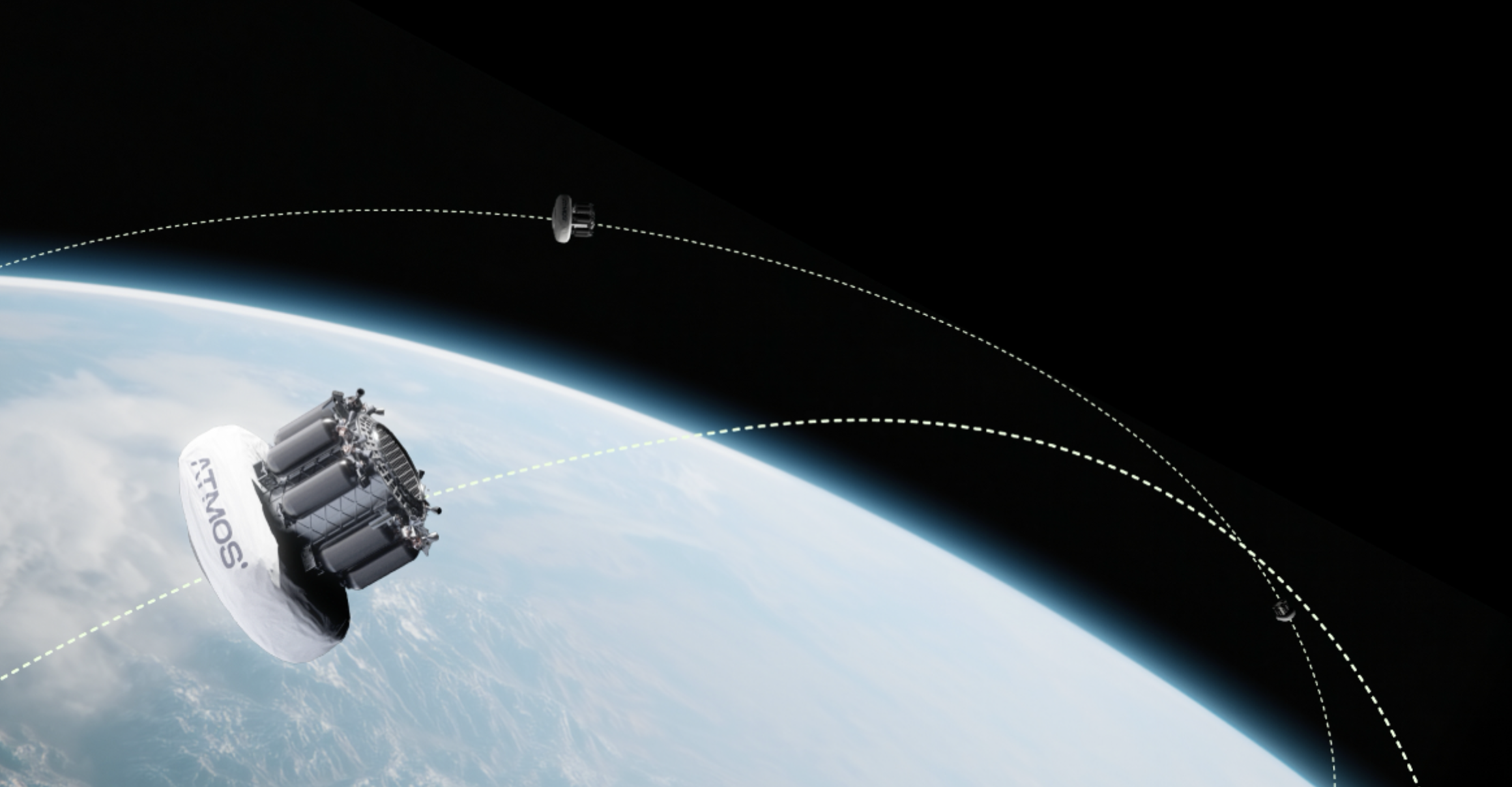
The system, which includes both hardware and software, is designed to stay in Low Earth Orbit for as little as several hours to as long as several months before autonomously returning to earth. The technology can support research and applications in life sciences and biotechnology, materials development, and military use. 

The funding comes on at the same time that Atmos is expanding, opening an office in Poland specifically to hone its defence tech capabilities. In the current geopolitical climate, space has become an increasingly important domain alongside air, land and sea, precisely for the unique capabilities that it affords.

“When you’re in space, you can pretty much reach any place on earth within 60 minutes,” Sebastian Klaus, Atmos’s founder and CEO, said on stage last week at the Resilience Conference in Warsaw. The company has not disclosed the names of customers to date.

Atmos said that the funds will be used in part for continued development of a three vehicle fleet using its current system, the Phoenix 2, for a launch in 2027; launching Atmos Works for government and defence customers; and R&D for the next generation of its system, Phoenix 3.

Balnord and Expansion, VCs with roots in Poland, are co-leading this round with participation also from Keen Defence and Security. Prior to this round, the company had raised around $20 million in seed, pre-seed and grant funding, per data in PitchBook.

Sources tell Resilience Media that the valuation of the company with this round is in the region of €100 million ($117 million).

Atmos spacecraft uses inflatable decelerators that look a little like round rafts. The technology was originally developed by NASA in the US, and it has been refined by the startup for its purposes. Atmos is “the very first company in Europe to use this type of technology,” said Klaus, noting that Atmos has made the tech “more scalable, even more lightweight and therefore more cost efficient than what NASA is doing.”

The material and design of the decelerators are meant to help preserve its payloads during re-entry so that they can be re-used in future.

Atmos is still very much an early-stage startup. The company has to date only had one launch into space — ridesharing on a SpaceX rocket to gather research data to develop its commercial product a year ago.

That launch — almost a year ago to today — was declared a success, although it wasn’t able to fill out the full intent of the mission after SpaceX altered the course of its launch at the last minute, which led to Atmos’s own hardware returning to one ocean instead of another. 

The company plans several more launches in the coming years while it also continues to develop further technology. This will include both its own home-grown support for defence applications, which can include strike capacity and other rapid response capabilities. This work is currently on a 2-3 year timeline, Klaus said in Warsaw, adding that what ultimately gets deployed will be a question for defence ministries, not Atmos. 

But space development is expensive, highly technical, and in some areas still to be proven viable. 

Aleksander Dobrzyniecki, a partner at Balnord, noted that space startups need patient and committed investors as a result.

“It’s very important to have alignment between the founding team and the investor base,” he said on the panel in Warsaw last week.

That complexity also leads a lot of space tech companies to collaborate on solutions, both to bring down their own costs and those of would-be customers. Atmos’s partners have included Space Cargo Unlimited, propulsion specialist ISPTech, and the US company Voyager, whose European division, Voyager Europe, is Atmos’ integration and implementation partner, with Atmos in turn providing its free-flying orbital vehicles to Voyager. 

These partnerships also extend to sales, with both companies intending to “mutually refer customers and mission opportunities across their networks.” It’s notable that Voyager is a public US company that has raised money specifically for M&A, to act as a consolidator across the space tech landscape. In Warsaw, Klaus categorically ruled out an acquisition by any American companies and emphasised sovereign European solutions for the space domain.

“It’s extremely important that we develop our own space transportation capabilities,” he said.

Others in this round include the European Innovation Council (EIC) by way of its accelerator programme, OTB Ventures, High-Tech Gründerfonds (HTGF), APEX Ventures, Seraphim, Faber, E2MC, Kirch Ventures, Lennertz & Co., Mätch VC, MBG Baden-Württemberg, and Tech Horizons.

Tags: Atmos Space CargoBalnorddefence techExpeditionsGermanyOTB VenturesPolandspace
Previous Post

Anduril taps UK’s Kraken to fast-track small USVs into US Navy hybrid fleet push

Next Post

Tiberius says it’s successfully tested Sceptre munitions that behave like more costly missiles

Ingrid Lunden

Ingrid Lunden

Ingrid is an editor and writer. Born in Moscow, brought up in the U.S. and now based out of London, from February 2012 to May 2025, she worked at leading technology publication TechCrunch, initially as a writer and eventually as one of TechCrunch’s managing editors, leading the company’s international editorial operation and working as part of TechCrunch’s senior leadership team. She speaks Russian, French and Spanish and takes a keen interest in the intersection of technology with geopolitics.

Related News

a group of cell towers sitting under a cloudy blue sky

Ofcom examines whether telecoms security rules are slowing adoption of AI cyber defences

byCarly Page
June 4, 2026

Ofcom has launched a review into whether existing telecoms security rules are making it harder for operators to adopt AI-driven...

Colorful software or web code on a computer monitor

Middle powers in the age of Anthropic’s Mythos

byPaddy Stephens
June 4, 2026

As AI rapidly develops, many are facing a tougher job market – and not just entry-level software engineers. International prize-winning...

Custodia co-founder Thomas Brooks

Swiss startup Custodia launches offline AI appliance for sensitive workloads

byCarly Page
June 4, 2026

A Swiss startup is betting that growing concerns around AI privacy, data sovereignty, and cloud dependence have created a market...

gray concrete building under white sky during daytime

AI to cement the future of industry

byIngrid Lunden
June 3, 2026

A UK startup called Gigaton has built an AI platform to optimise how cement is manufactured, cutting costs and carbon...

Taiwan’s drone dream, deferred by Chinese nationalists

Taiwan’s drone dream, deferred by Chinese nationalists

byChris Horton
June 2, 2026

Taiwan is deeply divided when it comes to facing up to China. It has turned the island's defence strategy into...

Oko Camera announces new Ukrainian-made thermal imager for drone systems

Oko Camera announces new Ukrainian-made thermal imager for drone systems

byJohn Biggs
June 1, 2026

Oko Camera has launched a new thermal imaging series aimed at the growing demand for AI-enabled autonomous systems on the...

Estonia deploys first anti-drone systems on Russian border

Estonia deploys first anti-drone systems on Russian border

byJohn Biggs
June 1, 2026

  Estonia has begun deploying its first fixed drone detection and monitoring systems along its Russian border as the Baltic...

Helsing launches Area 9 research unit and unveils European robotics platform

Helsing launches Area 9 research unit and unveils European robotics platform

byCarly Page
June 1, 2026

Helsing has launched a new advanced research division and unveiled its first European-built robotics research platform as the defence AI...

Load More
Next Post
Tiberius says it’s successfully tested Sceptre munitions that behave like more costly missiles

Tiberius says it's successfully tested Sceptre munitions that behave like more costly missiles

black drone during daytime

In the era of precise mass, FPVs are outgrowing the pilot

Most viewed

InVeris announces fats Drone, an integrated, multi-party drone flight simulator

Uforce raises $50M at a $1B+ valuation to build defence tech for Ukraine

Auterion, the drone software startup, eyes raising $200M at a $1.2B+ valuation

Palantir and Ukraine’s Brave1 have built a new AI “Dataroom”

Twentyfour Industries emerges from stealth with $11.8M for mass-produced drones

Senai exits stealth to help governments harness online video intelligence

Resilience Media is an independent publication covering the future of defence, security, and resilience. Our reporting focuses on emerging technologies, strategic threats, and the growing role of startups and investors in the defence of democracy.

  • About
  • News
  • Resilence Conference
    • Resilience Conference Copenhagen 2026
    • Resilience Conference Warsaw 2026
    • Resilience Conference 2026
  • Guest Posts
  • Subscribe
  • Privacy Policy
  • Terms & Conditions
  • Mission Statement & Code of Practice
  • Press

© 2026 Resilience Media

No Result
View All Result
  • Home
  • About
  • Subscribe
  • Events
  • Guest Posts
  • Interview
  • News
  • Resilience Conference London 2026
  • Resilience Conference Copenhagen 2026
  • Resilience Conference Warsaw 2026

© 2026 Resilience Media

This website uses cookies. By continuing to use this website you are giving consent to cookies being used. Visit our Privacy and Cookie Policy.