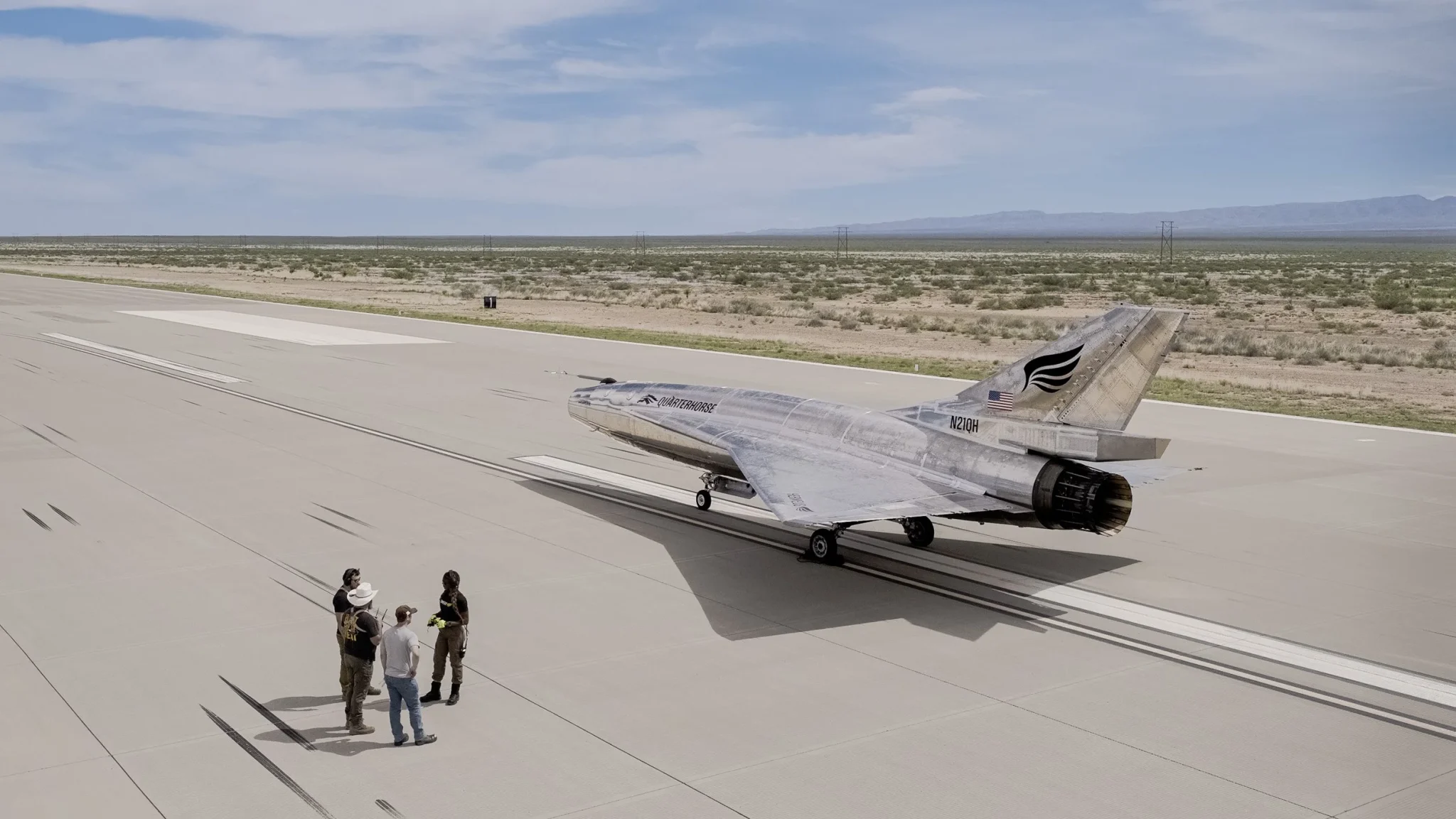
Atlanta-based Hermeus announced that its Quarterhorse Mk 2.1 experimental aircraft has completed its first supersonic flight, reaching Mach 1.21 during a test over New Mexico’s White Sands Missile Range.
The achievement came during just the aircraft’s third flight. The pace is notable in an industry where flight test programs often stretch across years rather than months.
Hermeus secured regulatory approval from the Federal Aviation Administration for up to seven tests in 2026. This is the company’s third this year. Its first two flights, conducted earlier this year, remained below the speed of sound.
“This flight demonstrates a pace of execution that is extremely rare in modern aviation,” said AJ Piplica, CEO and Co-founder of Hermeus. “Our country’s ability to deliver new asymmetric military capability at scale depends on teams that can solve hard technical challenges quickly. That’s exactly what we’re proving with each test flight we conduct and each new aircraft we build at Hermeus.”
The company has built its strategy around rapid iteration. Rather than spending a decade developing a single aircraft, Hermeus is producing a series of increasingly capable Quarterhorse variants. The Mk 2.1 has now demonstrated supersonic flight. The upcoming Mk 2.2 and Mk 2.3 aircraft are expected to push deeper into the high-Mach regime while validating systems needed for future hypersonic operations.
The company sees the Quarterhorse program as a stepping stone toward something much more ambitious: a reusable hypersonic aircraft capable of flying at Mach 5 and beyond.
The Pentagon and defence industry have spent years searching for practical hypersonic systems. Most current programs focus on missiles and one-time-use weapons. Hermeus is pursuing a different path. Quarterhorse is designed to take off and land under its own power, creating a reusable platform that could eventually support reconnaissance, strike, logistics, or testing missions. Because it is the equivalent of a hypersonic drone, it can be deployed on the battlefield and treated like any other UAV, complete with a human remote pilot.
The Quarterhorse is currently powered by a Pratt & Whitney F100 engine, but the company is building out Chimera, a turbine-based combined cycle system that adds a ramjet engine to the F100. This will allow for more range and speed during flight. The company estimates that future iterations could fly at Mach 5 or higher.
The company is not alone in the race. Competitor Stratolaunch has already completed multiple hypersonic flights with its reusable Talon-A vehicle. But the two approaches differ. Talon-A is carried by a “mothership” aircraft before being released, while the Quarterhorse is a fully independent aircraft capable of uncrewed takeoff and landing.
Military planners increasingly want reusable systems that can operate repeatedly without requiring specialized launch infrastructure. A hypersonic aircraft that can launch from a runway, complete a mission, and return for rapid reuse would represent a major shift from today’s expendable missile-based designs.