It’s a Sunday afternoon on the campus of Singapore’s national university, and Richard Xiong, chief pitchman for a startup that didn’t exist 47 hours ago, is struggling to memorise his lines.
“Here’s a thought,” he says. “The most dangerous place in the world is a doorway. Imagine this. We’re on a mission, six men, one floor to clear, and one robot to help you. Today, the whole section halts and… wait, restart restart restart restart.”
A generation ago, Xiong — tall, cocky, and fluent in both computer and human language — might have been pitching an e-commerce or ride-sharing app.
But times have changed. Xiong has come of age amidst Russian invasions, backlash against social media, and the rise of charismatic defence contractors like Anduril CEO Palmer Luckey. All of which have shifted the aspirations of young entrepreneurs away from software that makes life easier, and toward hardware that can end it.
So today, in a nondescript conference room with AI-generated graphics playing behind him, Xiong asks me to imagine a scenario in urban warfare.
The setting could be Iraq 20 years ago or Caracas this past January. The scene is this: a group of soldiers must clear a building floor of enemy combatants. Danger could be anywhere, and they don’t know what’s lurking in the next room. They send an unmanned ground vehicle, or UGV, around the corner for recon.
But there’s a problem: to steer the vehicle, one of the soldiers has to drop his weapon, grab a remote controller, then pick the weapon back up again.
“It’s slow, it’s dangerous, and the intel is stale,” Xiong says. “So we asked: What if the operator never has to put the rifle down?”
Xiong is preparing to compete in a type of contest that, just like his new startup, hasn’t existed for very long. Hackathons — where coders drink Red Bull, stay up all night, and race to see who can build the best code the fastest — have long been a staple of tech culture. In their prime, they awarded prizes in the six or seven figures and spawned unicorn startups.
But it wasn’t until 2024 that a defence-focused version started to catch on. Blindsided by the speed of weapons innovation on battlefields from Ukraine to the Middle East, governments were desperate for cheap, innovative solutions to the new problems of drone warfare. Young coders, eager to direct their engineering savvy toward a higher purpose, offered a readymade pool of human talent. Thus the defence tech hackathon was born.
AI has eliminated the need for sleepless nights spent debugging code. What matters is having a good idea and knowing how to sell it. The Steve Wozniacks of this world aren’t merely less famous than Steve Jobs. They might not be necessary at all.
In Europe, these events owe their rise in large part to the efforts of Benjamin Wolba, a former venture capitalist who organised his first defence tech hackathon (and maybe the first defence tech hackathon ever) in June 2024.
Two years later, Wolba’s events and others like it have gotten so big that, instead of starting from scratch each time, some entrepreneurs go from hackathon to hackathon, steadily building their company in a string of coding sprints.
The inaugural Singapore Defense Tech Hackathon, which Wolba helped organise last month, hewed more closely to the activity’s original spirit.
Few of the hackers had met before. Fewer still had ever run a company. Many were college students. Teams were given a week to discuss their ideas remotely, then two days to execute it. At 1:45 p.m. on Friday, hackers were let loose across two floors of the National University Singapore business school. On Sunday at 1 p.m., they reconvened, pitching their ideas for three minutes per team in front of a judging panel that included Major-General Kelvin Fan, chief of the Republic of Singapore Air Force.
All-nighters have traditionally been a hackathon rite of passage. And I did encounter one young man outside the entrance on day two, so exhausted that he had fallen asleep right there on the sidewalk.
But for the most part, AI has eliminated the need for sleepless nights spent debugging code. Even the PowerPoints virtually write themselves these days. What matters is having a good idea and knowing how to sell it. The Steve Wozniacks of this world aren’t merely less famous than Steve Jobs. They might not be necessary at all.
Xiong came off the stage on Sunday afternoon feeling flustered. With just a few seconds left in his presentation, he had forgotten to deliver NeuroMech’s signature line: “Hands on the weapon. Mind on the machine.”
Next to the judges sat a man raising up a color-coded sign every time the pitch clock passed a new threshold. Xiong said it threw him off.
“I was like, ‘Oh my God, I have one minute,’” he said afterward. “And I was like, ‘Oh, shit!’” But he soon regained his swagger. This was his fifth hackathon, Xiong reminded me. He’d pitched a different idea at each of the previous four, and each time, he’d won.
Xiong knew his teammate, Jackie Tan, from one of those past events. Tan is older than the others, and he has a couple of startup exits under his belt.
 In 2018, a platform Tan created to connect customers with financial advisors landed him on Forbes’ 30 Under 30 list for Asia. More recently, he’s been building a brain-computer interface company, which he hopes can help the disabled.
“The idea is to turn thoughts into text and action,” he said. Tan’s main equipment is a research-grade electrode cap that detects brainwaves through the skull. He figured they could come up with a military application for the device, but the team’s first idea was a flop.
“Basically, like, scheduling different robot feeds into multiple operators, so that one operator can operate as many robots as he wants, and then using the brain control device to measure how much stress he’s under,” Xiong explained. “But then, that wasn’t a very good idea.”
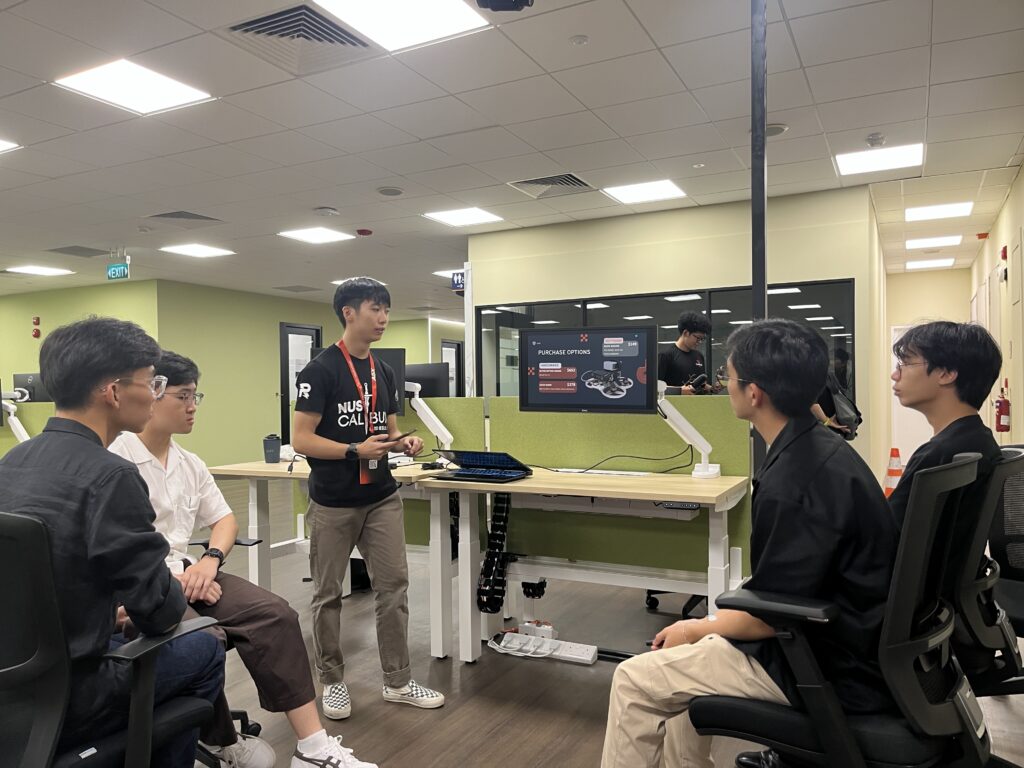
The turning point came when Tan showed the electrode cap to Jeremy Yee, a commanding officer in Singapore’s army who had agreed to serve as a mentor for the project.
According to Yee, the chemistry between the two was immediate. He told Tan that Singapore’s military used a lot of unmanned systems, including ground vehicles, but they all required handheld controls.
“If we can use such technology to keep it hands free,” Yee said, “to be able to command a UGV [for] a certain operation set will help us reduce the loading for operators and teams.” But to impress the judges, Yee told them, they couldn’t just simulate the technology. They would actually have to build a model of the UGV, and prove they could control it with Tan’s mind.
A few hours after the hackathon started, as Tan, Xiong, and the rest of their team got together to make Yee’s idea a reality, I sat down with Wolba.
The Ukraine nudge
Wolba speaks with an intensity well-suited to the events he promotes. He told me that he first thought of the concept of a defence tech hackathon in February 2024.
At the time, he was an entrepreneurial physics PhD on a journey of soul-searching when he came across a video of guys playing with drones in Southern California.
“They’re building drones, shooting down drones, and it just seemed exciting,” he said. “Like a young boy would watch a toy car thinking, ‘Yeah, that’s cool.’”
Wolba, who was on a pilgrimage to Silicon Valley at the time, messaged his friend Jonathan Luther-Bergquist, a Swedish venture capitalist and fellow physics PhD, and suggested they try organising their own event. At the time, he remembers, it was a total lark: “Like, ‘Hi, you know, one weekend we should drive a Ferrari, right?’”
Back in Germany, where Wolba is from, defence hackathons didn’t exist at that point.
The European Union was sending massive shipments of weaponry to Ukraine. But anything resembling militarism on home turf still met with strong resistance, especially among young people.
“In 2024, there were a lot of student associations who were still like, ‘Ah, defence, you know, I’d rather have nothing to do with that,’” Wolba said.
One person who did show interest was Rob Fink, CTO of Helsing. The company, which started with drones, was already well on its way to becoming Europe’s biggest defence tech startup. (Later that year, Helsing would announce $485 million in funding at a $5.4 billion valuation; it’s valued at $18 billion as of October 2026.)
With Fink’s backing, Wolba and Luther-Bergquist convinced a few other companies to sponsor them. Ukraine’s Ministry of Defence pitched in with materials to make the coding challenges more realistic. And in June 2024, Wolba and Luther-Bergquist put on their first event in Munich. 150 people showed up.
By the end of the year, defence tech hackathons were becoming a phenomenon. Wolba had been all over Europe, a travelling evangelist for a new approach to the weapons industry.
He attended a Resilience Conference in London. He took a bus to Kyiv to make contacts.
Then, in November, Donald Trump was reelected. Here was the man who had courted Putin and called NATO obsolete. Trump’s return to the White House drove European anxieties to a new high, setting off what Wolba calls the “hype train” for defence tech.
In 2025, the European Defence Tech Hub – the organisation that Wolba and Luther-Bergquist founded alongside that first hackathon in Munich – hosted 20 hackathons. Venture capitalists started showing up. So too did Russian spies. This year, EDTH is on track for more than 40 hackathons, with co-sponsored gatherings all over the world.
The Switzerland of Asia?
Singapore wasn’t the most obvious site for one of Wolba’s events. Of the four Asian countries where he’s holding events this fall, it ranks by far the lowest on Freedom House’s world freedom index, just below Kenya.
Democracy or not, Singapore is a conservative society: parents of talented students tend to push them toward a career in finance or government, not entrepreneurship. And relative to Taiwan, Japan, and South Korea — Wolba’s other stops — Singapore faces fewer immediate security threats. One thing it does have in common with those countries, however, is a historic reliance on American weapons.
Singapore would like to fashion itself as the Switzerland of Asia: a friend to all but a true friend to none. As far as harmonious havens for foreign wealth are concerned, it’s not a bad analogy.
But Singapore lacks the mountainous geography that made Switzerland’s pacifism possible. In World War II, the city’s airfields played host to the British Royal Air Force, who used them to launch bombing raids against the Japanese. Today, those same airfields house F-35s, a conspicuous reminder of Singapore’s continued reliance on the United States, even as its government keeps friendly ties with Beijing.
It’s the sort of balancing act that allowed the national university to host a Silicon Valley venture capitalist, a Tel Aviv tech veteran, and a Shenzhen administrator on a single stage during the conference last month. Someday soon, Singapore may have to choose. For now, like a lot of countries, it’s figuring out how to survive in a world of diminishing American leadership.
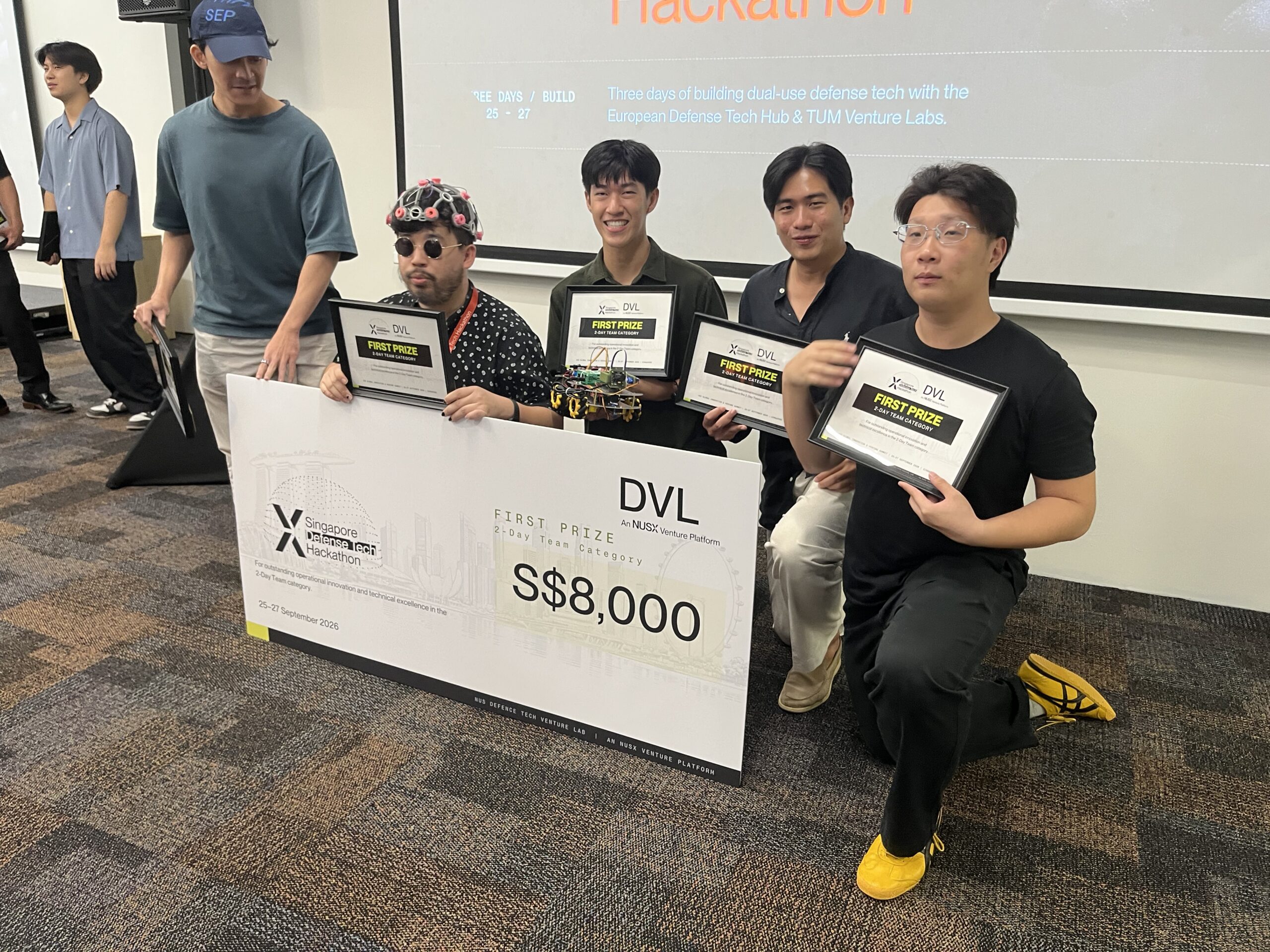
When I caught up with Xiong after the awards ceremony, he was posing for pictures with his teammates behind an S$8,000 (about US$6,200) check.
Tan wore his electrode cap, a pair of John Lennon shades, and a wide grin. They had taken first prize. Xiong’s pitch wasn’t flawless, but the product demo was. With Xiong addressing the audience, Tan sat off to the side, staring at a screen with four blinking lights.
Up, down, left, right. When he looked at one of the lights, his cap picked up on neural activation in his occipital lobe, sending a signal through his computer to their mini UGV prototype. The little vehicle buzzed around the floor, to the delight of the audience. No hands were involved.
Fan, the Air Force Major-General who helped judge NeuroMech’s presentation, told me their idea was “fantastic.”
“Beyond what they demonstrated, using brain waves to control an unmanned ground vehicle, if you use brain waves to control many other things, I think the potential applicability is actually unlimited,” he said.
Wolba was similarly impressed. “I come to Singapore, it’s like traveling to the future,” he said. “People talk about the singularity and Q-day for quantum… You get a lot of the eye fluff, but you also get really advanced projects.”
When I asked Xiong what NeuroMech planned to do with their prize money, he shrugged. “It’s $8,000 in the game,” he said. “It’s like, I’m in it just for the competition, you know?”