
100 investors to watch 2026 100 investors to watch 2026 100 investors to watch 2026
Tuesday 13 October, 2026
[email protected]
Resilience Media
  • News
    • Events
    • Interview
    • Startups
    • Venture
    • Weekly Digest
  • Resilience Conference
    • Resilience Conference London — Oct 2026
    • Resilience Conference Copenhagen — May 2026 (PAST)
    • Resilience Conference Warsaw — Apr 2026 (PAST)
  • Launch
  • About
  • Guest Posts
    • Author a Post
  • Subscribe
No Result
View All Result
  • News
    • Events
    • Interview
    • Startups
    • Venture
    • Weekly Digest
  • Resilience Conference
    • Resilience Conference London — Oct 2026
    • Resilience Conference Copenhagen — May 2026 (PAST)
    • Resilience Conference Warsaw — Apr 2026 (PAST)
  • Launch
  • About
  • Guest Posts
    • Author a Post
  • Subscribe
No Result
View All Result
Resilience Media
No Result
View All Result

At Washington’s premiere defence show the primes rule the roost

John BiggsbyJohn Biggs
October 12, 2026
in News, US Defence
Share on Linkedin

Across the street from the Carnegie Library Apple Store, not far from the National Portrait Gallery, missile launchers are aimed at the sky. Next to them, an autonomous ground drone scans the area using LIDAR, ensuring that it can negotiate rough terrain without GPS. A few feet over, an AI-based strategy system is using Google Gemini to manage tactical information.

Next to that, a hydration station is offering free energy drinks. A smart ring manufacturer is offering wearables that won’t tattle on soldiers when they’re in the field. Next to that, retail giant Amazon is selling software to soldiers, a sort of Amazon Prime for munitions.

Welcome to the Association of the United States Army (AUSA) Annual Meeting and Exposition, one of the world’s largest gatherings of military leaders, defence companies, and land warfare experts.

Held annually in Washington, D.C., the event brings together senior US Army officials, military personnel, government representatives, defence contractors, and technology startups to — very specifically — discuss the future of land warfare. The exhibition floor features armoured vehicles and weapons systems to drones, robotics, communications equipment, and artificial intelligence. 

Beyond the technology on display, AUSA is an important venue for discussions about military readiness, modernisation, defence spending, and the lessons emerging from conflicts around the world. For defence companies, it is also an opportunity to meet military customers, demonstrate new systems, and understand where the US Army plans to invest.

Basically, it’s a spot for the primes to schmooze. 

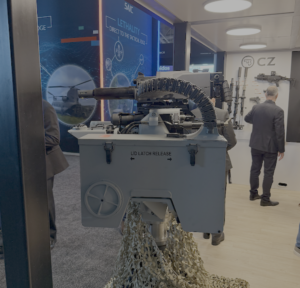
The show, when compared to other industry trade shows, is fairly small. Spanning one large exhibit hall with ancillary spaces scattered around the convention centre, the floor is dominated by the primes and the companies that have built their businesses around them. Amazon LEO, for example, has a booth situated right next to Northrop Grumman. Lockheed Martin, BAE Systems, General Dynamics, and RTX occupy much of the most visible real estate, surrounded by suppliers, subcontractors, and companies hoping to become part of their supply chains.

There is little mention of the current state of global affairs here, just an expansive science fair of impressive hardware. Rather than taking on the lessons of Ukraine, the hardware here is focused on autonomous systems attached to crewed hardware or missile batteries and turrets connected to well-constructed bases. The assumption at the show is that the soldier installing and maintaining this hardware is already in a well-guarded place.

The arrangement says quite a bit about the American defence industry. The major contractors are not simply selling equipment. They are selling entire systems, including the software, communications networks, maintenance contracts, and logistical support needed to keep that equipment running for decades. Smaller companies may develop individual components, but the primes remain the organisations most capable of bringing those components into a military programme at scale. Their size, existing relationships, and experience with government procurement give them an advantage that is difficult for newcomers to overcome. Interestingly, many of the European companies are focused on the same sort of all-in-one systems, from autonomous operating systems that run on EU-made drones to intelligence platforms that interface with partner hardware. The primary difference, then, is the cash available to the large-scale companies versus a startup from Kyiv.

Further, rather than reflecting the lessons of Ukraine, much of the hardware on display appears to follow a more traditional view of warfare. Autonomous systems are attached to crewed vehicles, missile batteries are integrated into established command structures, and sophisticated turrets sit on carefully engineered platforms. There is plenty of innovation here, particularly in sensors, targeting systems, and autonomous capabilities, but much of it is designed to improve existing military equipment rather than replace it.

Selling into the US government is particularly hard. The systems on display here are impressive, well designed, and, as mentioned before, largely built by primes. The startups cling to the sides of the event space like barnacles, hoping to catch a passing whale. Many are offering technologies that could genuinely improve military capabilities, but their immediate challenge is not necessarily proving that the technology works. It is finding a way through a procurement system built around established programmes, lengthy testing requirements, and companies with decades of experience dealing with the Pentagon.

This helps explain why so many startups pursue relationships with the primes rather than trying to sell directly to the Army. Becoming a subcontractor or technology partner can provide access to programmes that would otherwise be difficult to enter. It can also mean surrendering control over how a product is marketed and used. A company may have developed a genuinely new capability, only to find that its most practical route to market is through an organisation whose business depends on maintaining the existing procurement structure.

AUSA is a fascinating look into U.S. procurement strategies and, presumably, defence strategies. The assumption is that the United States has lots of money and hardware to throw at its problems, something distinctly different from the European viewpoint. When most European GDPs are less than California’s, the desire to work with expensive primes is uninteresting if impossible. Instead, sovereign hardware, local investments, and dual-use startups win the day. AUSA is focused on defending a global behemoth. The companies, however, may soon be fighting an entirely different war when it comes to agility, effectiveness, and stealth. All the heavy artillery in the world won’t help in that battle.



You Might Also Like

UK plots to strengthen national defences against emerging AI threats

Ukrainian drones strike 3 Russian data centres in 4 days, disrupting critical digital infrastructure

The Fourth Law and Odd Systems to produce thermal sensors in EU and US

Tags: ArmyAUSAUS
Previous Post

Japan to acquire interceptors from Ukraine’s SkyFall

John Biggs

John Biggs

John Biggs is an entrepreneur, consultant, writer, and maker. He spent fifteen years as an editor for Gizmodo, CrunchGear, and TechCrunch and has a deep background in hardware startups, 3D printing, and blockchain. His work has also appeared in Men’s Health, Wired, and the New York Times. He has written nine books including the best book on blogging, Bloggers Boot Camp, and a book about the most expensive timepiece ever made, Marie Antoinette’s Watch. He lives in Brooklyn, New York. He runs the Keep Going podcast, a podcast about failure. His goal is to share how even the most confident and successful people had to face adversity.

Related News

photo of black metal framed glass street post near gray concrete building during daytime

UK plots to strengthen national defences against emerging AI threats

byCarly Page
October 12, 2026

Britain plans to use AI to hunt for weaknesses in government systems. At the same time it says it is...

A man standing next to a motorcycle in front of a building

Ukrainian drones strike 3 Russian data centres in 4 days, disrupting critical digital infrastructure

byCarly Page
October 12, 2026

Three Yandex data centres have been hit by Ukrainian drones in the space of four days, knocking out facilities that...

Weekly Digest: Iranian ballistic missiles slip past US and UK defence systems in the Gulf while Ukraine’s startups deploy low-cost interceptors

The Fourth Law and Odd Systems to produce thermal sensors in EU and US

byLuke Smith
October 12, 2026

Ukrainian defense technology companies The Fourth Law and Odd Systems have announced a new initiative for large-scale production of thermal...

UAV surveillance firm Monopulse raises over €2M to further expand its NATO markets

UAV surveillance firm Monopulse raises over €2M to further expand its NATO markets

byFiona Alston
October 12, 2026

Danish-Lithuanian unmanned aerial vehicle manufacturer MNP Technologijos, operating under the Monopulse brand, has raised over €2 million. The funding will...

Exclusive: Reveal Technology receives $9.5M US Army order for their 3D mapping platform

Exclusive: Reveal Technology receives $9.5M US Army order for their 3D mapping platform

byJohn Biggs
October 10, 2026

US-based Reveal Technology has received a $9.5 million purchase order from the US Army to expand deployment of its Farsight...

Occam Industries quietly raised €3.8M

Occam Industries quietly raised €3.8M

byFiona Alston
October 9, 2026

Occam Industries, the British-Ukrainian defence software startup, has raised some more funding: a seed round of €3.8 million led by...

NATO’s eastern flank needs cheaper air defences to counter Russian threats, industry warns

NATO’s eastern flank needs cheaper air defences to counter Russian threats, industry warns

byCarly Page
October 9, 2026

NATO needs to rethink how it defends its eastern flank against Russian aerial threats, with industry leaders warning that existing...

GCHQ CTO warns outdated procurement risks driving UK tech overseas

GCHQ CTO warns outdated procurement risks driving UK tech overseas

byCarly Page
October 8, 2026

GCHQ has warned that government procurement rules “designed for the 1900s” are making it harder to turn British technology into...

Load More

Top stories

Dark digital map of north-western Europe
European Defence

State of Defence Tech 2026: European defence startup funding to quadruple to $10.5B

October 5, 2026
Estonia’s Golbriak Space raises €4M
European Defence

Estonia’s Golbriak Space raises €4M

October 8, 2026
Ukraine’s military tells defence startups to get closer to the front line
Events

Ukraine’s military tells defence startups to get closer to the front line

October 7, 2026
NATO Innovation Fund and Finland’s DEFINE sign MoU
European Defence

NATO Innovation Fund and Finland’s DEFINE sign MoU

October 6, 2026

Resilience Media is an independent publication covering the future of defence, security, and resilience. Our reporting focuses on emerging technologies, strategic threats, and the growing role of startups and investors in the defence of democracy.

  • About
  • News
  • Resilence Conference
    • Resilience Conference Copenhagen 2026
    • Resilience Conference Warsaw 2026
  • Guest Posts
  • Subscribe
  • Privacy Policy
  • Terms & Conditions
  • Mission Statement & Code of Practice
  • Press

© 2026 Resilience Media

No Result
View All Result
  • Home
  • About
  • Subscribe
  • Events
  • Guest Posts
  • Interview
  • News
  • Resilience Conference London 2026
  • Resilience Conference Copenhagen 2026
  • Resilience Conference Warsaw 2026

© 2026 Resilience Media

This website uses cookies. By continuing to use this website you are giving consent to cookies being used. Visit our Privacy and Cookie Policy.