Augur, the UK startup that has developed a “privacy first” AI-based analytics platform that ingests video and other feeds to build up profiles of activity in aid of improving security and safety, has raised new strategic funding from the UK government, an investment that coincides with Augur inking a public safety contract with Transport for London, which oversees London’s extensive transportation network.
The Sovereign AI Fund — a £500 million fund that the government is using to make strategic investments into startups within the defence and resilience technology space — is investing an undisclosed amount into Augur.
Resilience Media understands from sources close to the company that the funding is an extension of Augur’s $15 million seed round that it announced earlier in 2026, and that it’s preparing to raise its Series A.
The investment involves a couple of key details that take the relationship beyond a mere financial bet.
The first is that Augur will be working with Transport for London — the body that oversees the extensive public transport network in the UK capital. Augur is starting off with an initial project with the London bus network, where it is “researching” how it might use its platform to identify sexual offending, which in turn could be used for intervention in real-time, as well as for evidence gathering after the fact.
It is not clear when the research project will kick off, nor when it might be rolled out as a service across the bus network. It is also not clear whether the research or service will cover other activities beyond sex offences, nor whether it will extend to other transportation modes overseen by TfL, which is a huge operation that manages rail, underground and overground trains, river ferries, and vehicle and bike road traffic in London.
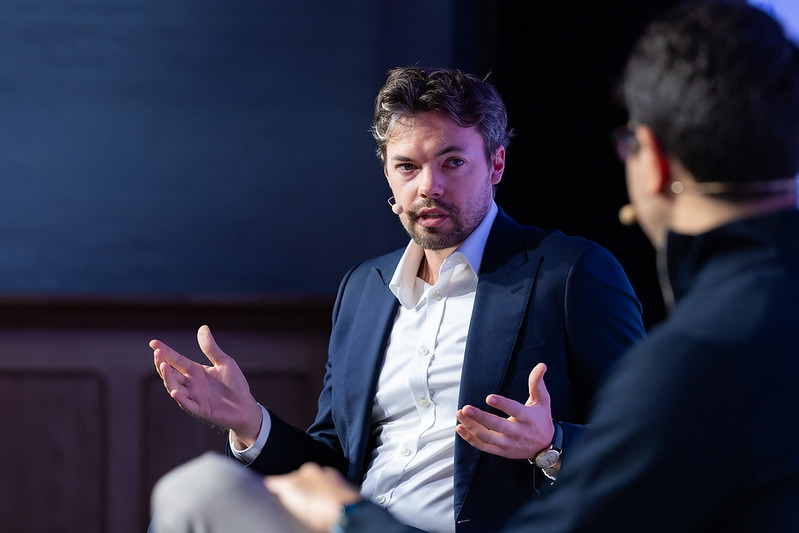
The deal fits tightly with how Augur is shaping its business. The startup has previously said that it is working across multiple potential use cases for public safety and national security. On stage at Resilience Conference last week, Augur CEO Harry Mead (pictured, above) spoke at length about the disconnect that exists in the UK between the extensive amount of surveillance cameras set up, and the lack of observation and understanding of the data that they record, something that plays out in particular in public transportation networks.
There are tens of thousands of cameras set up across the UK, Mead noted, but camera footage from any single CCTV network is not regularly observed, let alone run through systems that might compare it with other video data, or activity on social media or other channels, to find patterns of activity.
“London has more CCTV than anywhere else on the planet,” Mead said. “None of it is connected.”
This means that, in national security incidents, by the time an incident has occurred and it’s being investigated, the perpetrators will have often already left the country.
“You are looking at maybe two, three months to pull together specific evidence,” he said. “Our sensing infrastructure is not coordinated. I think there’s a general belief that, okay, we put up more cameras, we put up more sensors, then we could solve this issue, but unfortunately, we don’t have time.”
The second strategic aspect of the Sovereign AI investment involves compute and data access. As part of the deal, Augur will now have access to Isambard-AI, the government-run AI supercomputer, “to train on much larger and more complex multi-camera datasets.”
This is important because the power of any AI model is typically dependent on how much data has been used to train it, and how much compute power it has to run further inference on new data. Access to Isambard-AI gives Augur both of these in a way that is targeted very specifically to its national security and public safety focus.
Betting on sovereignty
The investment underscores how governments are looking to double down on home-grown technology bets to ensure that they continue to have direct connections to the companies that may well build and operate the public services and national security of the future.
In tech, this goes not just for the physical data centres but also the software being developed to run inside them. The recent news about US-based Starlink limiting satellite connectivity over Ukraine is just the latest in a long list of incidents that illustrate why countries need more technological resilience.
Sovereign AI also backs AI compute developer Callosum, AI drug discovery tech Isomorphic Labs, infrastructure player Olix, materials science startup Cusp.ai, “super intelligence” startup Ineffable, and biotech startup Basecamp Research.
“We are partnering with Augur because Britain needs this capability and should own it,” the Sovereign AI investors note. “The infrastructure is already here. The technology that helps keep us safe should be built here too, by a team that has shown that better security and privacy can go together.”