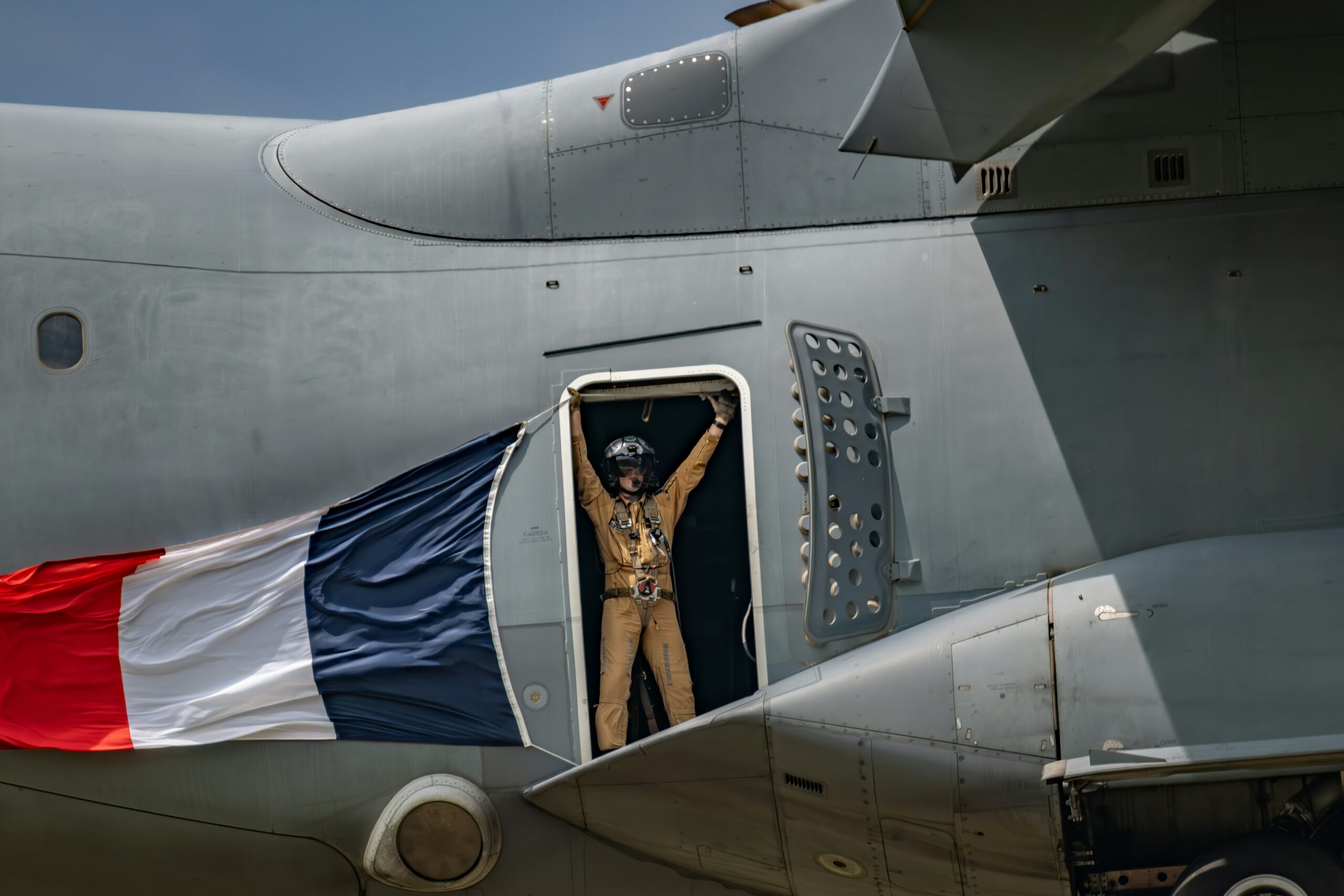
France has quietly set about building one of the world’s biggest arms-export machines, overtaking Russia in 2024 to become the second-largest exporter of major arms globally.
From 2021 to 2025, France accounted for 9.8% of global exports of major arms, according to recent figures from the Stockholm International Peace Research Institute (SIPRI). For fledgling European defence startups, that export reach means getting a product into the French military can carry weight far beyond the value of the initial contract.
But a new report from Amsterdam- and London-based VC firm Keen Venture Partners lays out why getting through the door can be exceptionally difficult — but not impossible. The report argues that France is among the hardest markets for startups to crack, but also one of the most valuable once they do.
“France buys French”
France’s preference for domestic suppliers shows up clearly in the government’s own figures. In 2025, 92.7% of suppliers to the French Ministry of the Armed Forces were based in France, while 82.6% of supplier payments went to companies resident in the country, according to the ministry’s latest economic statistics.
Ties Klinkhamer, an associate at Keen Venture Partners who has worked on the firm’s defence procurement reports (this report on France is the fourth in a series on European defence procurement; others cover The Netherlands, UK, and Germany) says France’s preference for domestic suppliers is rooted in its longstanding emphasis on sovereign defence capabilities. For startups coming from elsewhere in Europe, that creates hurdles beyond simply competing for contracts, with foreign investment, technical conformity, security clearance, and exports all subject to separate controls.
“France equips its forces from national capacity wherever it can,” Klinkhamer tells Resilience Media. “This sovereign mechanism is compounded by the requirements which are shaped inside a small, closely connected network of armament engineers.”
Alexander Ribbink, general partner at Keen Venture Partners, says that picture is beginning to change.
“France buys French — idéalement — and says so,” he says. “That is where non-French defence tech founders stop reading. But things are changing. The system that has preferred French industry for nearly seventy years is opening up to new, innovative international market entrants.”
Those entry points include the Agence de l’innovation de défense (AID), France’s Defence Innovation Agency, whose Guichet Unique, or “single-entry point,” lets companies put forward projects without first securing an introduction inside the ministry.
Startups can also pay to use testing facilities operated by the Direction générale de l’armement (DGA), France’s armament procurement and engineering agency. Another route is the achat innovant, a mechanism allowing qualifying defence and security contracts worth up to €300,000 to be awarded directly.
Klinkhamer says the best way in, ultimately, is often through alternative entry points that sit outside the usual procurement machinery, be that the innovation agency, paid testing, direct-award mechanisms, or defence attachés.
“What works is using the doors that need no programme behind them,” he says.
Heavy spending
France, it’s fair to say, is spending heavily on defence: the ministry puts its 2026 budget at €57.1 billion. But that figure overstates how much money is readily available to a new supplier.
Keen’s report notes that France signs equipment contracts for their full multi-year value, while the cash used to pay them is voted annually. Consequently, it calculates that around two-thirds of what the ministry spends outside salaries in 2026 will go towards contracts signed in previous years.
Indeed, Keen says practitioners it consulted for the report estimate that around 90% of France’s equipment budget is already committed to long-running programmes. The remaining 10% is spread across the Defence Innovation Agency, French public investment bank Bpifrance, regional programmes, and smaller budgets controlled elsewhere in the military, according to the report.
Even once a startup has found an interested buyer, technical requirements can still block a purchase. For products touching ministry information systems, one of the key hurdles is the cadre de cohérence technique (CCT), which sets requirements around operating systems, interfaces and security.
Klinkhamer says those rules can determine whether a product is compatible with the ministry’s systems in the first place.
“A product built on its own stack can be refused on conformity alone,” Klinkhamer says.
That gap between operational utility and formal approvals can also surface during military trials. In France, Keen says technical qualification, entry into operational service, and the budget and signature needed to buy the equipment sit with different authorities.
“The soldier conducting the trial holds none of these functions, and the standards against which a product is assessed are set by people absent from the demonstration,” Jules Boelens, an analyst at Keen Venture Partners who worked on the report, tells Resilience Media.
Keen therefore advises founders to identify both the authority responsible for certifying their product, and the body that could ultimately fund its purchase before investing in a trial.
The export prize
France’s focus on sovereignty reaches far beyond procurement mechanics. Florent Ogès, co-founder of European defence software startup Lysk, describes it as a longstanding strategic doctrine that shapes how the country thinks about control and dependence across defence.
“France cared about sovereignty long before it was fashionable elsewhere,” Ogès says in a statement issued to Resilience Media. “That mindset runs from nuclear deterrence down to who hosts your data.”
For startups, Boelens says the same emphasis on sovereignty can also shape foreign-investment screening, software architecture and supply-chain requirements. But for those that do establish themselves in France, it comes with another potential advantage: access to one of the world’s most important defence-export markets.
The French state plays an active role in supporting overseas defence sales. The DGA’s international division coordinates state support and export negotiations, while the Ministry of the Armed Forces offers companies assistance ranging from demonstrations and foreign delegations, to technical expertise and support at overseas events.
Smaller defence companies can also access dedicated export-support schemes.
“France sells as a state as well as an industry, and foreign buyers treat a French order as evidence that the product works,” Boelens says.
And all this brings the story back to France’s position as the world’s second-largest exporter of major arms. For startups that manage to secure a French military customer, the reference holds real value when pursuing buyers elsewhere. Part of that value also comes from formal qualification, which gives foreign buyers an approved technical configuration to assess.
“Qualification is worth planning around, since it is what foreign buyers rely on and it fixes the product to an approved configuration,” Boelens adds.
In other words, the French approval applies to a specific version of the product, so major changes later may require further qualification.
Same traps, different causes
After examining the Netherlands, UK, Germany and France, Keen sees a trade-off specific to the French market: breaking in can take longer, but its export reach can make the payoff greater once a company has established itself.
“Of the four, France takes the longest to get into and gives the most back once you are in,” Klinkhamer says.
But Keen also sees several recurring problems across the four markets it’s studied so far. One of those is a mismatch between interest and purchasing authority: the people most receptive to a startup’s product may have no control over the relevant budget.
“Founders spend months with interlocutors who are interested and hold none [of the budget],” Klinkhamer says.
Another common theme lies in confusing experimentation with procurement. Keen says time spent in a French battle lab, or on a UK innovation grant, can help shape what gets bought later, while the eventual order follows an entirely separate route.
And then there is sequencing. Security screening and export classification run on their own timetables, Klinkhamer says, so starting either process late can add months to qualification and a first contract.
“The source of the friction differs by country,” Klinkhamer notes.
He attributes that friction to different causes across the four markets: identifying who holds the requirement and budget in the Netherlands, individual accountability in Germany, institutional change in the UK, and buyer capacity in France.
And that capacity constraint is particularly visible at the DGA, which placed nearly €38 billion of orders in 2025 and employs around 10,600 people. Keen says its workforce remains smaller than it was in the 2000s.
Ogès, for his part, still sees room for younger companies alongside the larger established defence contractors that dominate much of the market.
“The opening for those new entrants lies in the gaps the primes are too big to fill,” he says.
Those wishing to read the full “Navigating French defence procurement” report can register here.