
Belgian satellite imaging company Simera Sense will partner with European space technology specialist S&T to develop a so-called sovereign Space Situational Awareness (SSA) system. The partnership aims to give European governments, defence organisations and commercial satellite operators greater control over how they monitor and protect their assets in orbit while ensuring that the systems, hardware, supply chain and software all belong to the government purchasers.
The agreement comes as Low Earth Orbit (LEO) becomes increasingly crowded and contested. According to the European Space Agency, there were 17,614 significant objects in orbit in 2025, with approximately 90% located in LEO. The growth of military and commercial satellite constellations, combined with accumulating debris, has increased demand for systems capable of identifying and tracking objects in space.
Further, Russian satellites have demonstrated the ability to approach other spacecraft, raising questions about surveillance, interference and the vulnerability of critical space infrastructure.
“Europe needs to be able to track and protect its own satellites and constellations without depending on foreign suppliers,” said Kammy Brun, Managing Director of Simera Sense France. “Together with S&T, we are building a sovereign European SSA capability that integrates space-based and ground-based assets, data fusion and advanced processing into a secure and reliable turnkey solution for European defence, institutional and commercial operators.”
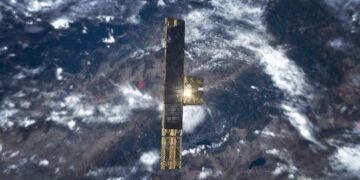
At the centre of the project is Simera Sense’s new xScape100 Scan360 system, currently under development at the company’s French subsidiary in Toulouse. The camera is designed to provide 360-degree scanning and detect objects as small as CubeSats in Low Earth Orbit and Medium Earth Orbit.
According to Simera Sense, a network of six to twelve SCAN360 payloads hosted on satellites could provide continuous monitoring of orbital assets, improving detection rates and reducing gaps in surveillance.
S&T will contribute ground-based tracking systems, passive radio-frequency sensing technology and software that processes information from multiple sensors. The goal is to combine the broad coverage of ground-based systems with the more detailed identification capabilities of cameras operating in space.
The resulting system would allow operators to detect objects, assess potential threats and respond to suspicious activity with less dependence on external surveillance providers.
Simera Sense expects the first flight model of SCAN360 to become commercially available in the fourth quarter of 2027.