
100 investors to watch 2026 100 investors to watch 2026 100 investors to watch 2026
Friday 16 October, 2026
[email protected]
Resilience Media
  • News
    • Events
    • Interview
    • Startups
    • Venture
    • Weekly Digest
  • Resilience Conference
    • Resilience Conference London — Oct 2026
    • Resilience Conference Copenhagen — May 2026 (PAST)
    • Resilience Conference Warsaw — Apr 2026 (PAST)
  • Launch
  • About
  • Guest Posts
    • Author a Post
  • Subscribe
No Result
View All Result
Resilience Media
No Result
View All Result

Finland’s NestAI expands to Estonia

Battlefield intelligence startup backed by Nokia builds up its European presence, starting with the Baltics and Nordics

Fiona AlstonbyFiona Alston
September 22, 2026
in European Defence, News
buildings during day
Share on Linkedin

NestAI, a defence tech startup from Finland backed by Nokia, is taking the next step in its strategy to build a battlefield OS that works across Europe. On Tuesday, it announced that it is expanding to Estonia.

You Might Also Like

Ukraine’s industry lacks parts to build interceptors, says D3 fund’s Eveline Buchatskiy

Augur takes new funding from Sovereign AI, inks deal to work on public safety with TfL

Kapta Space raises $24M Series A

Peter Sarlin, NestAI’s founder and executive chairman, announced the news at the Estonian Defence Industry Symposium in Tallinn.

The move is a natural progression for the startup: NestAI was already working with the Estonian Defence Forces after signing a joint Letter of Intent with them and the Finnish Defence Forces in June 2026.

The expansion will see NestAI open an office in Tallinn both to be closer to its customer, and to continue developing its technology in conjunction with local industry partners. NestAI said the set-up will include at least 25 engineers and other specialists, as well as a new R&D centre.

“Estonia is the right place to build because operational needs, technical talent, and political will are all present in one country,” the company said in a statement.
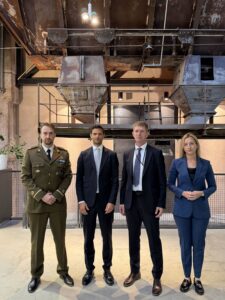
Dr Ivo Peets, Commander of the Force Transformation Command, Peter Sarlin, NestAI Founder and Executive Chairman, Estonian Minister of Defence Martin Herem and Angelica Tikk, Director of Defence innovation department at the Estonian MOD.

Dr Ivo Peets, commander of Estonia’s Force Transformation Command, said that NestAI’s presence gives Estonian talent the opportunity to develop sovereign AI for battlefield operations. “We have world-class engineers and data scientists, but retaining them requires world-class challenges,” he said in a statement. It is also, he added, “a way of keeping the right talent in Estonia.”

NestAI’s flagship product is NestOS. It describes it as an “adaptive intelligence” operating system for battlefield operations. Features include continuous AI services, even in low communication zones; and a set-up that enables the system to learn from and adapt to the operational data that passes through it.

NestAI’s expansion comes as militaries incorporate an increasing number of AI-powered tools into their battlefield systems, to power hardware, run analytics and help manage other operations.

European leaders have coalesced around the belief that working in conjunction with each other creates a more powerful defence than each nation working solely on its own, and that has been especially apparent in the Nordics, where alliances are forming to develop and use new technologies.

While NestAI could have carried out that strategy from a single base in Finland, expanding to Estonia gives it a much closer understanding of what it customer needs, and to be more responsive to that.

“Strengthening Europe’s borders is urgent, and it is not work that can be done at a distance,” said Sarlin in a statement. “Ukraine has shown how quickly operational requirements change. AI that cannot keep learning after it is deployed will not hold, and building that capability means building it with the forces and companies who face those conditions.”

Martin Herem, Estonia’s very new minister for defence, echoed the need to be close to ground, so to speak.

“Estonia’s objective is clear: new technologies must translate into real military capability faster,” he said in a statement. “To achieve that, we need a strong defence technology ecosystem, close cooperation between companies and the state, and access to international expertise in areas such as artificial intelligence and autonomous systems. Bringing this expertise together with Estonia’s operational experience and digital strengths helps us develop solutions that strengthen our defence and can be put to practical use by our forces.”

This is not NestAI’s first move outside of Finland. The startup has been building relationships across the Nordics and Baltics over the past few months with expansions into Sweden in August and Latvia in September.

Peter Sarlin will appear on stage at Resilience Conference London in October. Come join us there.


Tags: EstoniaFinlandnestaiPeter Sarlin
Previous Post

Funding the frontline: the hidden resilience risk in defence venture capital

Next Post

TERASi raises €11m to scale secure battlefield communications

Fiona Alston

Fiona Alston

Fiona Alston is a defence tech, innovation and business journalist based in Estonia. With over a decade of experience covering tech, business and sustainability for Irish and European publications, she has a knack for bringing interesting and technical stories to an everyday audience.

Related News

Ukraine’s industry lacks parts to build interceptors, says D3 fund’s Eveline Buchatskiy

Ukraine’s industry lacks parts to build interceptors, says D3 fund’s Eveline Buchatskiy

byStanislaw Naklicki
October 14, 2026

Ukraine is in desperate need for air defences, warned the managing partner of the D3 venture capital fund Eveline Buchatskiy....

Social networking apps like Snapchat are being used to recruit agents in grey-zone warfare, says Augur CEO

Augur takes new funding from Sovereign AI, inks deal to work on public safety with TfL

byIngrid Lunden
October 14, 2026

Augur, the UK startup that has developed a "privacy first" AI-based analytics platform that ingests video and other feeds to...

Kapta Space raises $24M Series A

Kapta Space raises $24M Series A

byJohn Biggs
October 14, 2026

Seattle-based space technology startup Kapta Space has raised $24 million in Series A funding and secured multiple classified contracts for...

Is there a defence tech bubble?

Is there a defence tech bubble?

byStanislaw Naklicki
October 13, 2026

Over the past few years, Europe has seen a remarkable growth of the defence tech sector, with several start-ups reaching...

Coders in Singapore embrace defence hackathons as America retreats from commitments abroad

Coders in Singapore embrace defence hackathons as America retreats from commitments abroad

byHarry Saunders
October 13, 2026

It’s a Sunday afternoon on the campus of Singapore’s national university, and Richard Xiong, chief pitchman for a startup that...

white red and green map

NATO Innovation Fund sets up a branch in Warsaw

byIngrid Lunden
October 13, 2026

The NATO Innovation Fund, one of the biggest investors into defence and resilience technology in Europe, is going local. Today,...

At Washington’s premiere defence show, the primes rule the roost

At Washington’s premiere defence show, the primes rule the roost

byJohn Biggs
October 12, 2026

Across the street from the Carnegie Library Apple Store, not far from the National Portrait Gallery, missile launchers are aimed...

photo of black metal framed glass street post near gray concrete building during daytime

UK plots to strengthen national defences against emerging AI threats

byCarly Page
October 12, 2026

Britain plans to use AI to hunt for weaknesses in government systems. At the same time it says it is...

Load More
Next Post
TERASi raises €11m to scale secure battlefield communications

TERASi raises €11m to scale secure battlefield communications

Tekever raises $580M at a $6.8B valuation to give flight to more drones

Tekever raises $580M at a $6.8B valuation to give flight to more drones

Top stories

white red and green map
European Defence

NATO Innovation Fund sets up a branch in Warsaw

October 13, 2026
Dark digital map of north-western Europe
European Defence

State of Defence Tech 2026: European defence startup funding to quadruple to $10.5B

October 5, 2026
UAV surveillance firm Monopulse raises over €2M to further expand its NATO markets
Drones & UAS

UAV surveillance firm Monopulse raises over €2M to further expand its NATO markets

October 12, 2026
Social networking apps like Snapchat are being used to recruit agents in grey-zone warfare, says Augur CEO
Cyber

Augur takes new funding from Sovereign AI, inks deal to work on public safety with TfL

October 14, 2026

Resilience Media is an independent publication covering the future of defence, security, and resilience. Our reporting focuses on emerging technologies, strategic threats, and the growing role of startups and investors in the defence of democracy.

  • About
  • News
  • Resilence Conference
    • Resilience Conference Copenhagen 2026
    • Resilience Conference Warsaw 2026
  • Guest Posts
  • Subscribe
  • Privacy Policy
  • Terms & Conditions
  • Mission Statement & Code of Practice
  • Press

© 2026 Resilience Media

No Result
View All Result
  • Home
  • About
  • Subscribe
  • Events
  • Guest Posts
  • Interview
  • News
  • Resilience Conference London 2026
  • Resilience Conference Copenhagen 2026
  • Resilience Conference Warsaw 2026

© 2026 Resilience Media

This website uses cookies. By continuing to use this website you are giving consent to cookies being used. Visit our Privacy and Cookie Policy.