Swedish defence technology company TERASi has raised €11 million to expand its millimetre-wave communications technology across European armed forces and develop new capabilities for the tactical edge.
The seed round was co-led by the NATO Innovation Fund (NIF) and JOIN Capital, with participation from In-Q-Tel and Ukrainian venture capital firm D3. Existing investors Navigare Ventures, Almi Invest, Onsight Ventures, Further Than Capital and KTH Ventures also joined the round.
Stockholm-based TERASi, a spinout from KTH Royal Institute of Technology, develops compact wireless communications systems designed to maintain high-speed data links in contested environments where satellite connectivity, GPS, and conventional radio-frequency communications may be disrupted.
Its technology uses highly directional millimetre-wave signals rather than the broader transmissions associated with many conventional wireless systems. TERASi says this makes its communications considerably harder to detect, intercept, or jam.
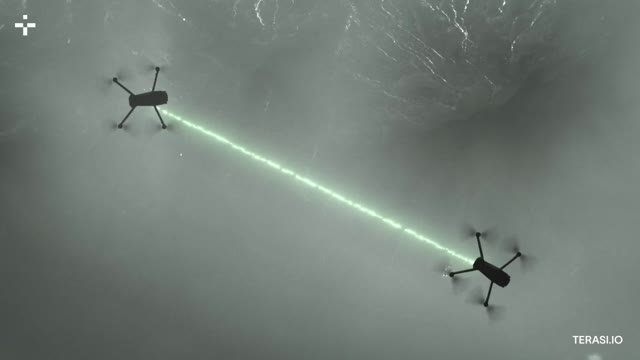
At the centre of the system is TERASi’s patented AirCore technology, which allows millimetre-wave radio hardware to be miniaturised for deployment on tripods, drones, and other tactical platforms. Its RU1 radio is designed to create point-to-point, gigabit-speed links without relying on fixed communications infrastructure.
The company says its communications links can operate across distances exceeding 100km and transfer data at speeds up to 50 times faster than satellite connections.
The new funding will be used to scale deployment of TERASi’s existing connectivity products, expand its engineering and field teams, and support partnerships with major defence companies. It will also fund development of a broader system combining communications with spatial awareness and electronic warfare capabilities.
TERASi already works with the Swedish Armed Forces and the European Space Agency, alongside defence and telecommunications companies. The company has previously participated in ESA’s Swedish business incubation programme, while its work with the Swedish military includes selection for Sweden’s Civil-Military Innovation Programme.
James Campion, CEO and co-founder of TERASi, said: “Europe’s armed forces need to be able to move decisive information securely, at speed, and in environments where infrastructure, satellites and the spectrum itself may be contested. That is about more than connectivity. It is about restoring Europe’s freedom to operate and communicate on its own terms.”
Sander Verbrugge at the NATO Innovation Fund described connectivity as a “decisive capability on the modern battlefield”, adding that the investment marks NIF’s first direct investment in Sweden.