Watching the events unfold in Ukraine has given me a profound sense of urgency, and a much clearer understanding of what truly keeps a nation standing. This isn’t just another war; it’s what I call the “Kilowatt War.”
Russia’s attacks on Ukraine’s power grid have turned energy into a central battleground. We’ve seen cities go dark for hours every day, vital services strained, and daily life turned upside down. By mid-2024, over half of Ukraine’s power generation was gone. This isn’t just about blowing things up; it’s a calculated move to break a country. The message is clear: if you rely on a central power grid, you’re vulnerable. This crisis makes finding strong, local power sources an absolute top priority for modern defence.
Hydrogen isn’t new to the military. For over a hundred years, it’s been used for observation, from Civil War balloons to World War I. Engineers also saw its power as a fuel, even flying a U.S. Air Force bomber on liquid hydrogen in the 1950s. And, of course, hydrogen fuel cells powered the Apollo and Space Shuttle missions, giving clean electricity and even drinking water. Yes, it also has a darker side, powering thermonuclear bombs.
But this long, varied history shows militaries have always known hydrogen’s potential. Today, it has a new, critical role: keeping soldiers going.
Modern armies run on diesel, and this dependence is a huge weakness. The U.S. Army knows its long, fragile fuel supply chain is a big risk in any major conflict. Getting fuel to the front lines is incredibly dangerous; in Iraq, one person was lost for every 24 fuel convoys. On the battlefield, diesel generators are a problem. They’re loud and hot, making units easy targets for modern sensors and drones. They also need constant fixing and waste fuel when not running at full power, which often leads to breakdowns. The situation in Ukraine really shows this on a national scale. As Russia hits the main power grid, civilians turn to diesel, forcing the military to compete for a fuel that’s already hard to get. It’s a clear example of how attacking energy infrastructure can indirectly cripple an army.
I am certain that part of the answer to the diesel problem is in hydrogen fuel cells. Unlike a generator that burns fuel, a fuel cell makes electricity through a quiet chemical reaction between hydrogen and oxygen. It only produces water and a little bit of heat. This makes them perfect for modern warfare. They’re nearly silent and have a much smaller heat signature, making units far harder for the enemy to find. Plus, they’re more reliable, with fewer moving parts to break down.
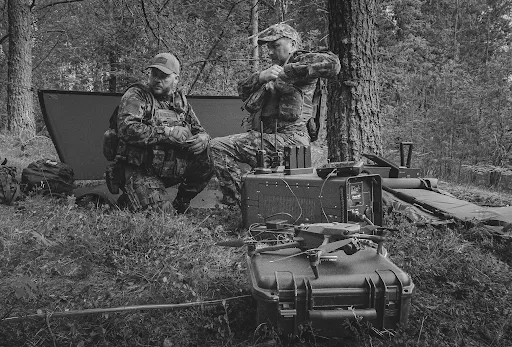
This isn’t some far-off idea; this technology is ready now. Companies like PowerUP make portable hydrogen generators that are ideal for frontline use, and NATO forces have already tested them. A small, portable unit, like our 1kW model, weighs less than 25 kg and is as quiet as a normal conversation. It can power crucial gear like radios, drones, and medical equipment, giving small units the energy they need to stay hidden and effective without the noise and heat of a diesel generator.
The biggest challenge with hydrogen has always been logistics: how do you get big hydrogen tanks to the front? The real game-changer is to stop shipping hydrogen and start making it right where it’s needed. New technologies make this possible. One way is electrolysis, using portable systems with solar or wind power to split water – even moisture from the air – into hydrogen. Imagine a unit that can be airdropped and produce both hydrogen fuel and drinking water from the air. Another method uses a safe, stable aluminium powder that instantly releases hydrogen gas when mixed with any available water.
These breakthroughs change everything. Instead of relying on risky fuel convoys, units can now “live off the land” and create their own energy. This allows small, stealthy teams to operate for longer periods deep in enemy territory, finally cutting the “tether of logistics” that has held armies back for centuries.
The war in Ukraine is a powerful, although painful wake-up call. In today’s conflicts, energy is a weapon. Relying on old diesel generators and fragile power grids is a recipe for disaster. Hydrogen fuel cells offer a clear, strong advantage: they provide stealth power: silent, and reliable, directly helping soldiers survive and fight effectively. With new tech quickly solving the old transport problems, the path forward is clear. We, as a global community, must act now: get these systems to Ukraine, invest heavily in on-demand generation, and update our military energy policies. The future of warfare will be powered differently. These lessons are being learned the hard way on the Ukrainian frontline; it’s our duty to learn and apply them.
Ivar Kruusenberg, PhD, a serial entrepreneur, is a founder and Chief Executive of PowerUP Energy Technologies. He holds a PhD in chemistry focused on fuel cells from the University of Tartu, with post-doctoral work at UC Berkeley, and possesses nearly two decades of experience in the field. Dr. Kruusenberg works closely with governments on hydrogen strategy development and previously founded the successful scaleup UP Catalyst. His company, PowerUP Energy Technologies, founded in 2016, innovates in hydrogen fuel cell technology. Before his work in deep tech, Ivar was an Estonian national snowboarding champion.