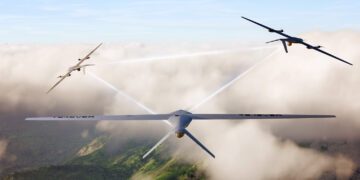
Ukraine’s Operation Spider’s Web attack on Russian airfields over the weekend has captured the news. Ukraine spent 18 months planning this attack. They built shipping containers that had bomber drones hidden in the roof, the panels were able to retract remotely, and the drones then lifted up and carried out precision attacks on fleets of Russian bombers that were parked in neat rows, unprotected, on airfields far from the Ukrainian border.
In a style now typical of Ukraine’s brilliant communication skills, some of the drones flew over the airfield to film the other drones detonating against the fuel tanks of the planes. They used Russian GPS signal to send the video back to Ukraine, where it was widely shared online.
Russia was prepared for night attacks by large drones on airfields close to Ukraine. They had not anticipated daytime attacks by short range drones far from the border. Ukraine had even previously attacked other Russian airfields to encourage the Russians to move their bombers to the target airfields.
People are likening this to Pearl Harbour. That comparison makes sense in terms of a pre-emptive strike on a static force far from the front line. The sight of planes burning on their runways reminded me of the early SAS attacks, for example on the Sidi Haneish Airfield in Egypt, when Stirling and his men destroyed or damaged 40 Luftwaffe aircraft using a shock attack with a convoy of 18 jeeps.
However, a more accurate comparison is probably the Israeli pager attacks of September 2024, which was the result of years of planning, hijacking supply chains, and technical innovation. The Ukrainian attack was clever on so many levels, not just the planning, but also the technology, and ultimately the timing and associated comms.
It also demonstrates real wartime defence innovation. Innovation in defence is not just about engineering, it is about innovating how you do things. A former British officer recently observed to me that in World War Two, the great British innovations like Operation Mincemeat and Operation Chastise (the DamBuster raid) were all the work of ‘civilians in uniform.’ These were what Churchill called his ‘corkscrew thinkers’ – people who could think in loops around an enemy that thought mainly in straight lines.
Reports indicate that Ukraine deployed 150 drones, of which 116 struck their targets. Some of the video circulating shows Russians examining a damaged shipping container, which then explodes when one of them walks in through the door, suggesting either that the containers were booby trapped, or that drones continued to explode after they failed to deploy. The drones that did deploy flew straight into the fuel tanks of the planes – another example of a very cheap bit of tech taking out a very expensive bit of hardware. They used a mixture of satellite imagery and automated targeting to cause catastrophic damage to the Russian airforce.
Artem Moroz, Head of Partnerships, Brave1 wrote over the weekend, “if you think drones are just tactical tools, think again. Ukraine is rewriting military doctrine in real time. This is next-gen asymmetric warfare in action. Cheap, smart, unstoppable.”
It is also striking that at least some of Operation Spider’s Web was run through Ardupilot, an open source platform that describes itself as “a trusted, versatile, and open source autopilot system supporting many vehicle types…The source code is developed by a large community of professionals and enthusiasts.” This attack was about cunning more than it was about cost.
In a recent guest post, Stavros Messinis argued that historic military victories happened when innovation combined with doctrine. The Ukrainian attack is a perfect example of this. This was an innovative technology — drones — being used in an incredibly innovative way. This was corkscrew thinking at its best. The Ukrainians not only deployed an inexpensive, innovative technology but they also outsmarted the Russians, using misdirection and subterfuge to do something completely unexpected. The Ukrainian SBU showed the audacity of a country fighting for its existence – driving trucks deep into Russia, taking serious risk, deploying limited resources with surgical precision. This compares with Russia firing 472 missiles and drones at Ukrainian cities the night before — expensive, un-targeted, dumb brute force.
Ukraine also showed what can be achieved when a country is dragged into total war — the best minds are all focussed on winning, and the level of engineering brilliance and tactical wizardry that came together to pull off this attack will go down in history as I wrote a while back, ‘the next Alan Turing is probably Ukrainian.’ Ukraine now has its best minds focussed on winning this war, while in Russia most of the best minds abandoned Putin’s dictatorship long ago.
From a British perspective, it is interesting that this attack came a day before the Strategic Defence Review (SDR) was published. The SDR is a major policy review for the British Government, and will mainly focus on building submarines, factories, and tanks. Part of it will address innovation, but it remains unclear what is meant by innovation.
This attack has prompted plenty of people to warn what it says about the risk to NATO. At Latitude59 in Estonia last week, a panellist warned that a major drone strike from Russia could take out Estonia’s critical infrastructure in about 15 minutes. At the Defence24 conference in Poland recently, a British General observed from his panel that none of the brand new Polish tanks on show outside were covered in anti-drone cages. We are really not at all prepared for an adversary carrying out an attack like Spider’s Web on us.
The obvious risk is that our collective response to the war in Ukraine is to continue to plough money into legacy hardware that costs a fortune, whilst only dedicating a slither of funding to what our governments call innovation. When the next phase of this conflict kicks off, will we — like Russia — see all that newly built hardware taken out by cheap drones using open source software?
Operation Spider’s Web should remind us that we need innovation to align with doctrine. We need people who have spent their careers in the military or in primes to learn how tech entrepreneurs and engineers think. Ukraine has tech entrepreneurs at the heart of its military now. These are people freed from legacy peacetime innovation strategies, thinking fast, breaking norms, and outwitting the enemy.
Any spending on innovation by NATO countries needs to understand that this is not just about putting money into novel technology, it is about embracing entrepreneurial thinking and novel approaches. Innovation in technology also needs to be matched by innovation in tactics and doctrine. Protecting new military hardware from cheap drones should not be an afterthought but part of its core design. Finally, our militaries and national security agencies need to reflect the innovation just demonstrated by Ukraine and figure out how to engage with entrepreneurs and corkscrew thinkers now, not only once they are needed to win a war that is faltering.