Friday 23 January, 2026
[email protected]
Resilience Media
  • About
  • News
  • Resilience Conference
  • Guest Posts
    • Author a Post
  • Subscribe
No Result
View All Result
  • About
  • News
  • Resilience Conference
  • Guest Posts
    • Author a Post
  • Subscribe
No Result
View All Result
Resilience Media
No Result
View All Result

Meet the Startups Building the Future of Autonomous Drone Warfare

Auterion, KrattWorks, and Huless brought expertise and tech to the battlefield.

John BiggsbyJohn Biggs
June 3, 2025
in Startups, Venture
Share on Linkedin

The drone war in Ukraine is no longer just about explosive payloads and aerial tactics. It’s a battle of software, sensors, and real-time adaptation. As Ukrainian forces execute complex, long-range strikes deep into Russian territory—like the recent June 1 attack that reportedly took out more than 40 Russian aircraft across bases thousands of kilometers from the front—it’s becoming clear that this is not just a military story. It’s a startup story.

You Might Also Like

Inside Dronamics bid to become the unmanned logistics carrier for future conflicts

How geopolitics complicates venture

Dominion Dynamics raises $15M to build a new arctic defence prime in Canada

Behind Ukraine’s evolving drone capabilities are a handful of companies pushing the limits of autonomy, navigation, and survivability. These startups aren’t just building better drones—they’re inventing a new playbook for warfare.

KrattWorks: From Tallinn to the Trenches

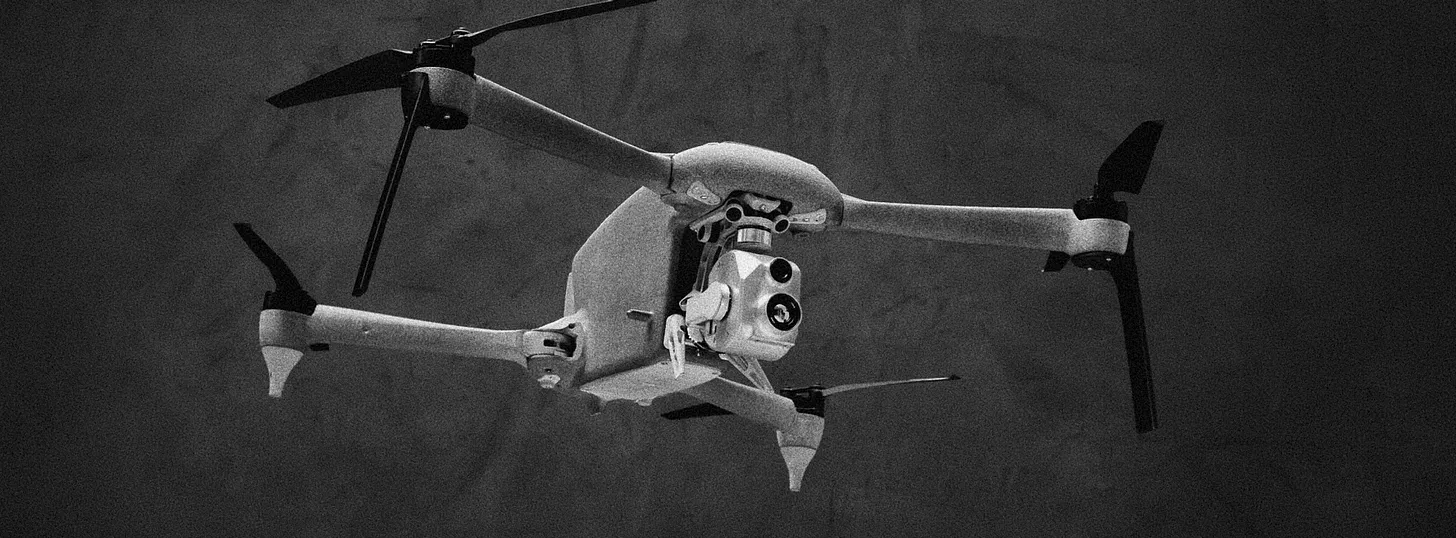
Estonian startup KrattWorks has emerged as one of the most adaptive players in this space. Their Ghost Dragon ISR drone first reached Ukrainian units in 2022. But what began as a robust quadcopter has quickly evolved into a jam-resistant, neural-network-guided system capable of continuing missions without GPS or radio contact. Battlefield conditions rendered early versions obsolete in months. So KrattWorks didn’t just iterate—they reimagined.

Today’s Ghost Dragon can visually navigate using landmark comparison. It’s built with a neural net that allows autonomous flight in GPS-denied environments. It can detect patterns, reorient mid-flight, and avoid spoofing attacks designed to confuse altitude or location data. KrattWorks’ team—many of whom are members of Estonia’s Defense League—see their work as critical not only to Ukraine, but to Estonia’s own national security.

Auterion: From Grocery Drones to Battlefield Intelligence

U.S.-based Auterion didn’t begin as a defense company. It pivoted in early 2024, aligning its advanced navigation software with Ukraine’s growing demand for autonomous systems. Its “terminal guidance” platform was used to strike Russian tanks equipped with heavy jamming equipment. By using optical recognition of terrain and target features, these drones could carry out attacks even after losing all comms with human operators.

Auterion’s value lies not just in the autonomy, but in the scale. A drone that makes its own final targeting decisions can operate in clusters, doesn’t require elite operators, and can hit jammed assets without fallback communication links. This makes them uniquely suited to Ukraine’s decentralized drone forces, many of which are built by small, ad hoc miltech teams.

Huless: Building Smarter Drones at Battlefield Prices

Ukrainian startup Huless is focused on solving a different problem: affordability. Russia’s fiber-optic drones—connected by physical cables to evade jamming—have created new challenges for Ukraine. But Huless believes software-based autonomy is a better long-term answer. Fiber is expensive, heavy, and limits payloads. Autonomous drones, in contrast, offer more explosive power, more onboard processing, and far less overhead for human teams.

The Huless team is now working on onboard AI that lets drones identify and track targets without operator input, using cheap hardware and in-house code. These aren’t experiments—they’re already being fielded.

A New Model for Defense Innovation

All three companies—KrattWorks, Auterion, and Huless—share more than technical expertise. They operate close to the battlefield, iterate quickly, and collaborate tightly with end users. Ukraine’s defense ecosystem isn’t just matching global defense contractors—it’s outpacing them. Western firms may offer high-spec systems, but Ukrainian and allied startups are delivering what soldiers actually need: drones that are cheap, smart, adaptable, and ready to fly today.

This is the emerging shape of insurgent defense innovation. Not top-down procurement cycles, but live-code updates, battlefield telemetry, and hardware that adapts as fast as the threat.

Ukraine’s drone war has forced a reckoning across the defense sector. The next wave of military technology won’t come from traditional primes. It will come from small shops in Tallinn, garages in Kyiv, and startups with a single mission: survive, adapt, strike, repeat.

Tags: AuterionHulessKrattWorks
Previous Post

Ukraine’s attack on Russian airfields: Operation Spider’s Web is ‘corkscrew’ innovation

Next Post

SDR vs Spider’s Web: UK Defence Plans and Real-World Innovation

John Biggs

John Biggs

John Biggs is an entrepreneur, consultant, writer, and maker. He spent fifteen years as an editor for Gizmodo, CrunchGear, and TechCrunch and has a deep background in hardware startups, 3D printing, and blockchain. His work has also appeared in Men’s Health, Wired, and the New York Times. He has written nine books including the best book on blogging, Bloggers Boot Camp, and a book about the most expensive timepiece ever made, Marie Antoinette’s Watch. He lives in Brooklyn, New York. He runs the Keep Going podcast, a podcast about failure. His goal is to share how even the most confident and successful people had to face adversity.

Related News

Inside Dronamics bid to become the unmanned logistics carrier for future conflicts

Inside Dronamics bid to become the unmanned logistics carrier for future conflicts

byJohn Biggs
January 22, 2026

https://youtu.be/aYt1Av6ojwQ Dronamics started as a cargo drone company, and it is now betting that the same airframe can do much...

World Economic Forum

How geopolitics complicates venture

byHugo Jammes
January 22, 2026

For the last three decades, European venture capital has benefited from a grand assumption that rarely makes it into pitch...

us a flag on pole near snow covered mountain

Dominion Dynamics raises $15M to build a new arctic defence prime in Canada

byIngrid Lunden
January 19, 2026

The US has become a somewhat unpredictable neighbour to Canada, with President Trump’s threats of annexation and spiking tariffs looming...

Twentyfour Industries emerges from stealth with $11.8M for mass-produced drones

Twentyfour Industries emerges from stealth with $11.8M for mass-produced drones

byIngrid Lunden
January 19, 2026

Make way for another drone startup in the European defence tech ecosystem. Twentyfour Industries is today emerging from stealth armed...

Power outages and small checks: The perils of being a VC in Kyiv

Power outages and small checks: The perils of being a VC in Kyiv

byJohn Biggs
January 16, 2026

When I called Sasha Yatsenko, the power had just cut out. No sirens, no warning, just a few minutes of...

Equal1 Wants Quantum to Be as Simple as CPUs and GPUs — and It’s Raised $60m to Prove It

Equal1 Wants Quantum to Be as Simple as CPUs and GPUs — and It’s Raised $60m to Prove It

byFiona Alston
January 16, 2026

Equal1, an Irish quantum semiconductor company announced this week it had raised $60 million to fuel the next stage of...

EIB backs Optics11 with €25M to boost undersea security and energy resilience

EIB backs Optics11 with €25M to boost undersea security and energy resilience

byCarly Page
January 15, 2026

The European Investment Bank has agreed a €25 million loan to Dutch fibre-optic sensor firm Optics11, backing technology designed to...

Touchwaves' founders Martin Romero and Charlotte Kjellander

Touchwaves brings wearable haptics to the military cockpit

byPaul Sawers
January 13, 2026

From fighter jet cockpits to surgical theaters, humans remain a critical point of failure in high-stress, high-stakes environments. Cognitive overload, physiological...

Load More
Next Post
SDR vs Spider’s Web: UK Defence Plans and Real-World Innovation

SDR vs Spider’s Web: UK Defence Plans and Real-World Innovation

The Strategic Defence Review in the UK: how it affects startups and the tech sector

The Strategic Defence Review in the UK: how it affects startups and the tech sector

Most viewed

InVeris announces fats Drone, an integrated, multi-party drone flight simulator

Harmattan AI raises $200M at a $1.4B valuation from Dassault

Twentyfour Industries emerges from stealth with $11.8M for mass-produced drones

Hydrosat raises $60M for its thermal satellite imaging tech

Palantir and Ukraine’s Brave1 have built a new AI “Dataroom”

Defense Unicorns lives up to its name: $136M round lifts valuation past $1B

Resilience Media is an independent publication covering the future of defence, security, and resilience. Our reporting focuses on emerging technologies, strategic threats, and the growing role of startups and investors in the defence of democracy.

  • About
  • News
  • Resilence Conference
  • Guest Posts
  • Subscribe
  • Privacy Policy
  • Terms & Conditions

© 2026 Resilience Media

No Result
View All Result
  • About
  • News
  • Resilence Conference
  • Guest Posts
  • Subscribe
  • Privacy Policy
  • Terms & Conditions

© 2026 Resilience Media

This website uses cookies. By continuing to use this website you are giving consent to cookies being used. Visit our Privacy and Cookie Policy.