Saturday 2 May, 2026
[email protected]
Resilience Media
  • About
  • News
  • Resilience Conference
    • Resilience Conference Warsaw 2026
    • Resilience Conference Copenhagen 2026
    • Resilience Conference London 2026
  • Guest Posts
    • Author a Post
  • Subscribe
No Result
View All Result
  • About
  • News
  • Resilience Conference
    • Resilience Conference Warsaw 2026
    • Resilience Conference Copenhagen 2026
    • Resilience Conference London 2026
  • Guest Posts
    • Author a Post
  • Subscribe
No Result
View All Result
Resilience Media
No Result
View All Result

Vizgard and the Future of Visual Autonomy

John BiggsbyJohn Biggs
June 10, 2025
in News, Resilience Conference, Startups
Image via Vizgard

Image via Vizgard

Share on Linkedin

Vizgard founder Alex Kehoe appeared on the Launch at Resilience Conference stage in 2024. As we near the application deadline for the 2025 cohort, we wanted to share an update on Vizgard and Kehoe. Apply for the Launch showcase here; we’ve extended the deadline and applications close on June 14, 2025.

You Might Also Like

Spiral Hydrogen raises €2.7M to pilot its new hydrogen tech at the Port of Rotterdam

Report maps Russia’s hybrid war on Poland

Report: Europe’s reliance on imported energy and technology presents both risk and opportunity

Alex Kehoe started his career deep under the ocean as a Weapons Engineer on Trafalgar-class submarines. Later, in industry roles at Kelvin Hughes (now part of Hensoldt), he worked on sensor integration for securing national infrastructure. It was there—while helping deploy the UK’s first counter-drone solution during the Gatwick airport shutdown—that he saw how limited even the best systems were without real autonomy. Most sensors could only detect; they couldn’t decide or act. And operators were overwhelmed.

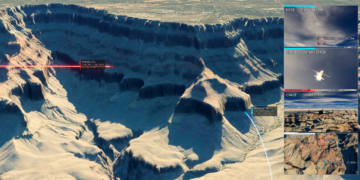
That insight led to Vizgard. The company’s core product is a visual autonomy system that turns existing defence cameras and sensors into smart, self-directing teammates. No GPS, no always-on internet. Just edge-based AI that reacts like a skilled human and coordinates like a trained unit.


With backing from Sure Valley Ventures and the UK’s National Security and Strategic Investment Fund, Vizgard recently closed a £1.5M seed round. The money is fuelling development of its AI fleet management platform—a system that controls and coordinates uncrewed assets across land, sea, and air.

“We are building a plug-and-play visual autonomy system that transforms traditional defence and security camera systems into autonomous robotic teammates,” said Kehoe. “Our sovereign UK AI integrates with existing infrastructure, operates at the edge without GPS or internet, and delivers scalable visual intelligence and precision control across fleets of AI-enabled assets – whether on land, in the air, or at sea.”

What sets Vizgard apart isn’t just technical horsepower. It’s focus. Their software avoids vendor lock-in. It works with existing hardware. It scales from a single drone to a full fleet. And it moves faster than traditional deployment models, using built-in training pipelines, versioning, and remote updates.

“The idea originated from repeated exposure to the same problem, first in uniform, and then while working with defence primes. I found end users consistently expressed the same frustration: the need to move away from complete reliance on human monitoring of their growing number of sensor feeds,” said Kehoe. “Even the most advanced sensors still generate false alarms in cluttered environments, and even the most attentive operator can miss a critical moment due to fatigue or distraction, whether it is an adversarial drone, an uncrewed vessel, or a lone intruder.”

At a time when most “AI” is just analytics dressed up in buzzwords, Vizgard is building an actual decision-making engine for national defence—one that works in the real world, not just the lab.

Tags: Alex KehoeResilience ConferenceSure Valley VenturesUK’s National Security and Strategic Investment FundVizgard
Previous Post

The role of Ukrainian civil society in the security and defence sector

Next Post

Talking about Defence Tech & Dual-Use, and the Role of NGOs in Ukraine’s defence tech sector

John Biggs

John Biggs

John Biggs is an entrepreneur, consultant, writer, and maker. He spent fifteen years as an editor for Gizmodo, CrunchGear, and TechCrunch and has a deep background in hardware startups, 3D printing, and blockchain. His work has also appeared in Men’s Health, Wired, and the New York Times. He has written nine books including the best book on blogging, Bloggers Boot Camp, and a book about the most expensive timepiece ever made, Marie Antoinette’s Watch. He lives in Brooklyn, New York. He runs the Keep Going podcast, a podcast about failure. His goal is to share how even the most confident and successful people had to face adversity.

Related News

Spiral Hydrogen raises €2.7M to pilot its new hydrogen tech at the Port of Rotterdam

Spiral Hydrogen raises €2.7M to pilot its new hydrogen tech at the Port of Rotterdam

byFiona Alston
April 30, 2026

Estonian-Dutch dual-use startup Spiral Hydrogen will be taking its centrifugal bubble-free electrolysis technology from the lab to the Port of...

Report maps Russia’s hybrid war on Poland

Report maps Russia’s hybrid war on Poland

byJohn Biggs
April 30, 2026

A new report from Defence24 has outlined the role of Russia in a number of cyberattacks and acts of sabotage....

Line illustration showing trucks, cars and a cyclist, alongside a wind turbine, solar panel, power lines, buildings and a data centre, depicting energy infrastructure

Report: Europe’s reliance on imported energy and technology presents both risk and opportunity

byPaul Sawers
April 29, 2026

Europe’s reliance on external technology and infrastructure faces growing scrutiny, as policymakers and industry leaders confront the risks of depending...

Weekly Digest: The mystery of the British unicorn – the story of our dealings with Roark Aerospace

Inside the case of Roark Aerospace: The British defence unicorn no one can verify

byIngrid Lunden
April 28, 2026

On Boxing Day 2025, we received a press release from Roark Aerospace. The UK startup, which makes anti-drone systems, reported...

German military uniform (Touko Aikioniemi from Unsplash)

Europe’s armed forces are too reliant on US cloud providers, report finds

byPaul Sawers
April 28, 2026

Europe’s defence systems depend heavily on US cloud infrastructure, leaving key military functions exposed to potential service disruptions during geopolitical...

ACUA Ocean completes three contracts with its UK-made autonomous boat

ACUA Ocean completes three contracts with its UK-made autonomous boat

byJohn Biggs
April 24, 2026

ACUA Ocean has completed three contracts under the Atlantic Net Technology Demonstrator programme, marking a step forward in the UK’s...

UNIVITY raises €27 million to build a 5G satellite constellation that can expand European communication networks

UNIVITY raises €27 million to build a 5G satellite constellation that can expand European communication networks

byJohn Biggs
April 24, 2026

UNIVITY has raised €27 million to transition its space-based telecom infrastructure from a demonstration phase to an early industrial stage....

Jacek Siewiera: a future NATO conflict will be fought against civilian targets

Jacek Siewiera: a future NATO conflict will be fought against civilian targets

byResilience Media
April 24, 2026

The wars in Iran and Ukraine have underscored how civilian infrastructure will become a feature of future conflicts. And Poland’s...

Load More
Next Post
Talking about Defence Tech & Dual-Use, and the Role of NGOs in Ukraine’s defence tech sector

Talking about Defence Tech & Dual-Use, and the Role of NGOs in Ukraine's defence tech sector

Startup HavocAI Bets Big on Autonomous Naval Drones, Eyes 100-Foot Platform by Year’s End

Startup HavocAI Bets Big on Autonomous Naval Drones, Eyes 100-Foot Platform by Year’s End

Most viewed

InVeris announces fats Drone, an integrated, multi-party drone flight simulator

Uforce raises $50M at a $1B+ valuation to build defence tech for Ukraine

Auterion, the drone software startup, eyes raising $200M at a $1.2B+ valuation

Senai exits stealth to help governments harness online video intelligence

Palantir and Ukraine’s Brave1 have built a new AI “Dataroom”

Twentyfour Industries emerges from stealth with $11.8M for mass-produced drones

Resilience Media is an independent publication covering the future of defence, security, and resilience. Our reporting focuses on emerging technologies, strategic threats, and the growing role of startups and investors in the defence of democracy.

  • About
  • News
  • Resilence Conference
    • Resilience Conference Copenhagen 2026
    • Resilience Conference Warsaw 2026
    • Resilience Conference 2026
  • Guest Posts
  • Subscribe
  • Privacy Policy
  • Terms & Conditions

© 2026 Resilience Media

No Result
View All Result
  • Home
  • Subscribe
  • About
  • Events
  • Guest Posts
  • Interview
  • News
  • Resilience Conference London 2026
  • Resilience Conference Copenhagen 2026
  • Resilience Conference Warsaw 2026
  • Startups
  • Venture
  • Weekly Digest

© 2026 Resilience Media

This website uses cookies. By continuing to use this website you are giving consent to cookies being used. Visit our Privacy and Cookie Policy.