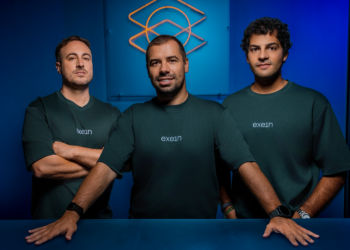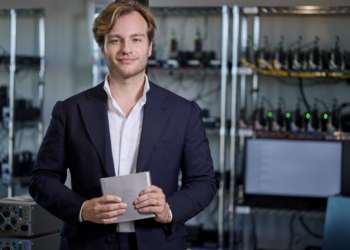
When the MITS Lightning Fund closed its first venture fund in May, its partners had raised slightly more than $20 million. The amount was well short of the fund’s $50 million target. For MITS Capital co-founder Perry Boyle, the result was a disappointment.
A Wall Street veteran who turned his attention to Ukraine after Russia’s full-scale invasion, Boyle co-founded MITS Capital with Denys Gurak and Anton Melnyk in 2024 to channel investment into the country’s defence technology industry.
“We were targeting $50 million, which I thought would not be hard,” Boyle said. “I did not think it would be this hard to raise money to invest in Ukraine.”
At the same time that other investors are also out raising money – Resist.UA is also looking for $50 million for its latest investment fund – Boyle attributes the shortfall to a combination of wartime risks and Ukrainian policies that discourage investment.
Unless those policies change, he warns, Ukraine risks seeing promising defence companies relocate or sell to foreign buyers, weakening its ability to retain the benefits of its wartime innovation.
Recorded investment in Ukrainian defence technology has nevertheless been growing. PitchBook tracked $57.2 million across 28 equity deals in 2025, up from $37.9 million across 20 deals in 2024. But capital has flowed unevenly: a March 2026 KSE Institute report found that major investments were concentrated in AI and software, which investors viewed as less risky and less exposed to export restrictions than hardware and weapons production. The findings suggest that battlefield demand alone does not determine which companies attract investment.
“Ukraine makes it unreasonably hard to do business in Ukraine,” Boyle said.
The complaints are not new. In an August 2025 interview with Defense Mirror, Boyle raised concerns about financing instruments, banking access and the difficulty of finding exits for investors. More than a year later, he says those barriers remain consequential.
One example is the difficulty of using SAFEs, or simple agreements for future equity, which allow startups to raise money while deferring the valuation used to determine an investor’s ownership stake. These are not a legally well-supported mechanism in Ukraine.
“Ukraine has to catch up with the rest of the world on modern financial techniques,” he said.
Access to familiar financing instruments is one reason Ukrainian defence technology companies establish holding companies abroad, even when their development and manufacturing remain in Ukraine. Such is the case with companies like Swarmer and UFORCE, which respectively publicly listed in the US and officially headquartered in the UK. Boyle doesn’t look optimistically on that kind of shift.
“UFORCE left Ukraine. They’re a UK company. This is a tragedy.” Boyle said.
Wartime capital controls create another obstacle by restricting investors’ ability to transfer capital and returns out of the country. Introduced after the invasion to prevent capital flight and maintain financial stability, the rules limit certain payments abroad including dividends and repayments of foreign loans. The restrictions have eased somewhat since their inception, but conditions and limits remain. For investors, this means a successful business does not necessarily translate into freely accessible returns.
Intellectual property is another key issue. Boyle said foreign investors do not regard Ukraine’s IP enforcement mechanisms as equivalent to those in EU or US jurisdictions. He pointed to Ukraine’s specialized High IP Court, which has yet to become operational, and the country’s absence from the European Patent Convention.
The difficulties also extend to staffing. Boyle said MITS Capital cannot secure mobilization exemptions for its employees, which allow workers in certain specializations not to be conscripted. These are available to companies that supply the war effort directly, but not to private firms like MITS.
“That grossly favors foreign companies over companies that operate in Ukraine,” he said. “I would be better off moving my business to Warsaw than doing my business in Kyiv. It would be much easier.”
Operating outside Ukraine would also ease concerns over mobilization exemptions for staff, bank accounts and cross-border capital movements (which are subject to strict wartime controls), he argued.
“This sends a message to me and to other Ukrainian entrepreneurs: Don’t [base] your business in Ukraine. Do [it] outside Ukraine.”
For Boyle, these are not isolated administrative problems. Together, they threaten Ukraine’s ability to retain the very defence ecosystem that has emerged out of this war.
“There is no coherent government industrial policy around its defence industry, and it is going to lose its defence industry unless it fixes this,” he said.
Preparing for consolidation
MITS sees itself as part of a solution. It operates two main businesses: MITS Capital, which finances and helps develop defence technology companies, and MITS Industries, which combines Ukrainian manufacturers into a larger defence group serving European markets.
According to Boyle, MITS Capital’s portfolio includes about 21 companies, most working on drones or related components. Alongside its venture investments, it runs an accelerator and provides investment-banking and advisory services.
The accelerator helps startups strengthen their corporate structures, financial controls and commercial operations. Not every company completes the process: Boyle said one participant in the first cohort could not assemble the documentation needed to pass due diligence.
“We hold them to certain performance indicators and standards, not because we need bureaucracy and paperwork, but because unless they do that, they will not be investable from a European or US venture capital fund,” he said. He declined to name the company.
While MITS Capital prepares individual businesses for investment, the intention of MITS Industries is to help shape the next phase.
“We’ve had the proliferation phase in Ukraine, and now we have to go through a consolidation phase,” Boyle said.
MITS Industries names signals-intelligence company Infozahyst and electronic-warfare and counter-drone developer Unwave among its founding companies. Its stated objective is to combine complementary technologies into integrated counter-drone systems, supported by shared infrastructure and access to international capital. Others are also seeking to integrate Ukrainian miltech companies into larger, consolidated businesses. Last week Swarmer announced its intention to acquire Ratel Robotics. Meanwhile, former Defence Minister Mykhailo Fedorov is developing a fund that would both invest in existing Ukrainian startups and create new miltech companies.
Boyle may be critical of how Ukrainian defence technology businesses are setting up shop outside of the country, but he’s doing the same himself. MITS Industries happens to be structured as a Danish holding company. Boyle said that incorporation in Denmark offers investors European governance, financial controls and compliance standards. Denmark’s support for Ukraine by way of capital and more, and the small size of the country’s own defence industry also influenced the choice.
“Denmark needs what Ukraine makes and cannot make it itself,” he said.
That arrangement, indeed, illustrates a tension in Boyle’s argument. Foreign incorporation can provide the financing and market access he wants Ukrainian companies to obtain. It does not necessarily mean their factories, engineering teams or jobs leave Ukraine. MITS’ stated aim is to use its Danish structure while keeping Ukrainian operations anchored at home.
The wider question is how much ownership, investment and economic activity Ukraine retains if and when its defence companies expand internationally.
Overseas customers matter as well as overseas investors. Export sales can help companies diversify beyond Ukrainian wartime procurement and generate the revenues needed to sustain production and attract further capital.
Despite the difficulties raising its first fund, MITS Capital is now seeking €100 million for a second. Boyle said the money would primarily support existing portfolio companies, alongside nine to 12 additional businesses in its pipeline. He expects the portfolio to approach 30 companies over the next year, with greater emphasis on directed energy and software.
“We know where to invest the money,” he said. “We have the pipeline.”
The larger target reflects his conviction that investment opportunities are already available. Securing the capital to pursue them remains the challenge.
The next technological bottleneck
Boyle says he thinks about the war in three layers: ground combat, drones and missiles. He praises Ukrainian soldiers’ ability to hold the front against a larger opponent, but sees growing technological challenges in the air.
Russia producing faster Geran attack drones are one concern. Boyle contrasts targets flying at roughly 300 kilometers per hour with even newer variants capable of around 600 kilometers per hour, arguing that interceptors developed for slower threats are inadequate against faster ones.
“We need a new generation of interceptor,” he said.
In Boyle’s assessment, that requires more sophisticated electronics for tracking and engaging incoming drones. As attack drones become more missile-like, interceptors will need capabilities beyond those of the relatively inexpensive systems developed earlier in the war.
He identifies radar seekers – the sensors used to guide missile-based interceptors toward their targets – as a particularly important constraint. Optical systems have helped make drone interception affordable, but Boyle argues that faster targets will increasingly require radar, adding cost and technical complexity.
That connects the drone problem to the missile problem. Boyle also sees access to radar seekers, alongside suitable propulsion technology, as essential to developing Ukrainian defenses against ballistic missiles as well.
In the meantime, he believes that Ukraine and Europe remain too dependent on limited supplies of expensive foreign interceptors.
His criticism focuses particularly on the Patriot missile supply chain. Boyle points to Lockheed Martin’s role in PAC-3 missile assembly, L3Harris’ role in rocket motors and Boeing’s role in seekers, describing the arrangement as a series of component-level monopolies.
In his view, that concentration weakens incentives to reduce prices and expand production as quickly as demand requires. He also argues that Europe has not sufficiently expanded production of its own French-made Aster interceptors to reduce dependence on US systems.
“Europe is missing a key component of its defence by relying on U.S. Patriot missiles and not ramping production of the Asters,” he said.
Ukraine’s ministry of defence says that it has contracted for 1,000 Patriot missiles over the coming years, partly by way of an EU loan. But supplies are constrained. Lockheed Martin delivered just 620 PAC-3 interceptors in 2025 to meet demand from the United States and its allies, with a planned increase to roughly 2,000 annually not expected until 2030. US military operations in Iran have put further pressure on US stocks, adding American combat requirements to demand from Ukraine and other allies.
MITS is not currently investing in radar seekers, Boyle said, but the technology is among the capabilities it wants to develop through MITS Industries.
Directed-energy systems offer another potential investment opportunity. Boyle expects counter-drone lasers to become more common as costs fall. He believes Ukrainian developers can compete on price. These systems also depend on sensors capable of finding and tracking small, fast-moving targets.
For Boyle, these industrial and technological choices form part of a larger strategic question: whether Europe is prepared to help Ukraine defeat Russia.
He argues that integrating Ukrainian capabilities into European defence is essential to Europe’s own security. If Russia prevails, he warns, it could turn Ukraine’s industrial capacity and resources against the rest of the continent.
Yet he sees a gap between the urgency felt in Ukraine and attitudes elsewhere in Europe. Outside the country, he said, the war can feel “like a movie or an abstraction,” making it easier to put out of mind.
Ultimately, he argues that Europe needs to move from defence to offence, pursuing Russia’s defeat rather than simply helping Ukraine withstand its attacks.
Financing Ukraine’s defence industry and integrating it into Europe’s military capabilities are part of that shift.
“The right outcome is a defeat of Russia,” Boyle said.