Friday 26 June, 2026
[email protected]
Resilience Media
  • News
    • Events
    • Interview
    • Startups
    • Venture
    • Weekly Digest
  • Resilience Conference
    • Resilience Conference Warsaw 2026
    • Resilience Conference Copenhagen 2026
    • Resilience Conference London 2026
  • About
  • Guest Posts
    • Author a Post
  • Subscribe
No Result
View All Result
  • News
    • Events
    • Interview
    • Startups
    • Venture
    • Weekly Digest
  • Resilience Conference
    • Resilience Conference Warsaw 2026
    • Resilience Conference Copenhagen 2026
    • Resilience Conference London 2026
  • About
  • Guest Posts
    • Author a Post
  • Subscribe
No Result
View All Result
Resilience Media
No Result
View All Result

Battlefield innovation drives surge in cyber attacks on defence contractors

New report warns drone developers and advanced weapons suppliers are becoming prime cyber targets as espionage campaigns expand across Europe’s defence industrial base

Carly PagebyCarly Page
February 10, 2026
in News
a desk with several monitors
Share on Linkedin

Defence firms developing next-generation battlefield technologies are increasingly being targeted by state-backed hackers and cybercriminal groups, according to a new report warning that the defence industrial base is under sustained, multifaceted cyber pressure.

You Might Also Like

Sanctioned Chinese cyber giant claims AI can rival Anthropic’s Mythos

SE3 Labs unveils its spatial AI tools for defence backed by Lakestar and Sequoia Scouts

Copenhagen-based startup Acodyne lands €2.5 million pre-seed round for autonomous cargo drones

The report, produced by Google Threat Intelligence Group (GTIG) and shared with Resilience Media ahead of publication, found that firms developing new defence technologies are attracting growing attention from cyber spies.

The activity ranges from attempts to steal sensitive research to efforts to disrupt manufacturing and to learn how emerging weapons systems are designed and used. 

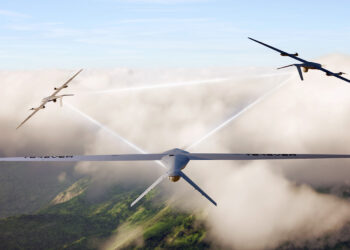
It highlights unmanned aircraft systems (UAS) as a particular focus, reflecting the central role drones have played in the Russia-Ukraine war and their growing importance in future conflict planning.

Russian state-linked actors are actively targeting organisations involved in drone production and related battlefield technologies, the report says, with operations extending beyond military users to include defence contractors and suppliers.

Threat groups have been observed impersonating legitimate defence companies and military systems to deliver malware or harvest credentials, indicating a shift toward supply-side targeting to undermine or monitor weapons development pipelines.

European defence suppliers are among those in the crosshairs.

The report identifies a suspected Russian espionage cluster, UNC5976, that has been running phishing operations since January 2025, using domains and infrastructure that impersonate defence contractors and telecom providers across the UK, Germany, France, Sweden, and Norway. The campaigns relied on fake domains and defence-themed lures to capture credentials and gain footholds within organisations connected to defence production and military communications.

Alongside direct targeting of companies, the report warns that employees themselves have become a major attack surface. Adversaries are increasingly exploiting recruitment processes, personal email accounts, and remote working arrangements to bypass corporate security controls.

The report also points to campaigns linked to several state actors, including North Korea, Iran, and China, which use fake job offers, compromised recruitment platforms, and insider-style tactics to gain access to defence networks and sensitive data. Much of this activity occurs outside company security monitoring, according to GTIG, making it harder to detect.

China-linked espionage activity represents the most persistent and highest-volume state threat identified in the report. Over the past two years, China-nexus groups have carried out more cyber intrusions targeting defence and aerospace organisations than any other nation-state actor tracked by the researchers. Their campaigns frequently exploit vulnerabilities in edge infrastructure, such as VPN appliances, routers, and network security devices, which often lack endpoint monitoring capabilities.

Since 2020, Chinese espionage groups have been assessed as having exploited more than two dozen previously unknown vulnerabilities in such systems to establish stealthy, long-term access to high-value targets, according to the report.

Luke McNamara, deputy chief analyst at GTIG, said the findings highlight how rapidly cyber threats are evolving alongside innovation in defence technology.

“The defense industry remains a primary target for sophisticated cyber operations. From the frontline targeting of drone developers in Ukraine to stealthy espionage campaigns by China-nexus threat actors, the threat landscape is shifting rapidly. As global investment in defense continues to grow, the expanding range of adversary tactics makes building resilience across the entire ecosystem an urgent priority.”

The report also highlights persistent cyber risk across the wider defence supply chain. While dedicated aerospace and defence organisations account for only a small proportion of ransomware victims listed on dark web leak sites, the broader manufacturing sector — which includes companies producing dual-use components for defence programmes — remains heavily targeted. Researchers warn that disruption to these suppliers could hinder nations’ ability to scale defence production during crises, even when attacks are limited to corporate IT environments rather than operational technology.

The report also points to growing hacktivist involvement. Pro-Russia groups have increasingly targeted Ukraine’s drone operations, claiming attacks intended to disrupt airspace monitoring and using stolen information to map manufacturing sites.

Google’s findings suggest the defence industrial base is facing constant pressure from espionage campaigns, cybercrime, and politically motivated attacks. The report notes that as militaries invest more heavily in autonomous and software-driven systems, securing the companies and supply chains behind those technologies is becoming just as important as protecting the weapons themselves.
Tags: Cybersecuritygooglesecurity
Previous Post

Constellr snaps up €37M to expand its thermal satellite imaging  

Next Post

Hypersonica raises €23.3M to develop hypersonic missiles for Europe

Carly Page

Carly Page

Carly Page is a freelance journalist and copywriter with 10+ years of experience covering the technology industry, and was formerly a senior cybersecurity reporter at TechCrunch. Bylines include Forbes, IT Pro, LeadDev, The Register, TechCrunch, TechFinitive, TechRadar, TES, The Telegraph, TIME, Uswitch, WIRED, & more.

Related News

a chinese flag hanging from the side of a building

Sanctioned Chinese cyber giant claims AI can rival Anthropic’s Mythos

byCarly Page
June 26, 2026

A Chinese cybersecurity company sanctioned by the US claims it has developed an artificial intelligence system capable of hunting software...

SE3 Labs unveils its spatial AI tools for defence backed by Lakestar and Sequoia Scouts

SE3 Labs unveils its spatial AI tools for defence backed by Lakestar and Sequoia Scouts

byIngrid Lunden
June 26, 2026

Large Language Models are changing how non-technical people engage with AI, and those learnings are permeating into the world of...

Copenhagen-based startup Acodyne lands €2.5 million pre-seed round for autonomous cargo drones

Copenhagen-based startup Acodyne lands €2.5 million pre-seed round for autonomous cargo drones

byJohn Biggs
June 25, 2026

Copenhagen-based Acodyne announced it has raised €2.5 million in pre-seed funding to help build autonomous cargo aircraft designed for "heavy...

Nearfield Instruments

Nearfield Instruments raises $380M to stake Europe’s claim in the global chip supply chain

byPaul Sawers
June 25, 2026

Sovereignty has emerged as one of the defining strategic preoccupations in Europe today, intersecting with almost every aspect of national...

Irish space tech firm Ubotica raises $11M

Irish space tech firm Ubotica raises $11M

byFiona Alston
June 24, 2026

Ubotica, the Irish space tech firm developing orbital AI for satellites, has raised $11 million to scale the commercialisation of...

Dutch semiconductor company is bringing secure, authenticated satellite positioning to handheld devices

Dutch semiconductor company is bringing secure, authenticated satellite positioning to handheld devices

byJohn Biggs
June 23, 2026

For years, authenticated satellite positioning has largely been reserved for expensive, power-hungry systems operating in defence, aviation, and other specialised...

Stark inks Virtus deal with NATO member in Northern Europe, one week after expanding to Sweden

Stark confirms monster €500M funding round, reportedly approaching a €3B valuation

byIngrid Lunden
June 23, 2026

It's another big news day for defence tech startups in Europe. Stark -- the company building air and surface attack...

a satellite satellite flying over the earth

Russia is jamming GPS from space

byPaddy Stephens
June 23, 2026

Russia can jam GPS across Europe, and as far west as Canada – and has been doing so for over...

Load More
Next Post
Hypersonica raises €23.3M to develop hypersonic missiles for Europe

Hypersonica raises €23.3M to develop hypersonic missiles for Europe

aerial view of city buildings during sunset

European defence, security and resilience startups raised a record $8.7B in 2025

Most viewed

InVeris announces fats Drone, an integrated, multi-party drone flight simulator

Uforce raises $50M at a $1B+ valuation to build defence tech for Ukraine

Auterion, the drone software startup, eyes raising $200M at a $1.2B+ valuation

Palantir and Ukraine’s Brave1 have built a new AI “Dataroom”

Twentyfour Industries emerges from stealth with $11.8M for mass-produced drones

Senai exits stealth to help governments harness online video intelligence

Resilience Media is an independent publication covering the future of defence, security, and resilience. Our reporting focuses on emerging technologies, strategic threats, and the growing role of startups and investors in the defence of democracy.

  • About
  • News
  • Resilence Conference
    • Resilience Conference Copenhagen 2026
    • Resilience Conference Warsaw 2026
    • Resilience Conference 2026
  • Guest Posts
  • Subscribe
  • Privacy Policy
  • Terms & Conditions
  • Mission Statement & Code of Practice
  • Press

© 2026 Resilience Media

No Result
View All Result
  • Home
  • About
  • Subscribe
  • Events
  • Guest Posts
  • Interview
  • News
  • Resilience Conference London 2026
  • Resilience Conference Copenhagen 2026
  • Resilience Conference Warsaw 2026

© 2026 Resilience Media

This website uses cookies. By continuing to use this website you are giving consent to cookies being used. Visit our Privacy and Cookie Policy.