
Ahead of the big Munich Security Conference later this week, the analysts at Dealroom teamed up with the NATO Innovation Fund to take a look at the startup funding ecosystem in deep tech — specifically in the areas of defence, security and resilience.
As you might expect, the current moment of geopolitical upheaval — punctuated by the ongoing war in Ukraine and a hardening sovereignty stance among superpowers — has directly intersected with the rapid pace of tech development and venture money fuelling smaller innovators. The result is an all-time high for venture activity in defence, security and resilience.
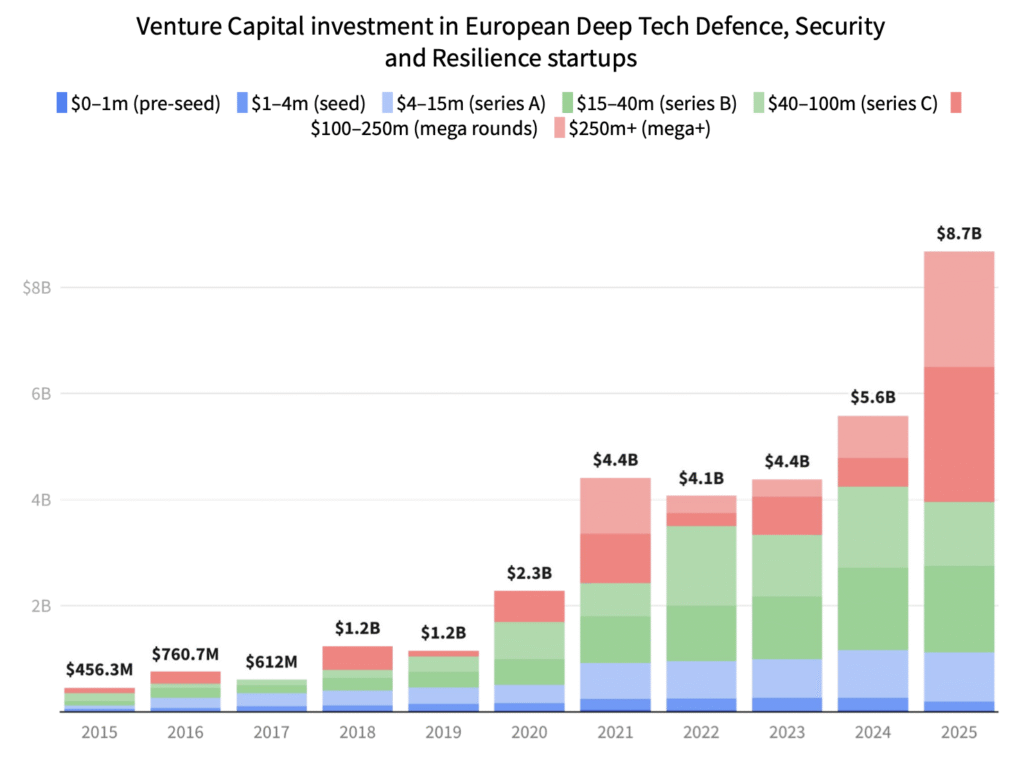
Some $8.7 billion was funnelled into “deep tech” startups across the DSR category last year, up 55% on 2024.
In a measure of just how much the landscape has changed in the last several years, that $8.7 billion figure is up almost four-fold compared to 2020, the year marked by the global Covid-19 pandemic, with VCs sinking billions into startups that catered to how businesses were being run (in the cloud) and people were living their lives (at home).
Important to note that funding does not provide a complete picture of the market.
Take a country like Ukraine and arguably some of the most cutting-edge development underway there is nowhere near a term sheet. Case in point: Dealroom notes that Ukraine is likely to produce 7 million drones this year, having produced 4 million in 2025. Drones are the most visible piece of defence tech in the market right now but a lot of that Ukraine activity might not be getting captured in the Dealroom report.
And there are many founders in DSR deep tech that come from outside the startup world who eschew private funding and/or publicly disclosing it.
Still, it’s an important barometer of the climate for these companies. The hardware and compute tasks involved in many deep tech endeavors eventually do need significant capital injections, and in an ideal world where where you can separate the genuinely interesting from overvalued hype, they speak to the wider interest and appetite for this technology. Here are some of the notable top-line takeaways:
DSR accounted for 43% of all deep tech funding in 2025
Dealroom does not give its won explicit definition of what “deep tech” means overall but generally the idea is a focus on technology that may still be in the R&D phase and may not be immediately commercialisable. (But this is an imperfect definition here, since some of the biggest rounds of the year included in the tallies are for Helsing and Quantum Systems, very much selling product to the market today.) It notes that categories include quantum computing, space tech, autonomy and AI, next-generation manufacturing, biotech, energy, communication and hypersonic technology. But this 43% figure speaks to investors’ smaller appetite for riskier bets overall: the $7.8 billion is just 13% of all VC funding last year. However, it’s increased 3X in the last three years.
Large growth rounds dominate the overall total
This is not a surprise: outsized growth rounds driving trends has been the case in tech for years. The biggest rounds in 2025 included $800 million for Quantinuum (quantum computing), €600 million for Helsing (drones and autonomous systems), $600 million for Isomorphic Laboratories (AI/pharmaceutical spin-out from Alphabet-owned DeepMind), €340 million for Quantum Systems (autonomous systems, not quantum), $320 million for IQM (quantum), €189 million for Multiverse (quantum), €150 million for Isar Aerospace (satellites), €150 million for ICEYE (satellites), and €140 million for Destinus (hypersonic aircraft, not missiles). As you can see in the table below, nine-figure rounds (of over $100 million) accounted for slightly more than half of all investments over the year. That still leaves a room for long-tail investments but not as much, but it does show that there is growth money to be found, and likely there might be more going forward.
AI dominates funding
As with technology overall, the AI train is roaring through deep tech DSR, accounting for 44% of all investments. This will pick up a lot of hype-driven company building and investing, but some of that effort is bound to carry over into the longer term trajectory of how the category, and the startups in it, evolve.
Regional leaders
Just as the larger funding rounds dominate the overall picture for funding, they contribute to mapping out other trends, such which parts of Europe represent the most activity. Overall, the UK dominated all funding for 2025, as it has done since 2020, Dealroom noted. Part of this might be attributed, however, to it being the home of some of the single biggest deals in the year, namely Quantinuum and Isomorphic Labs.
Anecdotally, if it has felt to you like Munich is the city dominating in defence tech startups right now, you would not be wrong. Its proximity to manufacturing infrastructure combined with a longstanding culture of engineering education and industry has resulted in no less than 42 VC-backed startups operating in and around the city. (That’s not counting those that don’t take VC money.) Munich startups collectively raised $1.7 billion in VC funding in 2025, up 18-fold since 2020. Dealroom estimates the collective valuation of these startups at $22.7 billion. And from the looks of it, based on funding rounds we have covered just today for Constellr and Hypersonica — covering two of the big categories of deep tech, respectively space and hypersonics — that pace is not slowing down this year.
No exit
This is a pretty striking graphic that Dealroom has drawn up to show what kind of exits deep tech DSRs have achieved. Note that there was not a single public listing of any company, and just 20 M&A deals in 2025.
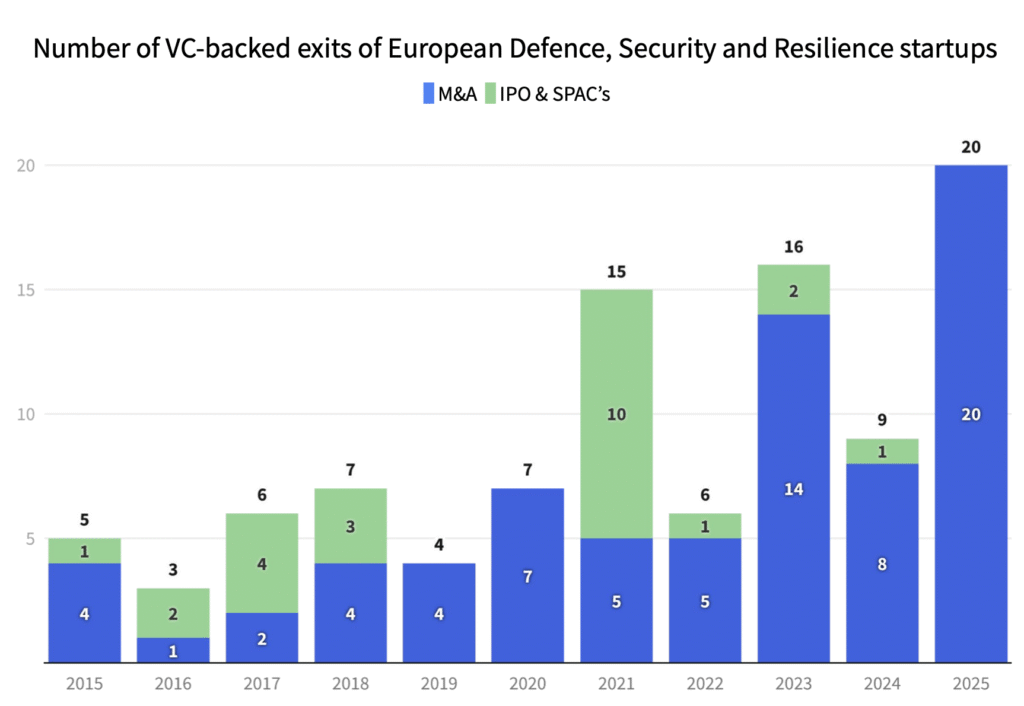 The lack of IPOs underscores what is happening across the rest of the tech market: the window has slightly opened in the US but activity is nowhere close to where it was before 2020. The smaller number of M&A deals, meanwhile, likely speaks less to the health of the market and more to the stage that the market is in right now: most companies are still very young, founded after 2022, and won’t be looking for exits just yet. There’s more to come on this front, no doubt, in the next few years: investors will want their liquidity events, and not all of these hopefuls will be transitioning into becoming primes, so there will be consolidation, if not a lot of disappearances, ahead.
You can read the full report here.