Saturday 13 June, 2026
[email protected]
Resilience Media
  • News
    • Events
    • Interview
    • Startups
    • Venture
    • Weekly Digest
  • Resilience Conference
    • Resilience Conference Warsaw 2026
    • Resilience Conference Copenhagen 2026
    • Resilience Conference London 2026
  • About
  • Guest Posts
    • Author a Post
  • Subscribe
No Result
View All Result
  • News
    • Events
    • Interview
    • Startups
    • Venture
    • Weekly Digest
  • Resilience Conference
    • Resilience Conference Warsaw 2026
    • Resilience Conference Copenhagen 2026
    • Resilience Conference London 2026
  • About
  • Guest Posts
    • Author a Post
  • Subscribe
No Result
View All Result
Resilience Media
No Result
View All Result

Post-Quantum trials quantum-resilient drones built for future battlefield threats

Trial sees heavyweight post-quantum cryptography deployed on drones for the first time, with plans to move toward allied deployment

Carly PagebyCarly Page
March 31, 2026
in News
black and white round illustration
Share on Linkedin

A UK-based cybersecurity startup claims to have done what many in cryptography circles have long written off as impractical: getting one of the heaviest post-quantum algorithms airborne on a drone without compromising its flight.

You Might Also Like

NATO Innovation Fund appoints Nur Özdemir as its newest partner

Jarvis takes on MoD crisis as second minister resigns over defence spending

France moves to boost its military budget with €36B

Post-Quantum and STV Group say they have successfully trialled a quantum-resilient drone platform built around the airborne use of Classic McEliece, with testing carried out at STV’s weapons facility in the Czech Republic and further field validation planned on systems already operating in active theatres. 

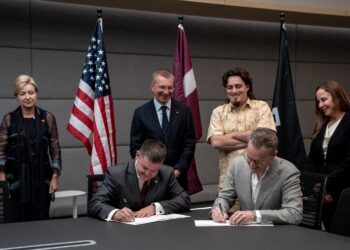
The trial builds on an earlier partnership between Post-Quantum and STV to embed quantum-safe communications across defence systems, including drones and command-and-control networks, aimed at NATO and allied deployments. 

At the centre of the claim is not just that post-quantum cryptography can be made to work on unmanned systems, but that one of its most unwieldy candidates can be made operational. Classic McEliece has long been regarded as a non-starter for constrained environments due to its large public key size, typically around one megabyte. That has pushed most real-world implementations towards more efficient alternatives, particularly CRYSTALS-Kyber.

“Nobody has solved that for a drone before. We have,” Post-Quantum CEO Rikky Hasan told Resilience Media. “Classic McEliece has nearly 50 years of unbroken cryptanalytic scrutiny behind it and no other post-quantum algorithm comes close to that security track record. Deploying a newer, less-studied algorithm on a military platform because it is more convenient is a risk decision. We chose not to make that compromise.”

The company’s approach has been to avoid treating the algorithm as a drop-in replacement for existing cryptography. Instead, it has engineered how and where it is used within the communications stack. 

“Rather than treating it as a generic, drop-in replacement, we engineered how and where it is used within the communications stack,” Hasan explained. “We designed the communication flow so that Classic McEliece is used where its performance characteristics minimise bandwidth and latency impact.”

That design decision appears to be doing much of the heavy lifting. The main overhead associated with Classic McEliece – the large public key exchange – is handled at session establishment, outside the critical flight window. “Once airborne, the cryptographic workload is lightweight and the data exchanged remains minimal,” Hasan said. “In normal operation, the impact is negligible.”

Those are bold claims in a domain where even small performance penalties can have operational consequences. Drone systems operating in contested environments must already contend with jamming, degraded links, and intermittent connectivity. Any additional burden on bandwidth or power risks reducing range, endurance or reliability. Post-Quantum says testing at STV’s facility confirmed that the system can operate effectively under those conditions, though it is not yet publishing detailed performance data.

The system has been validated in testing, but not yet deployed in live operations. Even so, Hasan argues the gap between trial and deployment is narrow. “We are not claiming live operational deployment today,” he said. “We are claiming a validated, deployment-ready platform with a clear and short path to theatre.”

That confidence rests in part on STV’s position as a supplier whose unmanned systems are already in use in active conflict zones. The company’s ability to deploy platforms directly to theatre without further certification is being presented as a key enabler for rapid adoption, particularly as allied defence programmes look to harden systems against emerging threats.

Chief among those is the so-called “harvest now, decrypt later” risk, which Hasan describes in unequivocal terms. “It is the most immediate and concrete quantum threat in the defence domain, and it is already happening,” he said. “State-level adversaries… are intercepting and storing encrypted communications now. The question is not whether they will attempt this, it is whether the data will still be sensitive when decryption becomes feasible.”

In the case of drone operations, that sensitivity can persist for years. ISR data – from video feeds to telemetry –  may retain intelligence value long after it is captured, particularly in protracted conflicts or when analysing infrastructure and force movements. “A drone procured today may be flying operationally in 2030 or 2035,” Hasan said. “The encryption protecting its communications must be secure not just today but across that entire operational life.”

The argument is that if systems are expected to remain in service for decades, then the cryptography underpinning them must be selected with that lifespan in mind. “Classical encryption cannot provide that assurance,” Hasan said. “Post-quantum cryptography, implemented now, at the point of manufacture, is the only solution.”

Whether defence buyers accept that argument will depend on how the technology performs in real-world conditions beyond controlled trials. However, the work by Post-Quantum and STV suggests that even the most cumbersome forms of post-quantum cryptography may be edging closer to operational reality – not by changing the algorithms themselves, but by rethinking how they are deployed in the systems that depend on them.

Tags: dronePost-QuantumSTV
Previous Post

A BEAM of light for EU sovereignty as Belgium rolls out Matrix-based messaging app for government

Next Post

Airbus demonstrates is autonomous Bird of Prey interceptor drone in Germany

Carly Page

Carly Page

Carly Page is a freelance journalist and copywriter with 10+ years of experience covering the technology industry, and was formerly a senior cybersecurity reporter at TechCrunch. Bylines include Forbes, IT Pro, LeadDev, The Register, TechCrunch, TechFinitive, TechRadar, TES, The Telegraph, TIME, Uswitch, WIRED, & more.

Related News

NATO Innovation Fund appoints Nur Özdemir as its newest partner

NATO Innovation Fund appoints Nur Özdemir as its newest partner

byIngrid Lunden
June 12, 2026

The NATO Innovation Fund, the $1 billion+ investment vehicle for NATO to back innovative startups in defence and resilience tech,...

Jarvis takes on MoD crisis as second minister resigns over defence spending

Jarvis takes on MoD crisis as second minister resigns over defence spending

byCarly Pageand1 others
June 12, 2026

The chaos sweeping over the United Kingdom's Ministry of Defence shows no signs of dying down. Just hours after John...

Eiffel Tower, Paris France

France moves to boost its military budget with €36B

bystanislaw naklicki
June 12, 2026

The United Kingdom Ministry of Defence is in meltdown right now, with the secretary of defence, one of his top...

Tytan Technologies

The primes and the upstarts: Counter-drone tech makes for fast friends at ILA Berlin

byPaul Sawers
June 12, 2026

Mercedes-Benz is pushing deeper into defence technology, announcing this week a partnership with a Munich drone-defence startup to mount counter-drone...

Helsing expands CA-1 platform with AI-powered Electronic Attack drone

Helsing expands CA-1 platform with AI-powered Electronic Attack drone

byJohn Biggs
June 11, 2026

Helsing, a leading European AI-infused weapons manufacturer, has announced the launch of the CA-1 Electronic Attack or CA-1EA, an uncrewed,...

Breaking: John Healey resigns as UK Defence Secretary in protest over funding shortfall

Breaking: John Healey resigns as UK Defence Secretary in protest over funding shortfall

byIngrid Lundenand1 others
June 11, 2026

The United Kingdom's long-delayed Defence Investment Plan has yet to be published, but it has already claimed a very serious...

a close-up of a money bill

Ukraine gets down to AI business

byThomas Macaulay
June 11, 2026

Ukraine is celebrated as a bottom-up laboratory for military innovation. The popular narrative casts its defence-tech scene as a landscape...

Orqa unveils hybrid tactical drone for jammed battlefields

Orqa unveils hybrid tactical drone for jammed battlefields

byJohn Biggs
June 11, 2026

Croatian drone manufacturer Orqa has announced the launch of their latest tactical drone, the MRM2-10AI, a hybrid Unmanned Aerial Vehicle...

Load More
Next Post
Airbus demonstrates is autonomous Bird of Prey interceptor drone in Germany

Airbus demonstrates is autonomous Bird of Prey interceptor drone in Germany

Varjo begins shipping “extended reality” training systems to Ukraine

Varjo begins shipping "extended reality" training systems to Ukraine

Most viewed

InVeris announces fats Drone, an integrated, multi-party drone flight simulator

Uforce raises $50M at a $1B+ valuation to build defence tech for Ukraine

Auterion, the drone software startup, eyes raising $200M at a $1.2B+ valuation

Palantir and Ukraine’s Brave1 have built a new AI “Dataroom”

Twentyfour Industries emerges from stealth with $11.8M for mass-produced drones

Senai exits stealth to help governments harness online video intelligence

Resilience Media is an independent publication covering the future of defence, security, and resilience. Our reporting focuses on emerging technologies, strategic threats, and the growing role of startups and investors in the defence of democracy.

  • About
  • News
  • Resilence Conference
    • Resilience Conference Copenhagen 2026
    • Resilience Conference Warsaw 2026
    • Resilience Conference 2026
  • Guest Posts
  • Subscribe
  • Privacy Policy
  • Terms & Conditions
  • Mission Statement & Code of Practice
  • Press

© 2026 Resilience Media

No Result
View All Result
  • Home
  • About
  • Subscribe
  • Events
  • Guest Posts
  • Interview
  • News
  • Resilience Conference London 2026
  • Resilience Conference Copenhagen 2026
  • Resilience Conference Warsaw 2026

© 2026 Resilience Media

This website uses cookies. By continuing to use this website you are giving consent to cookies being used. Visit our Privacy and Cookie Policy.