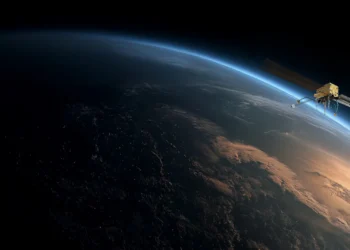

Starlink – estimated as the largest low Earth orbit (LEO) communications constellation by a long shot – has been invaluable to the Ukrainian military in fending off Russia’s full scale invasion.
That has not gone unnoticed elsewhere. Since 2022, China has worked to accelerate deployment of its own planned Guowang constellation, one of several the country has planned according to its filings with the ITU, though some may never come to fruition.
Guowang is sometimes inaccurately described as China’s Starlink. But a picture is emerging indicating that the system has a much wider range of possible functions beyond just communication.
China has less than operational 200 Guowang satellites in orbit, compared to the thousands needed for full deployment. For the time being, China simply does not have the launch capacity to deliver the bigger number. But as a handful of Chinese rocket companies edge towards reusability, that may change in the next few years.
So what exactly is Guowang? And what would be the strategic implications if China manages to deploy it?
One way to look at the first question – about which unclassified information is scarce – is to look at what China thinks Starlink is, says Victoria Samson, chief director of space security and stability for Secure World Foundation.
There are a broad range of potential capabilities and payloads that Guowang could plausibly have, such as for reconnaissance or electronic warfare.
“If they think Starlink has [X], and they’re doing their version of Starlink… [we can ask ourselves] did they build [X] in?” Samson says, noting that any such inferences about what Guowang has are “speculative.”
As Berlin-based think tank MERICS recently noted, Chinese military observers seem to “fear that Starlink could strengthen US military dominance and threaten China, for example by intercepting its missiles or engaging in electronic warfare.”
Samson continues that China may be conflating Starlink with Starshield, the military-grade LEO system used by one military in particular, that of the US, and also operated by SpaceX. According to figures from Jonathan McDowell’s Space Report, the US has launched 212 Starshield satellites. Nevertheless, they remain shrouded in secrecy.
A report by RAND published last year found that “PLA researchers rarely make efforts to distinguish between the satellite internet constellation Starlink and its military derivative Starshield in their publications”.
The authors continue that PLA researchers seem to view Starlink’s capabilities as including “highly sophisticated and resilient command, control, computing, communications, cyber, intelligence, surveillance, reconnaissance, and targeting (C5ISRT) sufficient to provide US. forces ‘one-way transparency’ on any battlefield.”
A 2022 piece in China’s Liberation Army Daily states that Starlink has “deep ties to the US military” and “Starlink satellites can carry reconnaissance, navigation, and meteorological payloads.”
There are no images of Guowang satellites, but analysts have tried to guess the weight of each satellite based on the possible payloads of the launch vehicles being used. If it is assumed that the rockets are carrying close to their maximum payload – and that is not necessarily the case – these are much heavier than you would expect communications satellites to be, indicating some other payloads may be on board.
State media coverage of the new Five Year plan – unveiled and approved in March – highlights China’s plans to “construct a satellite internet constellation and deeply integrate it with BeiDou navigation system,” referring to China’s equivalent of GPS. It’s not clear whether this refers to Guowang specifically or China’s overall satellite ambitions.
Earlier Chinese news reports, referenced in a piece in The Space Review, state that Guowang satellites can carry payloads including broadband communication payloads, laser communication payloads, synthetic aperture radar payloads, optical remote sensing payloads, and others, to meet the needs of different users and scenarios. They also indicate that it has some kind of positioning and navigation capabilities.
In his testimony to a house committee in December, deputy director of the Aerospace Security Project at CSIS Clayton Swope stated that “in addition to providing broadband, Guowang may serve as the backbone for a plug-and-play system that incorporates satellites having synthetic aperture radar, electro-optical sensors, or other payloads.”
If the reports are true, the overall picture is of a system with a staggering range of potential payloads.
One possible way to understand this, says Juliana Suess, associate for Space Security at the Stiftung Wissenschaft und Politik (SWP) in Berlin, could be a “several payloads logic, where they’re just building the hardware now and just seeing what they can make use of out of it after the fact,” though she stresses that this is guesswork.
Reporting from Ars Technica states that “US officials believe Guowang is a step toward integrating satellites into China’s own kill web.”
So as launches ramp up, what effect will that have on China’s military capabilities?
Some US officials told Ars Technica of concerns that – with the Space Force’s megaconstellation for missile tracking, data relay and command and control satellites still not fully deployed – if China already has those capabilities within Guowang for its own kill web, that would give it a “head start.”
Given the slow rate of Chinese launches at present, that may not prove to be a major issue unless deployment rapidly accelerates.
But if it does, Guowang – as with other LEO satellite constellations – could have clear military value, although challenges remain for all of these systems.
“We increasingly talk about a transparent battlefield, where you have sensors in every single corner,” said Suess. “How do you connect all these sensors, have the information fed back into headquarters, and process all of that data? That’s where latency as well as high bandwidth really come into play.”
According to the report by MERICS, Guowang “could boost China’s military’s C4ISR (Command, Control, Communications, Computers, Intelligence, Surveillance, and Reconnaissance) architecture by enabling high-speed, low latency and high-bandwidth communications, for instance for drones and mobile units.”
In recent years, many of the world’s militaries have added LEO satellites to their existing space capabilities, which were mostly satellites in higher orbits, particularly geostationary orbit (GEO). The new LEO satellites are offer highly accurate images for reconnaissance and low latency (fast) communication. These capabilities are utilised, for example, in live video and drone cameras collecting intelligence for target identification. Taiwanese media reported in February 2024 that the Chinese coast guard was judged to be helping the Chinese military to test Guowang for use in precision missile strikes.
Both LEO and GEO have their pros and cons in terms of vulnerability. With just 156 military satellites in total in GEO, an adversary would need to take out or disable a far smaller number of these to have an effect on the military’s capabilities. On the other hand, very few countries have the capability to hit targets in that orbit at all.
Only China, according to the Secure World Foundation report, may have some kind of Direct Ascent anti-satellite weapons that could reach that kind of orbit and they remain experimental. Russia has some capabilities to conduct manoeuvres in that orbit.
LEO is much easier to hit with anti-satellite missiles. But it would come with serious costs and may make little strategic sense, given the sheer number of LEO satellites in a megaconstellation.
“If you wanted to disable Starlink, a kinetic attack would make very little sense, because there’s 10,000 targets to hit,” said Suess. “It’s unlikely to have immediate tactical consequences for you unless you take out a significant number and then obviously you’ve also blocked LEO for yourself with debris.”
As China ramps up launches of Guowang, it will be a useful asset for the country’s military. But it’s no panacea.
“At the end of the day, things like Guowang and Starlink are enabling other assets,” said Suess. “It’s a big element, but I don’t think it’s the full picture.”
With Starlink now battle-tested in Ukraine, its software and hardware have proven to be adaptable to make it a better system for use on the front line, she added.
China’s Guowang – even when fully deployed – remains untested in this kind of scenario.