Tuesday 7 July, 2026
[email protected]
Resilience Media
  • News
    • Events
    • Interview
    • Startups
    • Venture
    • Weekly Digest
  • Resilience Conference
    • Resilience Conference Warsaw 2026
    • Resilience Conference Copenhagen 2026
    • Resilience Conference London 2026
  • About
  • Guest Posts
    • Author a Post
  • Subscribe
No Result
View All Result
  • News
    • Events
    • Interview
    • Startups
    • Venture
    • Weekly Digest
  • Resilience Conference
    • Resilience Conference Warsaw 2026
    • Resilience Conference Copenhagen 2026
    • Resilience Conference London 2026
  • About
  • Guest Posts
    • Author a Post
  • Subscribe
No Result
View All Result
Resilience Media
No Result
View All Result

Proxima Fusion raises €411m to accelerate Europe’s fusion power ambitions

Funding round backed by Google and RWE gives Munich startup the firepower to build its Alpha demonstrator and challenge US and Chinese rivals

Carly PagebyCarly Page
July 7, 2026
in News
Share on Linkedin

Europe’s bid to commercialise fusion energy received a major boost on Tuesday after German startup Proxima Fusion announced a €411 million funding round, valuing the company at €2.4 billion and making it one of the best-funded fusion businesses on the continent.

You Might Also Like

Trinity Robotics raises more than €500,000 to expand production of autonomous combat vehicles

Expeditions closes its latest fund at €197M, smashing through its original target

Nordic Air Defence demonstrates a super-fast, super-light drone designed to destroy other drones

The investment was led by XTX Ventures and East X Ventures, with strategic backing from Google and German energy giant RWE, alongside a syndicate of existing and new investors including KfW Capital, Germany’s Federal Agency for Disruptive Innovation (SPRIND), Plural, Balderton Capital, Lightspeed, and the European Innovation Council (EIC) Fund.

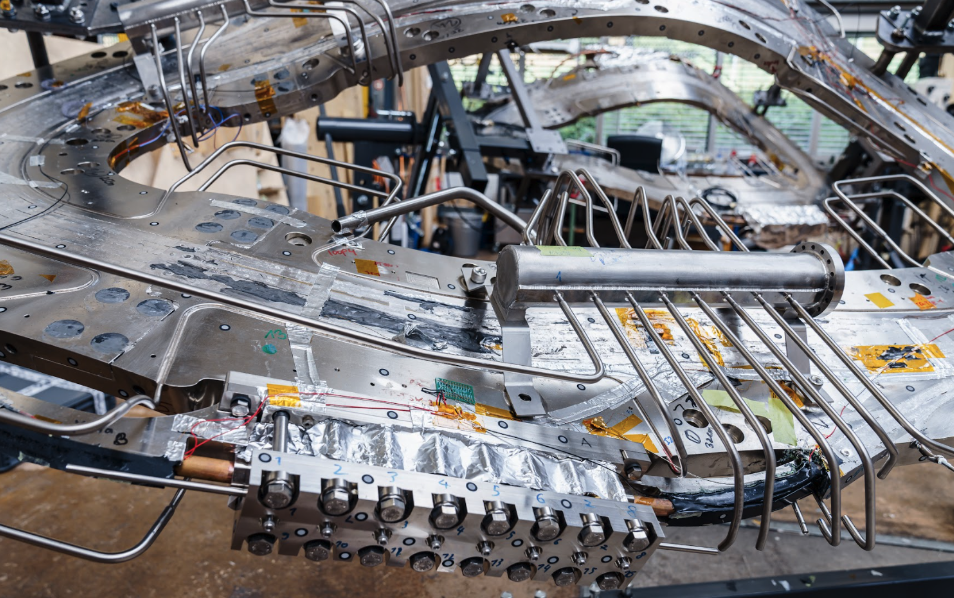
The latest raise brings Proxima’s total funding to more than €650 million, including €95 million in public grants, and provides the capital needed to develop Alpha, its planned net-energy stellarator demonstrator near Munich.

Founded as a spin-out from the Max Planck Institute for Plasma Physics, Proxima is developing fusion power plants based on stellarators, an alternative to the more widely pursued tokamak design. The company argues advances in high-temperature superconducting magnets and modern computing make stellarators a more practical route to commercial fusion than previously thought.

The funding follows an agreement signed earlier this year between Proxima, RWE, the Free State of Bavaria, and the Max Planck Institute to develop what they hope will become the first stellarator fusion power plant on the site of the former Gundremmingen nuclear power station.

Chief executive and co-founder Francesco Sciortino said the investment demonstrated Europe’s ability to compete in the global race to commercialise fusion technology.

“Europe is racing with the United States and China to get to the first fusion power plant,” he said. “Investors recognise both the urgency and the opportunity of what we’re doing.”

Proxima will use the fresh capital to finish its Alpha demonstrator, ramp up production of the superconducting magnets at the heart of its stellarator design, and add engineers and manufacturing staff across its sites in Munich, Oxford and Zurich.

Fusion remains years away from commercial deployment, but investors continue to pour billions into companies promising virtually limitless, carbon-free electricity if the longstanding scientific and engineering challenges can finally be overcome.


Tags: fundingfusiongooglePluralproxima fusionrwe
Previous Post

Expeditions closes its latest fund at €197M, smashing through its original target

Carly Page

Carly Page

Carly Page is a freelance journalist and copywriter with 10+ years of experience covering the technology industry, and was formerly a senior cybersecurity reporter at TechCrunch. Bylines include Forbes, IT Pro, LeadDev, The Register, TechCrunch, TechFinitive, TechRadar, TES, The Telegraph, TIME, Uswitch, WIRED, & more.

Related News

Trinity Robotics raises more than €500,000 to expand production of autonomous combat vehicles

Trinity Robotics raises more than €500,000 to expand production of autonomous combat vehicles

byJohn Biggs
July 7, 2026

In Ukrainian, Konyk means “horse," and that's exactly what Kyiv-based Trinity Robotics has built: an autonomous pack vehicle to support...

Expeditions closes its latest fund at €197M, smashing through its original target

Expeditions closes its latest fund at €197M, smashing through its original target

byIngrid Lunden
July 7, 2026

The war in Ukraine has put a spotlight on innovation in defence, not just how it can be used to...

Nordic Air Defence demonstrates a super-fast, super-light drone designed to destroy other drones

Nordic Air Defence demonstrates a super-fast, super-light drone designed to destroy other drones

byJohn Biggs
July 6, 2026

Swedish aerospace startup Nordic Air Defence has publicly demonstrated its K100XR counter-drone interceptor for the first time, showing the system...

Touchwaves' founders Martin Romero and Charlotte Kjellander

How Touchwaves moved from academia into the cockpit

byJohn Biggs
July 6, 2026

Touchwaves, a Dutch company building wearable haptic systems for aerospace and defence, has been selected by General Atomics Aeronautical Systems...

Nexus by Intelic

Software before drones: Dutch defence ministry bets on interoperability

byPaul Sawers
July 3, 2026

Most militaries buy hardware first and work out how to make it talk to everything else afterwards. The Dutch Ministry...

Iceye, the Finnish satellite startup, nabs €1B at a €10B valuation amid growing demand for space intel

Leading Defence Investors Join Resilience Conference London

byLeslie Hitchcock
July 3, 2026

Capital is as critical to the future of defence as technology. Resilience Conference London is pleased to welcome three leading...

Six Robotics CEO Christian Fredrik Eggesbø

Six Robotics raises €12M to help individual drones work as a team

byPaul Sawers
July 3, 2026

Coordinating a swarm of drones to operate as a single force is one of the harder problems in modern unmanned...

Defence Tech Valley 2025: Kicking Around Military Innovation at a Football Pitch

Ukraine opens controlled exports for domestic defense tech

byJohn Biggs
July 2, 2026

The Ukrainian Cabinet of Ministers has officially approved the "first transparent mechanism for exporting domestically produced defense technologies." The plan,...

Load More

Most viewed

InVeris announces fats Drone, an integrated, multi-party drone flight simulator

Uforce raises $50M at a $1B+ valuation to build defence tech for Ukraine

Auterion, the drone software startup, eyes raising $200M at a $1.2B+ valuation

Palantir and Ukraine’s Brave1 have built a new AI “Dataroom”

Twentyfour Industries emerges from stealth with $11.8M for mass-produced drones

Senai exits stealth to help governments harness online video intelligence

Resilience Media is an independent publication covering the future of defence, security, and resilience. Our reporting focuses on emerging technologies, strategic threats, and the growing role of startups and investors in the defence of democracy.

  • About
  • News
  • Resilence Conference
    • Resilience Conference Copenhagen 2026
    • Resilience Conference Warsaw 2026
    • Resilience Conference 2026
  • Guest Posts
  • Subscribe
  • Privacy Policy
  • Terms & Conditions
  • Mission Statement & Code of Practice
  • Press

© 2026 Resilience Media

No Result
View All Result
  • Home
  • About
  • Subscribe
  • Events
  • Guest Posts
  • Interview
  • News
  • Resilience Conference London 2026
  • Resilience Conference Copenhagen 2026
  • Resilience Conference Warsaw 2026

© 2026 Resilience Media

This website uses cookies. By continuing to use this website you are giving consent to cookies being used. Visit our Privacy and Cookie Policy.