President Volodymyr Zelenskyy on Tuesday named Mykhailo Drapatyi as the new commander-in-chief of Ukraine’s Armed Forces.
The move marks more than a change in military leadership. It’s a nod to the reforms that Mykhailo Fedorov, the recently-ousted popular Defence Minister, had championed throughout the ongoing war against Russia – tactical use of defence technology; procurement reform; and battlefield autonomy among them – while removing one of those reforms’ reportedly principal opponents: Oleksandr Syrskyi, the former commander-in-chief, who now takes on a new role.
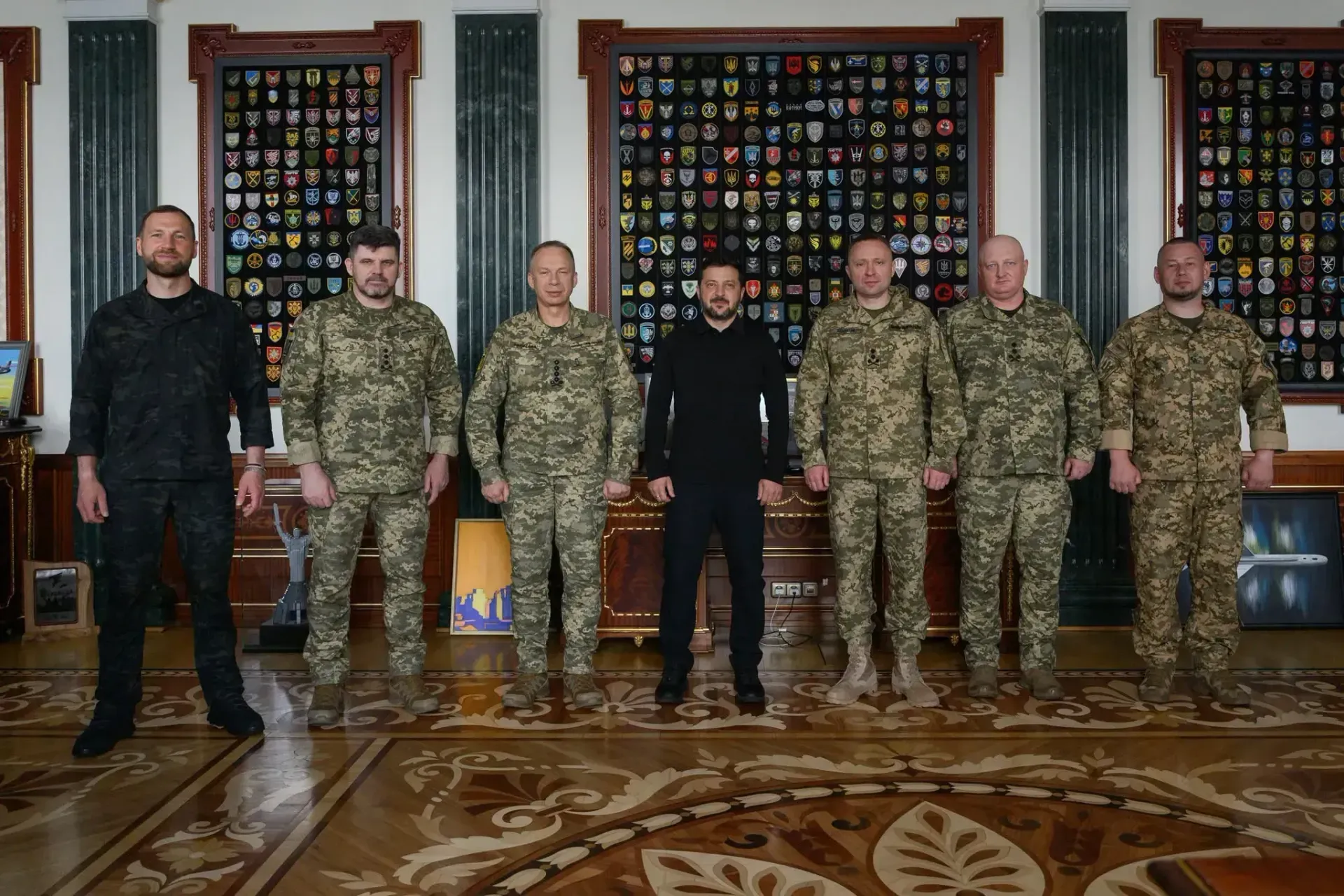
With all of them pictured above together (Syrskyi flanking Zelenskyy on his right; Drapatyi on his left), it’s also one more attempt from Zelenskyy to wrap up the military and political drama of the last week.
Zelenskyy’s initial dismissal of Defence Minister Mykhailo Fedorov may have come amid other leadership changes (he also named a new prime minister), but it carried its own backstory. Fedorov had been clashing for some time with the military’s commander-in-chief, and Zelenskyy initially made a call on resolving it: Fedorov was out; Syrskyi stayed in.
Zelenskyy might have underestimated Fedorov’s popularity and what he stood for.
Fedorov, even after stepping down, continued to remain highly critical of Syrskyi. And a wave of resignations, criticism and protests across Ukraine and its military and defense technology community began to build up. These included large public demonstrations in Kyiv, Lviv, Kharkiv, Odesa and Kamianets-Podilskyi – coincidentally, Drapatyi’s hometown.
While Fedorov has (so far) reportedly declined offers to come back into the government fold, Drapatyi represents a step in the Fedorov direction.
At 43 – 17 years younger than Syrskyi, eight older than Fedorov – Drapatyi represents a generational shift within Ukraine’s senior military leadership. He has commanded some of the country’s most important operational formations during the full-scale war, including Operational Tactical Group Kharkiv, Operational Strategic Group Khortytsia, the Joint Forces Command and, most recently, Ukraine’s Land Forces.
More significant than his age, however, is his reputation.
Drapatyi is known as one of Ukraine’s most technology-forward commanders and an advocate for adapting military structures to modern warfare. Military analysts and officers have frequently contrasted his approach with what many critics view as Syrskyi’s preference for more centralized, attritional methods. These are rooted in Soviet military tradition, and the approach earned Syrskyi the nickname “The Butcher” among some critics.
Analyst Rob Lee, a senior fellow at FPRI, has previously identified Drapatyi as an early supporter of initiatives such as the Middle Strike concept, the Drone Line program and greater integration of battlefield feedback into operational decision-making.
Officers who have served under him describe a commander willing to decentralize authority, experiment with new technologies and incorporate lessons emerging directly from frontline units.
“I think it’s good for the armed forces,” an active-duty member of Ukraine’s Armed Forces told Resilience Media, requesting anonymity because he was not authorised to speak to the media. “We are now much less likely to be the smaller Soviet army fighting the larger Soviet army.”
Having someone looking at the situation with fresher eyes less tied to old power and tradition might also help with decision making, he added.
“Military careers always balance displays of loyalty and displays of competence. I think there was too much of the former, and we need more of the latter at all levels of command.”
Those priorities closely overlap with the vision Fedorov advanced during his tenure as defense minister.
Rather than representing a victory for one individual, Drapatyi’s appointment is widely viewed inside Ukraine’s defense community as a victory for the broader reform movement that Fedorov came to embody: one centered on technology, drones, procurement reform, faster innovation cycles, greater battlefield autonomy and a military better able to adapt to rapidly changing conditions.
Several military sources told Resilience they also expect Drapatyi to reassess how scarce resources are allocated across the armed forces.
Many officers perceived that, under Syrskyi, assault formations – particularly those associated with commanders regarded as close to the commander-in-chief – received priority access to manpower and other resources. Sources expect greater emphasis under Drapatyi on technology-intensive formations, particularly drone and precision-strike units, although whether those expectations translate into institutional change remains to be seen.
Other high-profile commanders, including Andriy Biletsky and Denys Prokopenko, were widely discussed as potential successors following Syrskyi’s dismissal. While both enjoy considerable support within parts of the military, Drapatyi ultimately represented a less politically contentious choice while still satisfying widespread demands for leadership change.
The appointment follows one of the most politically sensitive episodes within Ukraine’s wartime leadership.
Fedorov’s 15 July dismissal sparked demonstrations across multiple Ukrainian cities and prompted an unusually public response from serving military personnel. Zelensky acknowledged that an irreconcilable conflict had emerged between the defense minister and Syrskyi, although both sides offered sharply different explanations for the breakdown.
Fedorov and his supporters argued that key reforms – including procurement changes, technological innovation and institutional restructuring – were being obstructed by resistance within the military command. Syrskyi’s supporters, meanwhile, maintained that the defense minister had increasingly encroached on areas falling under the authority of the General Staff.
Rather than reversing Fedorov’s dismissal, Zelensky appears to have opted for a compromise. By replacing Syrskyi with one of the commanders most closely associated with the military’s reform wing, the president preserves much of Fedorov’s agenda while avoiding the political cost of reinstating the minister himself. The move also helps defuse an increasingly public split at the top of Ukraine’s wartime leadership at a time when maintaining military cohesion remains critical.
Off the record, multiple sources familiar with Ukraine’s Defense Ministry told Resilience they believe some of Fedorov’s reforms disrupted entrenched procurement and corruption networks, generating significant resistance from influential figures within Ukraine’s political and defense establishment.
The big question will be whether changing one person at the top will materially change how so much of the rest of the defence machine operates.
Appointing someone with an eye to reform from within the military ranks will be a good test of how that might play out.
Drapatyi emerged as one of the highest-ranking serving officers to publicly defend Fedorov following his dismissal. Other resignations also emerged around that time, including that of Air Force Deputy Commander Pavlo Leziarov, whose tenure was credited by many observers with improving Ukraine’s drone interception capability.
His elevation to commander-in-chief therefore carries significance beyond a routine personnel change. Although Zelensky has not reinstated Fedorov – and the former minister has so far reportedly declined alternative government positions – it signals that many of the principles associated with his reform agenda continue to enjoy support at the highest levels of Ukraine’s military leadership.
As for Fedorov, currently his political future remains uncertain. Some Ukrainian commentators have speculated that, if he does not return to government, he could eventually lay the groundwork for a future presidential campaign, presenting an altogether different kind of political problem for Zelenskyy.