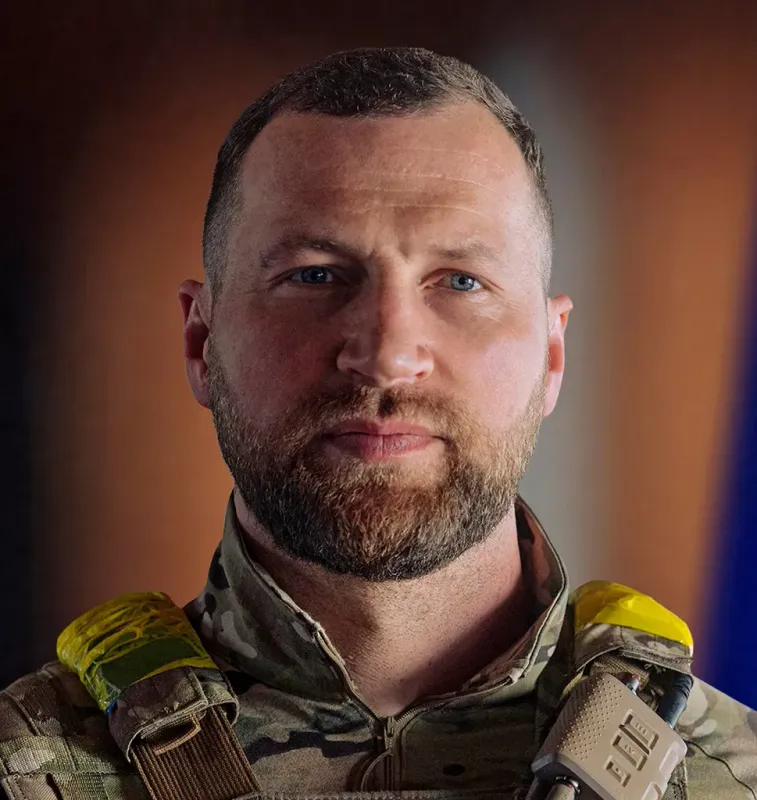
Ukraine has a new defence minister: Yevhenii Khmara, formerly a leader in the country’s security and intelligence service, has now been confirmed as the head of the ministry by the country’s parliament, charged with overseeing — but not commanding — the country’s armed forces and national defence. The appointment is significant: it comes not just as the war with Russia wages on, but also after a month of political turmoil surrounding the removal of his high-profile predecessor, Mykhailo Fedorov.
The Verkhovna Rada backed Khmara’s appointment with 312 votes on 19 August, making official what had already been an appointment in practice: Khmara had been running the ministry on an acting basis following Fedorov’s dismissal in July.
Khmara’s background coming into the position is an interesting one. He had previously headed the elite Alpha (“A”) Special Operations Center of the SBU, the country’s security and intelligence service, before becoming the acting head of the whole SBU in January 2026. He has had a key role in the war effort. Under his leadership, the center executed Operation Spiderweb, the June 2025 attack that destroyed and damaged dozens of strategic aircraft in Russia using drones hidden in long-haul trucks.
While still a tech-forward choice, Khmara is very much a military insider with some sensibility of how the two halves need to work together, a key point given the reports of the rifts with military brass that preceded the ouster of his predecessor.
Last year, for example, speaking at a Brave1 event, Khmara acknowledged the role that new technology and startups were playing in the military, but also said that tech needed input from combatants to really make it usable.
“Never ever did we receive a product which was 100% combat-ready,” he said. “Everything must be fine-tuned, which requires a synergy between the soldiers and the engineers, who are quite literally sitting in trenches with us.”
Fedorov, on the other hand, is a civilian technology executive-turned-politician whose brief tenure at the ministry centered on digitization, drone warfare, procurement reform and efforts to overhaul the relationship between the military bureaucracy and Ukraine’s defense technology sector.
Fedorov’s civilian relatability and tech-first stance – presented as drones and AI were the weapons and tools making headlines, helping Ukraine punch above its weight against a much larger adversary – brought him a high profile, too, and his removal after just six months in office triggered a public outcry.
Protests broke out in Kyiv and several other Ukrainian cities demanding his return, while his increasingly open conflict with then-Commander-in-Chief Oleksandr Syrskyi became a focal point of criticism of the government. Syrskyi was subsequently removed as commander-in-chief.
While Khmara settles into the role officially, the Fedorov controversy has not quite died down.
This week – specifically the evening before Khmara was confirmed – Fedorov took to his newly-created YouTube account to publicly criticise the government over corruption, transparency and what he described as appointments based on loyalty rather than competence. He also called for Ukraine to hold presidential elections – a particularly interesting detail, given that some alleged his removal from the ministerial role was to take away a would-be rival to President Zelenskyy.
“Democracy cannot be held hostage by Russia. We are fighting precisely because we want to remain a free European state,” Fedorov said in the video statement.
Fedorov’s call for elections, however, has not been well-received. Many see it as a distraction from the original reform agenda of the protests.
Dmytro Koziatynskyi, a veteran combat medic and one of the primary organizers of the original protests to reinstate Fedorov in July, took to social media after the release of Fedorov’s statement to wish Khmara success and indicate that the protest is now over, and to distance himself from calls for elections.
“I cannot imagine how to technically provide the possibility of a vote to thousands of service personnel currently serving at the front,” he wrote on Facebook.
Notably, Khmara coming to the ministry having previously served in the security service has raised a separate legal question.
Ukraine’s Law on National Security actually requires the defense minister to be a civilian. Khmara was an active-duty SBU major general when Zelenskyy initially selected him to run the ministry.
Ukrainian lawmakers and legal commentators have questioned how Khmara could be permanently appointed without first leaving military service. Officials had reportedly even considered legislation that would have temporarily allowed a servicemember to hold the post during martial law.
Khmara sought to resolve the issue before parliament voted on his nomination.
“I stand before you as a civilian,” he told lawmakers, saying he had been discharged from military service under Article 26 of Ukraine’s law on military duty and military service.
That may have cleared the principal statutory obstacle to his appointment, but the unusual transition from serving security-service general to civilian defense minister nevertheless has highlighted the increasingly blurred relationship between Ukraine’s military, security and political leadership during the war.
Now, amid a brutal war that shows little sign of winding down, Khmara inherits not only Fedorov’s unfinished reform agenda but a ministry at the center of one of Ukraine’s most significant domestic political disputes since the beginning of the full-scale invasion.