On 10 August, Mark Zuckerberg spent about 6,500 words arguing that the artificial intelligence field should be broadly distributed rather than concentrated in a handful of labs, government departments, or institutions.
He shipped an open-weight model alongside it and asked the US government to speed up energy and infrastructure buildout, and to stop treating model distillation as a sin. Philosophically, he talks about “superintelligence,” yet he doesn’t predict the field heading towards a single runaway system.
Instead, he points to, and advocates for, the diffusion – “distribute it widely” appears more than once in the essay – of smart, generative computing capabilities. This is a stark contrast to the direction advocated by leading frontier labs such as OpenAI and Anthropic, and may well lead to their commoditisation (not something Zuck would be quick to admit).
A future of commoditised smartness instead of a single AGI
Let me be clear about the obvious: Zuck is not doing this out of kindness. Meta has never held the frontier crown, but it does own distribution, so “cheap, open, everywhere” is simply the strategy under which Meta wins. However, while self-interest is often a feature of manifestos, it is not necessarily a disqualification.
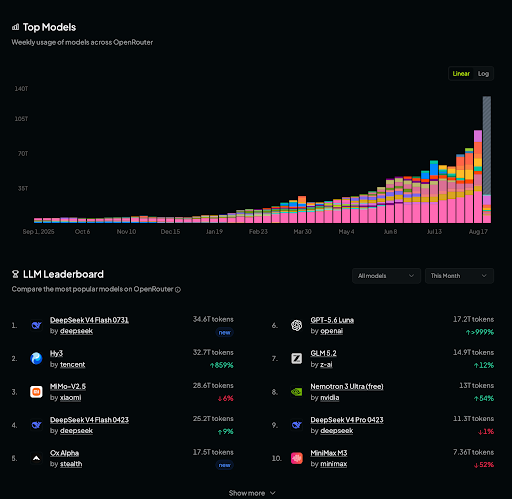
Read past the messenger and the argument holds. In fact, it has been holding for six months, in the only dataset that doesn’t measure abstract “intelligence” benchmarks but rather what developers actually run: OpenRouter.
There, US models from Google, OpenAI and Anthropic held around 70% of token share in June 2025. Twelve months later they were near 30%, and Chinese open-weight providers now process roughly three times the weekly tokens of their American counterparts. Vercel’s enterprise gateway says the same: open weights took 29% of tokens routed in June 2026, against under 4% of spend. A third of the work, a twenty-fifth of the money.
Let’s rewind to see how we got here. The over-inflated Silicon Valley belief that software would be eating the world started cracking at the start of the decade and peaked around 2022. Growth slowed, valuations fell, people realised productivity was actually stagnating.
Then OpenAI released LLMs to the public with ChatGPT and everyone remembered opening an internet browser in the 1990s, once again feeling that technology was a powerful, limitless magic. Machine Learning officially became AI for everyone, and this time technology wasn’t just going to eat the world, it was going all the way to save it or, maybe, to take it over.
America won the race. It may have been the wrong one
But it wasn’t just a matter of garage renegades building new stuff on this “internet thing.”
Every tech giant had an LLM within months, and if everyone builds roughly the same thing, competition gets hard and the only move left is to raise more capital and to switch efforts from fringe research to an all-out product war.
More GPUs, more data centres, a larger model. Then your competitor does the same, so you raise again. At which point the spending itself becomes the argument: look at the capital, look at the data centres, this must be the biggest technological revolution in history.
Amazon, Microsoft, Alphabet and Meta alone are guiding to roughly $725 billion of capex in 2026, against about $410 billion last year. Employees leaving top firms launched new frontier labs with inception rounds in the billions right off the gate.
Meanwhile, so far, most of the revenue produced by the industry is subsidised by investors and by the established infrastructure winners of the ICT tech cycle, and productivity gains, let alone something close to an actual “AGI“, remain elusive in a conspiracy-theory fashion.
Which is why DeepSeek dropping R1 in 2025 was really a watershed. US firms were spending hundreds of billions to reproduce flavours of the same software, and the Chinese caught up for a fraction of that and open-sourced both models and weights.
Rather than starting a frontier-model race with the US, China focused on getting smarter computing software to “do stuff” in the real world: from moving robots to improving manufacturing and managing the electric grid. Maybe not by chance, China doesn’t associate the field with human intelligence, i.e. 智慧 (zhìhuì), meaning wisdom and insight. They call it 人工智能 (réngōng zhìnéng), which conveys man-made smartness and the ability to do intelligent-like tasks.
While America has become one big bet on AI being the biggest technology revolution of our age, economic historian Carlota Perez has cautioned that GenAI and advanced ML may not be the signs of a new techno-economic revolution. Instead, current AI tech is better understood as the late-cycle diffusion phase of the computing cycle, the part where a technology commoditises, spreads into everything, and leaves behind an over-built infrastructure that somebody else buys cheaply.
If that is right, Zuckerberg is describing a long-term inevitability as opposed to making a concession of defeat. Value relocates rather than vanishing, into distribution, into industrial manufacturing at the infrastructure layer, and into cheap abundant energy. Those will compound over decades. An AI company’s latest round doesn’t necessarily do so.
Europe can still compete where it matters – if it so chooses
Europe, like Meta, lost the frontier AI race. European startups overall (not just those classified as AI) raised roughly $57 billion in 2025. The San Francisco Bay Area alone raised about $366 billion. Europe has produced no leading foundational model. Mistral, the closest, was never really a race contender. Europe also has no Google, no Apple, no Meta, so the “model diffusion plus platform” monetisation play is not available to its companies.
Yet in the first half of 2026, AI took more than half of all European VC for the first time. The worrying consequence is that the continent is copying the American allocation with a fraction of the American capital, a fraction of the compute, and none of the distribution. A strategy that takes on all the hype risk for the dubious upside of finishing second.
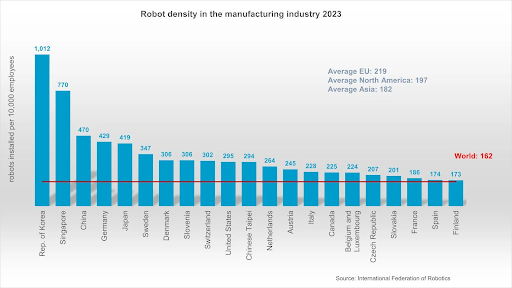
However, what Europe does have is a network of high-tech hubs and a very strong manufacturing heritage. France for nuclear. Dresden for semiconductors. Munich aerospace. Italy for precision engineering. Eindhoven for lithography. The UK for biology and applied AI research. CEE and Ukraine for mass and affordable defence tech, produced at a tempo nobody else in the West can match.
No one industry mapped to a single country is big enough on its own. What would make them matter on a global scale is flow between them, plus the willingness to repurpose industrial legacy rather than revive it. The tooling, metrology and tier-two supply base built over eighty years for automotive, aerospace and optics in Stuttgart, Turin or Lyon transfer directly to energetics, propulsion, robotics and reactor components. Not to make a worse copycat of an AI-obsessed Silicon Valley.
The next crucial move for European sovereignty
There are two steps European governments can take, both playing to the continent’s strength, especially in the context of ReArm Europe and the European Commission’s tech sovereignty priorities.
First, mandate what Zuckerberg asked Washington for politely. Let private capital build data centres, and make the permit conditional on co-located generation and storage on the same timeline. Invite American corporations, also conditional on energy investment. Every compute buildout then becomes a privately financed energy project. Data centre economics may work out or not, but the grid upgrade will permanently support businesses.
Second, embrace open-source and pay to cannibalise the frontier. Grants and public compute in their purest form (not for profit) for early-stage work on open weights, open research and even distillation-powered sovereign models that help commoditise token production.
This is a sovereignty argument first and an economic one second: a closed frontier API is a dependency with a political owner, and anything built on top of it can be gated, priced or switched off by a foreign administration. Weights you can download, audit, fine-tune on proprietary data, and run air-gapped on your own hardware carry no such risk. Europe should fund that layer not to win a benchmark race it already lost, but because every euro that pushes the price of a token toward zero subsidises every European company whose moat is a factory, a reactor or a fielded system.
For founders and investors, the corollary is to double down on industrial and novel infrastructure technologies.
American capital concentrating ever harder on frontier AI data centres and software layer applications creates an arbitrage opportunity, and Europe is already producing the right non-consensus answers.
It now only needs to find the guts to listen. For example: Francesco Sciortino of Proxima Fusion lobbying governments to commit to fusion plants; Anmol Manohar of Greenjets betting on the electrification and re-defensification of aerospace propulsion, already flying on defence UAVs; or Carmen Palacios-Berraquero at Nu Quantum building the interconnects for distributed quantum computing, alongside scaled players like IQM and Quantinuum. Every one of those bets is easier to build in Europe than in California, because the engineers, the labs, the industrial background, and the first customers are here.
The path won’t necessarily be easy. Europe has structurally less risk capital compared to the US, lacks China’s evenly distributed cheap energy, and is chronically short of late-stage domestic money.
The regulatory instinct that could be turned into an industrial weapon is often used to slow things down. Energy de-regulation, especially around nuclear, has a long way to go. Plenty of the €800 billion ReArm Europe budget will end up buying the last war supplies from the usual suspects. But the fighting chance is real, and both the Chinese results and Meta’s realisation are pointing to a future where forsaking the frontier AI race can lead to gaining competitive advantages in the more important industrial ones.
Because, in the long run, the companies (and countries) that capture the most value from this late-cycle wave will likely be the ones that never sold a token. They will buy them cheaply just like they buy electric power or cloud storage, and embed them in reactors, propulsion systems, production lines, and fielded hardware. They will compound a moat made of atoms while frontier lab founders and investors get distracted by the next mega-round and topping math benchmarks.
Mark Zuckerberg made the argument for that world to the West, for his own reasons. Europe should take the blueprint and use it better than he will.
Disclosure: Silicon Roundabout Ventures, where Francesco Perticarari is the founder, is an investor in Greenjets and Nu Quantum. The author’s fund has no financial interest in Proxima, IQM, Quantinuum, or Mistral.
Francesco Perticarari is a computer scientist who built the largest European deeptech meetup and ended up investing as an angel in the sector. In 2023 he launched Silicon Roundabout Ventures, his deeptech soloGP fund, writing first cheques in European pre-seed and seed rounds in critical sectors such as computing, energy and defence. His firm is backed by the likes of Molten Ventures (LSE:GROW), Multiple Capital, Cherry Ventures and exited founders and operators including 1 Nasdaq listed & 3 unicorn companies. His mission? To build Europe’s first community-driven VC firm built by technical folks exclusively for frontier technology founders building the future computing and physical infrastructure.