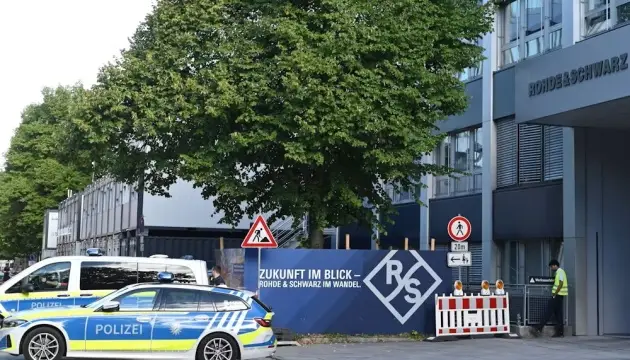
German police are investigating an apparent arson attempt outside a building used by defense companies in Munich. The incident happened around midnight September 3, 2026 on Mühldorfstraße in the city’s Berg am Laim district, an area that includes offices belonging to German electronics group Rohde & Schwarz and defense startup Helsing.
According to Mezha, witnesses reported seeing several incendiary devices thrown from a vehicle onto the street. Police arriving at the scene extinguished one of the devices. At least one other device failed to ignite and was later made safe by specialists.
The Bavarian State Criminal Police Office is now investigating the incident, including the possibility that the attack had a political motive. Police detained two people shortly afterward, a 28-year-old woman and a 38-year-old man. Both are Bulgarian citizens. Authorities have not yet established publicly whether they were responsible for the attempted attack.
The location matters because both companies operating there have become increasingly important to Germany’s defense sector.
Rohde & Schwarz is one of Germany’s major electronics companies. Its defense business includes secure communications, signals intelligence, electronic warfare, and other radio and communications systems used by governments and armed forces. Helsing represents a much newer part of Europe’s defense industry.
Founded in 2021, the company develops AI and autonomous systems for military use and has expanded into unmanned aircraft. Its rapid growth has made it one of Europe’s most prominent new defense technology companies.
This is also not the first time Rohde & Schwarz has appeared in connection with politically motivated attacks in Munich. The company was reportedly named as a possible target by left-wing extremists responsible for an attack on Munich’s power infrastructure in May 2021. Investigators have not said that the latest incident is connected to that attack, and the motive remains under investigation. But the attempted arson raises a larger security problem for Europe’s growing defense industry.
Germany and other European countries are spending heavily to increase weapons production, develop autonomous systems, expand ammunition manufacturing, and rebuild military capacity.