
European defence startups are drawing in venture capital at a rate of knots in 2026.
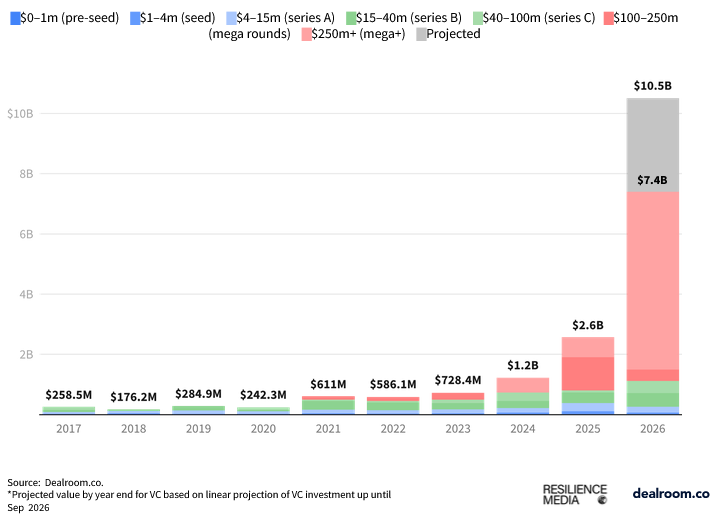
That’s according to Dealroom’s latest State of Defence Tech report, produced in partnership with Resilience Media. VC funding into European defence companies has already reached $7.4 billion in 2026. It projects that figure will reach around $10.5 billion by the end of the year, representing growth of more than 300% on 2025, when European defence startups raised $2.6 billion.
When the 2025 report landed last September, European defence startups had raised $1.5 billion and were on course for $2.3 billion by year-end; the final tally came in around $300 million higher.
Beyond the headline funding total, though, the latest report illustrates just how quickly defence is eating into European venture capital.
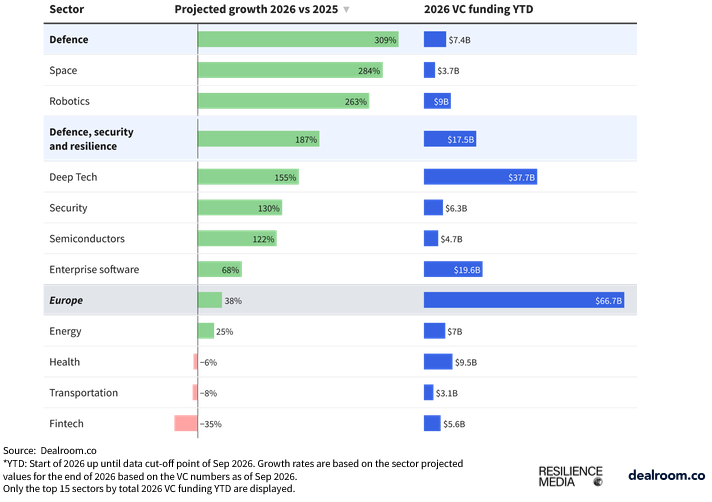
Defence tech’s share of all European VC funding has almost tripled in a year, from 4% in 2025 to 11.1% in 2026. Moreover, defence retained its position as the fastest-growing sector in European venture capital. Dealroom projects defence tech funding will grow 309% in 2026, ahead of space at 284% and robotics at 263%. These are huge numbers, when you consider that European VC overall is projected to grow just 38%.
The broader Defence, Security and Resilience (DSR) category — encompassing technologies such as space, quantum and semiconductors alongside defence — is projected to grow 187%.
NATO by the numbers
The State of Defence Tech 2026 report, which is being presented at Resilience Conference in London on Monday, 5 October, also looks beyond Europe to track investment across NATO and allied countries.
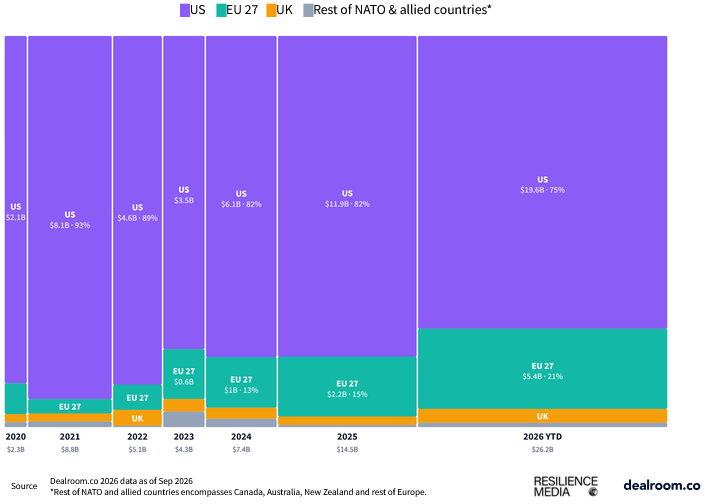
Across that wider segment, defence startups have raised $27.1 billion so far in 2026, already 1.9 times the amount raised across the whole of 2025. The total includes around $900 million in rounds that had been reported but not yet verified at Dealroom’s September cut-off; excluding those deals, the geographically allocated total comes to $26.2 billion. Dealroom also projects funding across NATO and allied countries will reach $38.5 billion by year-end, helped by seven rounds worth more than $1 billion apiece from Anduril, Helsing, Saronic, Shield AI, Quantum Systems, Iceye and Castelion.
Unsurprisingly, the US still accounts for the lion’s share of that capital. In 2026 to date, startups in the US have attracted $19.6 billion, or 75% of all defence VC funding across NATO and allied countries. But the EU has gained ground. The 27 constituent countries of the EU account for 21% of all defence tech funding. That’s up from 15% last year, after funding more than doubled from $2.2 billion in 2025 to $5.4 billion this year.
US funding nearly doubled, too. It is now at $19.6 billion compared to $11.9 billion over the same period.
But while the report does track defence investment across a broad gamut of NATO and allied countries, Europe remains a major focus, particularly given how quickly funding has grown over the past two years. And diving into the data shows that the money is heavily concentrated by company, country and technology.
Germany and drones lead European funding
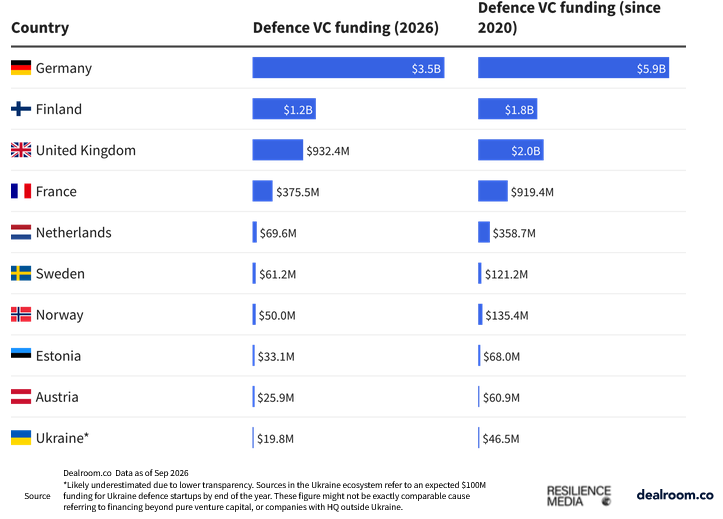
Germany sits comfortably at the top of the European rankings, with defence startups attracting $3.5 billion in VC funding so far this year, followed by Finland on $1.2 billion and the UK on $932 million. Since 2020, German defence companies have raised $5.9 billion, almost three times the UK’s $2 billion total.
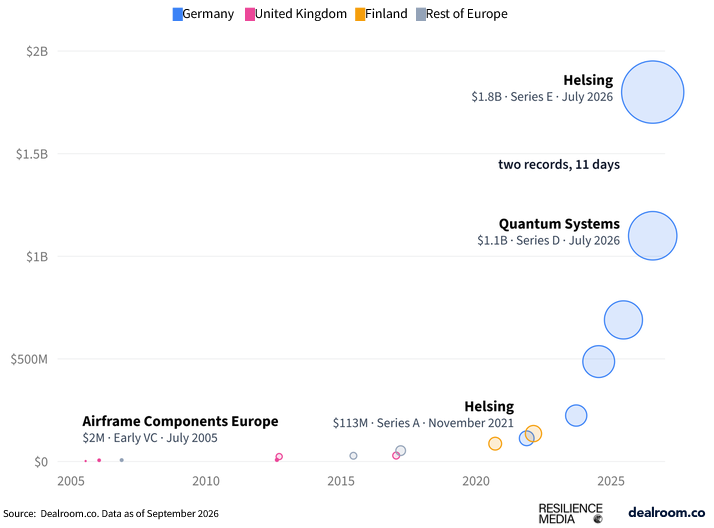
Of course, much of Germany’s lead can be traced to two outsized rounds out of one city: Munich. Helsing raised a $1.8 billion round in July at a hefty $18 billion valuation, less than two weeks after drone maker Quantum Systems secured a $1.2 billion Series D at a valuation of $8 billion.
Those two deals set consecutive records for the largest European defence tech VC rounds ever. A corresponding chart demonstrates how much funding sizes have ballooned in recent years. As recently as 2021, a $113 million Series A from Helsing was enough to set a new European record.
The longer-term funding picture puts this year’s surge in perspective: European defence startups raised $611 million in 2021, $1.2 billion in 2024, and $2.6 billion last year. Against those totals, Dealroom’s projected $10.5 billion for 2026 would represent increases of around 1,620%, 775%, and 300%, respectively.
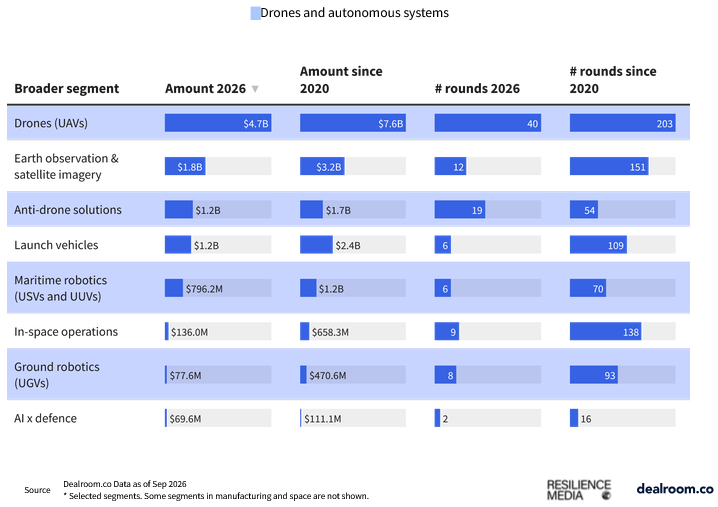
Digging into the nuts and bolts of the deals, the report also highlights where, specifically, that money is flowing.
Drones have attracted $4.7 billion across 40 European funding rounds in 2026, according to the report, making them the biggest defence segment by some distance. Anti-drone technologies have raised another $1.2 billion, while maritime robotics — including unmanned surface and underwater vessels — has drawn some $800 million.
Exit strategy
For all the fervour around funding, those doling out the cash ultimately want a return on their investment. With that in mind, Dealroom’s data suggests exits are beginning to pick up: 21 defence-tech exits were recorded across NATO and allied countries in 2025, up from an average of eight a year between 2021 and 2024, while 31 are projected for 2026.
However, the report puts total exit value at $18.6 billion last year and projects $15.4 billion for 2026.
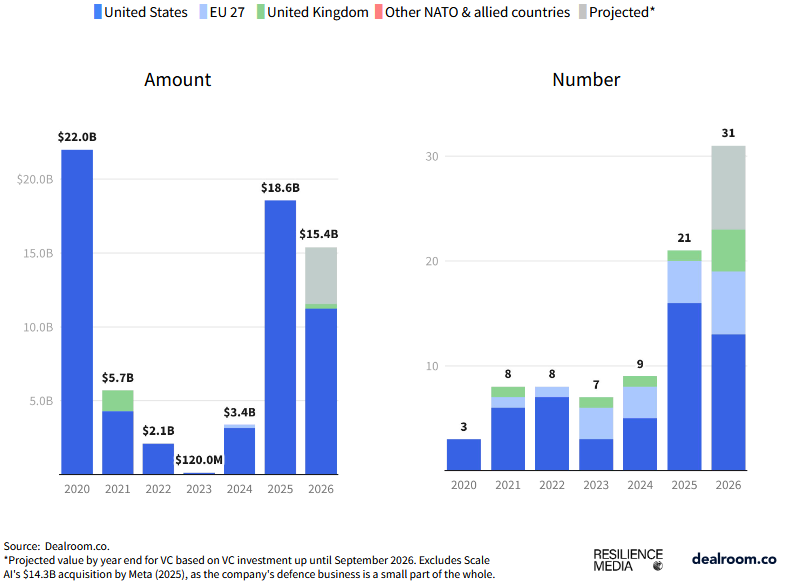
As with overall funding, the biggest exits continue to come overwhelmingly out of the US, and interestingly 2026 has not seen a lot of activity on this front.
Of Dealroom’s 10 largest all-time defence-tech exits, four took place in 2025: Beta Technologies’ $7.2 billion IPO, Digital Global Systems’ $5 billion acquisition, Kodiak Robotics’ $2.95 billion SPAC listing, and Voyager Technologies’ $1.51 billion IPO. The sole entry from 2026 is Armis, the security company that is less classic defence tech and more about resilience. It was acquired by ServiceNow at a $7.64 billion valuation in late December 2025 and the deal closed in 2026.
Only one company in the top 10 exit ranking is European: London-based quantum-encryption company Arqit, which went public through a SPAC in 2021 at a $1.4 billion valuation.
Alex Ferrara, a London-based partner at Bessemer Venture Partners who leads the firm’s resilience-tech investing, says the shortage of exits reflects a structural problem in defence investing. There are simply fewer potential buyers than in more traditional enterprise sectors.
“Lack of exits is indeed an issue here in Europe, but I think it’s a problem in the US as well,” Ferrara told Resilience Media. “One issue is that, unlike categories of enterprise software where there are many acquirers, in defense tech there are only a small number of strategic acquirers. This is both the opportunity and the challenge.”
Indeed, the opportunity, Ferrara argues, is for a new generation of “neo primes” to grow rapidly by building broad portfolios of AI- and software-driven defence products. The corresponding challenge, though, is that companies with narrower offerings, or those unable to grow into that larger role, have far fewer potential acquirers to fall back on.
“This is different from categories like enterprise software where we see a lot of smaller bolt-on product acquisitions in the $200 million to $1 billion valuation range,” Ferrara added.
From funding to deployment
Separate to the report’s findings, there is plenty of evidence that defence tech has become a strategic priority for investors and governments.
The enormous rounds raised by Helsing and Quantum Systems are being accompanied by dedicated pools of capital that will fuel future scale-ups in the category. Lakestar closed a $300 million defence and dual-use fund in July, while Expeditions raised a €197 million defence-focused fund of its own. There will be more funds likely coming around the corner. Plural, the London VC that has been a major investor across resilience tech, has reportedly been raising a €1 billion fund.
Raised money leads to next hurdle: converting investor appetite into procurement. Recent reporting from Resilience Media has highlighted the hurdles startups still face in two of Europe’s biggest defence markets. In Germany, startups can struggle to move from demonstration to contract through a procurement system that continues to favour established suppliers, despite a defence budget exceeding €100 billion this year.
The UK presents a similar challenge. Pilots, grants and successful field trials doesn’t necessarily lead to a funded programme; just 4% of the UK Ministry of Defence’s direct expenditure with domestic industry went straight to SMEs in 2024/25.
So the money is certainly there. The harder part, arguably, is turning that funding into technologies that militaries actually buy and deploy.