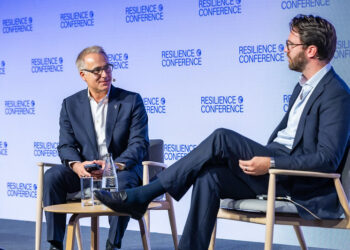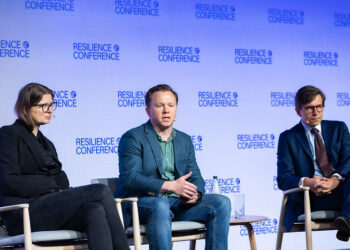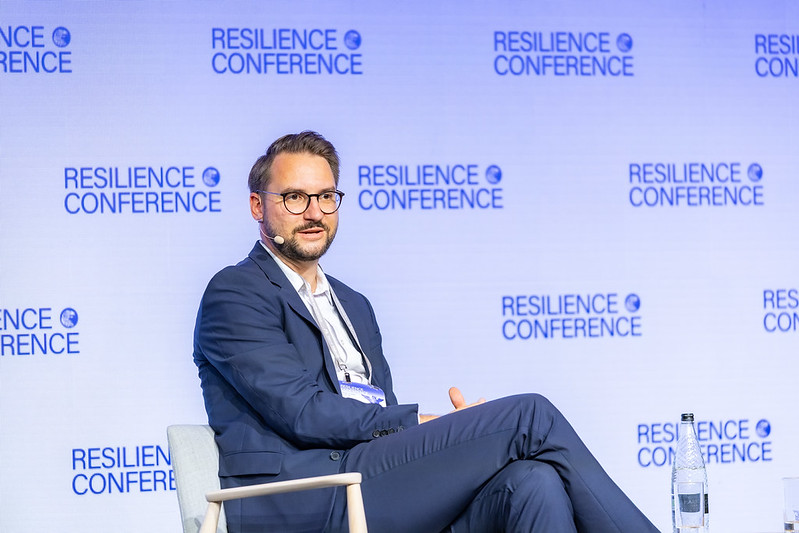
Quantum Systems’ CFO Jonas Jarosch sat down with Jack Wang from Project A to discuss Quantum’s partnerships with the Ukrainian defence industry and its status as a European neo-prime at Resilience Conference.
Jarosch said that companies like Quantum, but also Helsing, Tekever, or Cambridge Aerospace, are now in a new stage of maturity. As neo-primes, they “are now looking to grow their capabilities not only from a technical standpoint, but also from a geographical one, globally.”
Now, he said, the ambition was to compete on a global level with “market leaders in the US, whether it’s Anduril or Shield.” Jarosch believes “all the companies over here [in Europe], from a technical standpoint, can do [that].”
Much of that is playing out right now as a rush for more vertical integration. Some of it is being grown organically in-house, but companies are using the vast sums that they have raised to become consolidators, adding on new technologies, new capabilities, and new geographies. Companies such as Quantum have a “strategy of being a multi-domain supplier,” Jarosch said.
This leaves gaps for specialised developers, who could become neo primes’ suppliers or direct government contractors.
Quantum Systems, currently at an €8 billion valuation, has over the past year consolidated its market position by acquiring stakes, as well as launching joint ventures. A particular focus for the company has been Ukrainian partners.
Just ahead of Resilience Conference, Quantum Systems signed a memorandum of understanding with Ukraine’s Fire Point to collaborate on developing new, unmanned systems, as well as systems for countering aerial threats. Jarosch did not comment on the specifics of the deal, but a solid guess of what might be included is that it is likely to build on the pan-European Freyja anti-ballistic program; Fire Point has been leading on this and completed its portion of the development work earlier in October.
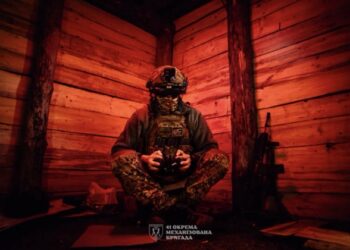
For Jarosch, partnering with Ukrainian companies has decisive advantages for international partners like Quantum Systems, among them Ukraine’s technical superiority and unique opportunity to combat-test technologies. Ukraine’s war reality also presents obvious challenges for EU-based firms.
“No one in Ukraine is, for rightful reasons, concerned about any accounting, taxes, or government setup,” said Jarosch, adding that Ukrainian companies cannot offer “the stability and due diligence processes” of their European competitors.
Furthermore, as Jack Wang observed, Ukrainian technologies are not always transferable to European ecosystems, as they are built with Chinese components, to make them as cheap as possible.
Jarosch responded that Quantum System’s philosophy is to keep their partners and subsidiaries in Ukraine building low-cost products, using their standard supply-chains.
While this makes the solutions effectively un-exportable as they are, Jarosch outlined how Quantum sees it as a net-positive: “You have a team over here in Germany or in the U.S. working on counter systems, and at the same time, you have a team working in Ukraine. You might not be able to license out their full IP or get their full design. But of course, both teams can interact,” he said, adding that both sides have things to learn from each other.