Countries around the world have identified the massive power of quantum computing as key to the future of their national security. That means promising startups working in this nascent field, developing better ways of working with qubits, get a lot of attention. In the latest example, Phasecraft – a UK-based specialist in quantum algorithms – has raised $34 million in funding.
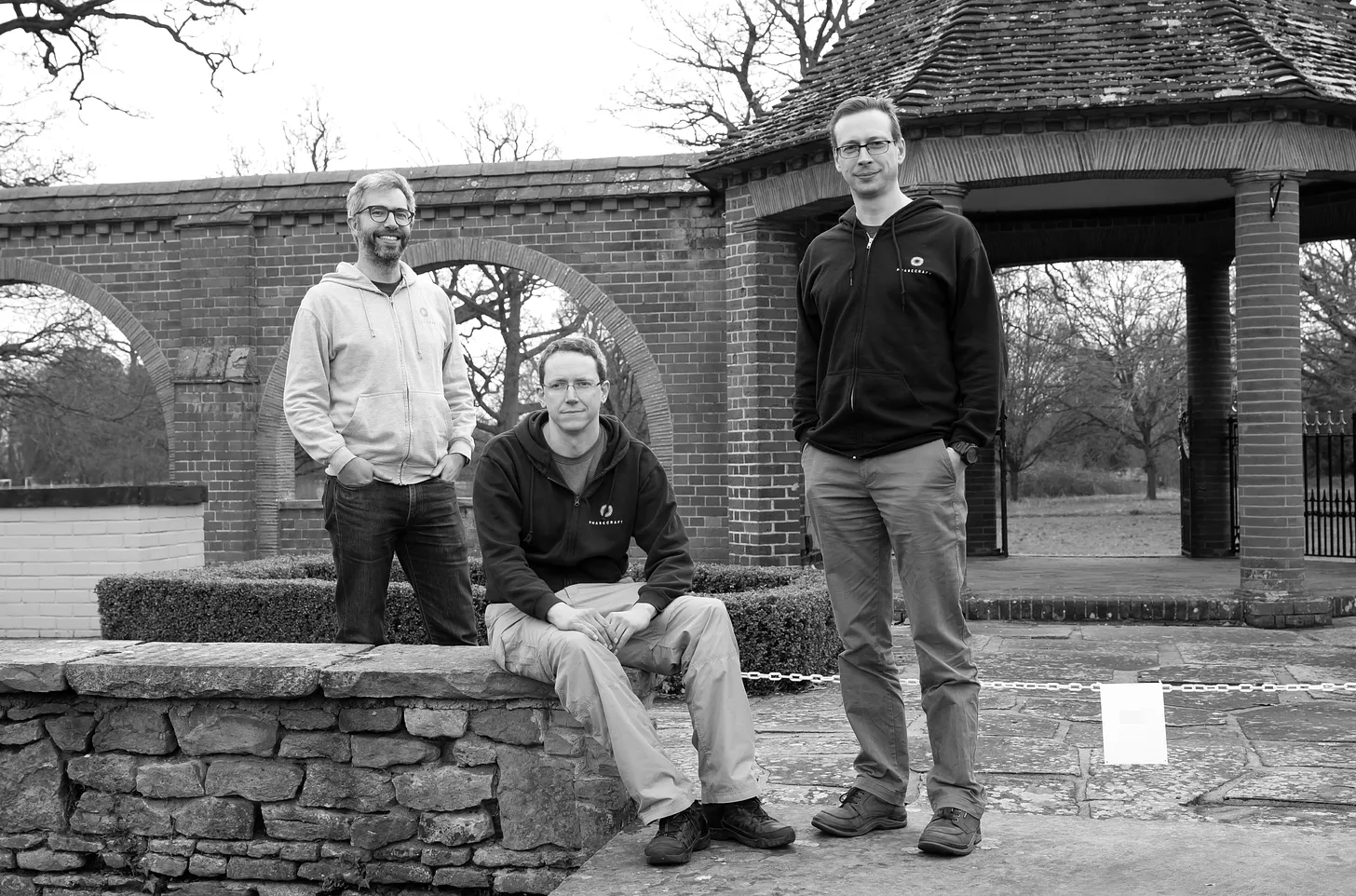
Ashley Montanaro, the CEO and co-founder (pictured, centre), said in an interview that Phasecraft plans to use the money, a Series B, to hire and invest in more R&D, and to expand its business development across the US and Europe, tapping into the interest among organizations wanting to dip their feet into the quantum waters.
The company is a spinout of work at Bristol University, where Montanaro is a professor; and UCL, where Phasecraft’s other two co-founders, CTO Toby Cubitt – yes, that is his real name – and director John Morton are professors (respectively pictured right and left).
Phasecraft’s customer list meanwhile includes specialty materials developer Johnson Matthey, solar cell developer Oxford PV, the UK’s National Energy System Operator (NESO), and telecoms carrier BT.
Early fields for which the startup has already started work on quantum algorithms include drug and material discovery (you can see a related database here of materials and possible applications for them), chemistry applications, energy networks, and logistics optimization.
In keeping with that business growth, Phasecraft’s picked up a very interesting strategic backer with this investment. Novo Nordisk, Plural, and Playground Global are all co-leading the round, with LocalGlobe, AlbionVC, and Parkwalk Advisors also participating.
Novo Nordisk is the pharma giant best known for Ozempic and Wegovy, and Phasecraft is its first investment out of its new Quantum Fund, the company said. (Plural and Playground Global have been making a lot of bets on deep tech, and for Plural its involvement is especially deep: one of its founding partners, Ian Hogarth, is also Phasecraft’s chairman.)
Going hard on software
Quantum computing’s potential impact across critical industries like healthcare and national security works both ways. At its best, it could be used to help break new ground in different fields, improving the resilience of nations by strengthening their security, industries and infrastructure. At its worst, quantum power in the wrong hands could break any of those down.
That is the theory, at least. In reality, the best of the technology remains elusive in the real world. While the likes of IBM and Google are developing quantum hardware, no one has yet to produce a fault-free machine that can be used at scale.
This is where companies like Phasecraft come into the picture. While specialists continue to work on improving hardware (and software to improve the operation of hardware), Phasecraft is focusing on building algorithms that can run on the limited quantum compute power that we have today, in anticipation of the next generation of machines that will be more powerful.
“We founded the company because we felt that in order to make quantum computing useful and impactful in the near term, it was critical to push much harder on the algorithm developments,” Montanaro said.
Phasecraft, he added, estimates that “scientific” quantum advantage – the point at which a quantum computer will be able to solve a complex calculation that cannot be solved by an ordinary computer – by the spring of next year. It will take some time longer to progress that to the next stage, which he referred to as a “practical” quantum advantage, where a quantum machine solves a more complex problem that cannot be solved by classic supercomputers.
Phasecraft’s algorithmic work is hardware-agnostic, but it also has secured collaboration partnerships with Google, IBM, Quantinuum, and QuEra, four of the bigger names in quantum hardware, to optimise algorithms in relation to those systems in particular.
Added to that, Phasecraft has staff that add other dimensions of deep experience with other hardware and software players.
For example, Phasecraft’s US office in Washington, DC, is headed up by Steven Flammia, a professor at Virginia Tech. Previously, he had been the chief research scientist at AWS, where he spearheaded its substantial quantum efforts. Flammia is also recognised as one of the top researchers globally in the field.
This round brings the total raised by Phasecraft to over $50 million. It is not disclosing valuation, but a look at some of the others in the same space underscores the heat of the moment.
Classiq – an Israeli startup developing quantum algorithms – raised $110 million in May 2025, claiming the largest round to-date for quantum software. Another developer of algorithms for quantum systems, Terra Quantum, was last valued at over $600 million according to PitchBook estimates. This speaks to how crowded even a nascent field can be, but also the field’s potential.