Saturday 13 June, 2026
[email protected]
Resilience Media
  • News
    • Events
    • Interview
    • Startups
    • Venture
    • Weekly Digest
  • Resilience Conference
    • Resilience Conference Warsaw 2026
    • Resilience Conference Copenhagen 2026
    • Resilience Conference London 2026
  • About
  • Guest Posts
    • Author a Post
  • Subscribe
No Result
View All Result
  • News
    • Events
    • Interview
    • Startups
    • Venture
    • Weekly Digest
  • Resilience Conference
    • Resilience Conference Warsaw 2026
    • Resilience Conference Copenhagen 2026
    • Resilience Conference London 2026
  • About
  • Guest Posts
    • Author a Post
  • Subscribe
No Result
View All Result
Resilience Media
No Result
View All Result

An Interview With Javier Castellar, CSO of Aechelon

John BiggsbyJohn Biggs
September 15, 2025
in Interview, News, Startups
Share on Linkedin

Jorge Luis Borges once imagined a map so detailed it matched the territory one-to-one. Aechelon’s new initiative, Project Orbion, is trying something more audacious: a live, continuously updating, synthetic copy of Earth that emergency crews, pilots, and eventually civilians can use the way we use weather radar or traffic updates today. In other words, some of the biggest cartographers, VR experts, and satellite mappers have come together to create a twin of the globe.

You Might Also Like

NATO Innovation Fund appoints Nur Özdemir as its newest partner

Jarvis takes on MoD crisis as second minister resigns over defence spending

France moves to boost its military budget with €36B

The team plans to eventually offer the technology to general users, but right now it’s sending 3D data to the U.S. Coast Guard.

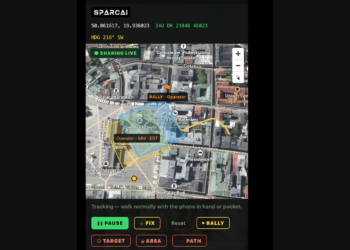
“There is enough technology now, together with Niantic Spatial and other partners, to capture the surroundings of the rescue area, even with an iPhone,” said CSO Javier Castellar in our extensive Resilience interview. “And then immediately send that data, process it with AI, and force it into the system that the pilots use to plan the mission that quickly.”

“Some of the technologies, especially space-based radar, is not like normal radar. It’s radar as space imaging. It’s able to see through clouds, through smoke, through canopy. So it’s able to rebuild from space pretty much any location on the world very quickly. And you can exploit that data and reconstruct the environment really quickly,” he said.

That sounds like science fiction. It isn’t. “This is real,” Castellar told us. The difference now is that many of the pieces once locked behind classified doors including high-refresh satellites, space-based radar, computer vision that can locate you without GPS, and display tech that shows true 3D without glasses, have spilled into the commercial world. Orbion is the effort to stitch those pieces together.

We’ve had “digital twins” before. These include static or slowly updated 3D models you can pan and zoom. Orbion’s pitch is speed. It aims to refresh the planet in near-real time using a mesh of commercial imagery providers, including Europe’s ICEYE and BlackSky, plus space-based radar that can see through clouds, smoke, and canopy. In a wildfire or hurricane, satellite radar can reconstruct the environment when optical cameras are blind.

On the ground, partners like Niantic Spatial can feed the twin with phone-captured video that turns into detailed 3D in minutes. Display partners such as Distance provide no-glasses, light-field windshields to visualize that data. Crucially, Niantic’s visual positioning techniques can pin location and orientation to centimeter-level accuracy with no GPS required.

Finally, Castellar addressed privacy for a system that allows for real-time global surveillance. His answer borrows from multilevel security in defense: invert the pyramid. What the military calls “Top Secret,” Orbeon treats as private by default; what’s accessible to a neighborhood, a city, or an agency depends on pre-adjudicated rules baked into the system. Every pixel and polygon carries a permission tag, and emergency declarations can temporarily lift curtains only within a bounded area. It’s not a policy panacea but it’s privacy as architecture, not an afterthought.

Our wide-ranging conversation about Orbion was fascinating and enlightening. And, most importantly, Orbion shows us the future of mapping tech and what it means to truly have a 1-to-1 digital version of the Earth.

Tags: AechelonJavier CastellarNiantic SpatialProject Orbion
Previous Post

Defence Expos Become Tech Shows at DSEI; Ukraine Defence Startup Falcons Secures Funding from Green Flag; Project Orion Launches to Construct AI-Enabled Digital Twin of the Earth

Next Post

Resilience Conference 2025 | Full Agenda

John Biggs

John Biggs

John Biggs is an entrepreneur, consultant, writer, and maker. He spent fifteen years as an editor for Gizmodo, CrunchGear, and TechCrunch and has a deep background in hardware startups, 3D printing, and blockchain. His work has also appeared in Men’s Health, Wired, and the New York Times. He has written nine books including the best book on blogging, Bloggers Boot Camp, and a book about the most expensive timepiece ever made, Marie Antoinette’s Watch. He lives in Brooklyn, New York. He runs the Keep Going podcast, a podcast about failure. His goal is to share how even the most confident and successful people had to face adversity.

Related News

NATO Innovation Fund appoints Nur Özdemir as its newest partner

NATO Innovation Fund appoints Nur Özdemir as its newest partner

byIngrid Lunden
June 12, 2026

The NATO Innovation Fund, the $1 billion+ investment vehicle for NATO to back innovative startups in defence and resilience tech,...

Jarvis takes on MoD crisis as second minister resigns over defence spending

Jarvis takes on MoD crisis as second minister resigns over defence spending

byCarly Pageand1 others
June 12, 2026

The chaos sweeping over the United Kingdom's Ministry of Defence shows no signs of dying down. Just hours after John...

Eiffel Tower, Paris France

France moves to boost its military budget with €36B

bystanislaw naklicki
June 12, 2026

The United Kingdom Ministry of Defence is in meltdown right now, with the secretary of defence, one of his top...

Tytan Technologies

The primes and the upstarts: Counter-drone tech makes for fast friends at ILA Berlin

byPaul Sawers
June 12, 2026

Mercedes-Benz is pushing deeper into defence technology, announcing this week a partnership with a Munich drone-defence startup to mount counter-drone...

Helsing expands CA-1 platform with AI-powered Electronic Attack drone

Helsing expands CA-1 platform with AI-powered Electronic Attack drone

byJohn Biggs
June 11, 2026

Helsing, a leading European AI-infused weapons manufacturer, has announced the launch of the CA-1 Electronic Attack or CA-1EA, an uncrewed,...

Breaking: John Healey resigns as UK Defence Secretary in protest over funding shortfall

Breaking: John Healey resigns as UK Defence Secretary in protest over funding shortfall

byIngrid Lundenand1 others
June 11, 2026

The United Kingdom's long-delayed Defence Investment Plan has yet to be published, but it has already claimed a very serious...

a close-up of a money bill

Ukraine gets down to AI business

byThomas Macaulay
June 11, 2026

Ukraine is celebrated as a bottom-up laboratory for military innovation. The popular narrative casts its defence-tech scene as a landscape...

Orqa unveils hybrid tactical drone for jammed battlefields

Orqa unveils hybrid tactical drone for jammed battlefields

byJohn Biggs
June 11, 2026

Croatian drone manufacturer Orqa has announced the launch of their latest tactical drone, the MRM2-10AI, a hybrid Unmanned Aerial Vehicle...

Load More
Next Post
Resilience Conference 2025 | Full Agenda

Resilience Conference 2025 | Full Agenda

The Hypersonic Arms Race

The Hypersonic Arms Race

Most viewed

InVeris announces fats Drone, an integrated, multi-party drone flight simulator

Uforce raises $50M at a $1B+ valuation to build defence tech for Ukraine

Auterion, the drone software startup, eyes raising $200M at a $1.2B+ valuation

Palantir and Ukraine’s Brave1 have built a new AI “Dataroom”

Twentyfour Industries emerges from stealth with $11.8M for mass-produced drones

Senai exits stealth to help governments harness online video intelligence

Resilience Media is an independent publication covering the future of defence, security, and resilience. Our reporting focuses on emerging technologies, strategic threats, and the growing role of startups and investors in the defence of democracy.

  • About
  • News
  • Resilence Conference
    • Resilience Conference Copenhagen 2026
    • Resilience Conference Warsaw 2026
    • Resilience Conference 2026
  • Guest Posts
  • Subscribe
  • Privacy Policy
  • Terms & Conditions
  • Mission Statement & Code of Practice
  • Press

© 2026 Resilience Media

No Result
View All Result
  • Home
  • About
  • Subscribe
  • Events
  • Guest Posts
  • Interview
  • News
  • Resilience Conference London 2026
  • Resilience Conference Copenhagen 2026
  • Resilience Conference Warsaw 2026

© 2026 Resilience Media

This website uses cookies. By continuing to use this website you are giving consent to cookies being used. Visit our Privacy and Cookie Policy.