100 investors to watch 2026 100 investors to watch 2026 100 investors to watch 2026
Tuesday 22 September, 2026
[email protected]
Resilience Media
  • News
    • Events
    • Interview
    • Startups
    • Venture
    • Weekly Digest
  • Resilience Conference
    • Resilience Conference London — Oct 2026
    • Resilience Conference Copenhagen — May 2026 (PAST)
    • Resilience Conference Warsaw — Apr 2026 (PAST)
  • Launch
  • About
  • Guest Posts
    • Author a Post
  • Subscribe
No Result
View All Result
  • News
    • Events
    • Interview
    • Startups
    • Venture
    • Weekly Digest
  • Resilience Conference
    • Resilience Conference London — Oct 2026
    • Resilience Conference Copenhagen — May 2026 (PAST)
    • Resilience Conference Warsaw — Apr 2026 (PAST)
  • Launch
  • About
  • Guest Posts
    • Author a Post
  • Subscribe
No Result
View All Result
Resilience Media
No Result
View All Result

Militaries want to tap startup innovation: Tiberius has built Grail to get them on track

Slow-moving, incumbent primes dominate the procurement landscape today. Now, a wave of new collaboration platforms aims to disrupt that supply chain for the better

Ingrid LundenbyIngrid Lunden
September 10, 2025
in Events, News
Photo by NASA on Unsplash

Photo by NASA on Unsplash

Share on Linkedin

Primes and other large defence contractors dominate how governments procure equipment and shape their military strategies today. But a wave of startups entering the sector, applying cutting-edge technology to defence and resilience use cases, is angling for a different business model tomorrow. Some are taking matters into their own hands and building the platforms they hope will help improve the chances of startups and SMBs working on securing military deals in the future.

You Might Also Like

TERASi raises €11m to scale secure battlefield communications

Finland’s NestAI expands to Estonia

Funding the frontline: the hidden resilience risk in defence venture capital

Tiberius is a UK startup developing a new class of weapons and launchers that it believes will extend the targeting and range capabilities of what the military uses today. Alongside that work, it’s using this week’s large DSEI defence exposition in London to announce a separate product aimed both at helping governments and other large organisations buy in the future and net startups into the mix.

Grail, as the platform is called, at its most basic is an enterprise resource planning and supply chain management platform.

Buyers (defence departments, militaries, military alliances) are pitched to use it to plan what they are doing and to build corresponding procurement strategies. Larger suppliers can use it to build consortiums to go after bids. And lastly, smaller suppliers can use it to get into the food chain as a partner or in some cases respond to RFPs directly.

ERP sounds a little unremarkable, but Grail is a notable development for several reasons.

First and foremost, the platform underscores a significant trend in the world of defence, propelled largely by startups, which is seeing the sector launch and adopt tools from the enterprise as it slowly modernises.

Just as enterprises in tech have seen a wave of “consumerisation” — where B2B products have borrowed user experience and design from the world of consumer tech to make their products more palatable and adopted by business users (bringing in smartphones, app stores, gamification, social networking and other traditionally consumer tools) — defence has effectively made a turn to “enterprisation.”

That has come through in the form of dual-use technology built both for civilian and military use, but also building military software (and hardware) built on concepts that have proven to be successful in enterprise.

Procurement has been a notoriously tortious process in the sector, and this aims to improve that, especially for the smaller technology companies that are entering the field with new approaches.

“Designing the most cost-effective and lethal weapons of the future is a challenge of innovation,” Blythe Crawford, who this week was revealed as the new Director of Grail for Tiberius, told Resilience Media. “Sustaining their relevance for warfighters across vastly different environments is a challenge of supply. Grail unites design objectivity with the world’s largest mobilised supply chain, enabling every Allied nation to harness the power of Silicon Valley style continuous iteration and development (CI/CD).”

Tiberius describes the functionality as “AI powered”. That includes predictability and modelling that can be used for “just in time” procurement and production, which represents a big shift from the production, slow manufacturing cycles and subsequent stockpiling that typically characterises how militaries manage their inventory. Tiberius hopes that Grail can, in effect, be “the holy grail” for defence organisations to modernise how all this works.

Grail is not alone in identifying this opportunity.

Hadean — a company that incidentally pivoted from the world of consumer tech, originally building tooling to power multiplayer and immersive gaming experiences — this week also announced Sceptre, another platform for SMBs to collaborate on larger defence bids. (Tiberius and Hadean work together as well, Hadean told Resilience Media). Others like Anduril, with its Lattice platform, are also bringing the concept of interoperability and collaboration into the world of defence planning and procurement.

It is not too surprising to see Tiberius building a product like Grail. The team behind the startup has a long track record in tech that includes years spent at other startups, and then at big tech companies are those startups got acquired.

Chad Steelberg, the CEO and co-founder of Tiberius, came to starting the company after years of building, running and selling startups in the worlds of adtech and marketing tech, including time at Google building its multimedia ad products after the Internet giant acquired one of his startups.

His co-founder, chief strategy officer Andy Baynes, worked for years at Apple, Nest and Google (which acquired Nest), working on iconic consumer products as a director of product design at the first company, and then business development and growth at the latter two, before then moving into life sciences.

The startup he built, GT LifeScience, brought him to Ukraine to work with local tech talent in the country (and itself had built its own ERP-style platform for life science companies to collaborate). Nevertheless, it was when war broke out in the country, he told Resilience Media, that he found his calling to build Tiberius, tapping his friend to co-found and develop the business with him.

The primary focus at Tiberius today seems to be building hardware — Sceptre (not to be confused with Hadean’s Sceptre, or indeed BAE’s Sceptre) is being trialled now by the UK’s Ministry of Defence, a big deal for the startup — but Grail may end up gaining traction in its own right. Tiberius claims that Sceptre itself was conceived using Grail, and that it’s seeing a lot of early interest from third parties to join up to the platform (which is free to join).

“Defense supremacy is not defined by the most lethal systems alone. It is secured by weapons that endure, adapt and evolve for every warfighter, in every domain,” said Steelberg. “Grail transforms this challenge into strength by uniting breakthrough design with the world’s largest mobilized supply chain. For the first time, every NATO ally can wield Silicon Valley style speed, agility, and continuous innovation in the service of peace through strength.”

Tags: Andy BaynesBlythe CrawfordChad SteelbergDSEIHadeanTiberius
Previous Post

Project Orbion: Building the Earth’s First AI-Enabled Digital Twin

Next Post

A letter from Help99 on missiles and friends in Poland

Ingrid Lunden

Ingrid Lunden

Ingrid is an editor and writer. Born in Moscow, brought up in the U.S. and now based out of London, from February 2012 to May 2025, she worked at leading technology publication TechCrunch, initially as a writer and eventually as one of TechCrunch’s managing editors, leading the company’s international editorial operation and working as part of TechCrunch’s senior leadership team. She speaks Russian, French and Spanish and takes a keen interest in the intersection of technology with geopolitics.

Related News

TERASi raises €11m to scale secure battlefield communications

TERASi raises €11m to scale secure battlefield communications

byCarly Page
September 22, 2026

Swedish defence technology company TERASi has raised €11 million to expand its millimetre-wave communications technology across European armed forces and...

buildings during day

Finland’s NestAI expands to Estonia

byFiona Alston
September 22, 2026

NestAI, a defence tech startup from Finland backed by Nokia, is taking the next step in its strategy to build...

A collection of various international banknotes scattered across a flat surface

Funding the frontline: the hidden resilience risk in defence venture capital

byJamie Burnham
September 22, 2026

It was a former Ukrainian Chief of the General Staff who put the awkward truth to Britain’s General Sir Roly...

a street sign on the side of a building

UK and US deepen AI defence ties after uncrewed torpedo first

byCarly Page
September 22, 2026

The UK and US are launching a new defence partnership focused on artificial intelligence and autonomous systems, as the allies...

ARX Robotics wants its land drones fighting alongside Britain’s Ajax vehicles

ARX Robotics wants its land drones fighting alongside Britain’s Ajax vehicles

byJohn Biggs
September 21, 2026

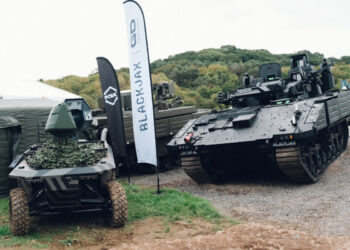
German defence startup ARX Robotics is working with General Dynamics Land Systems UK to integrate autonomous ground vehicles with the...

a street light in the snow at night

Iceland’s Laki Power charges up with €6M from NIF because electric grids are under threat

byIngrid Lunden
September 21, 2026

The NATO Innovation Fund is making another resilience tech investment out of its €1 billion+ coffer, and it happens also...

German military uniform

Germany has Europe’s biggest defence budget. Startups don’t get much of it

byPaul Sawers
September 21, 2026

A pattern is emerging among European defence-tech startups looking for sales: plenty of money is up for grabs, but the...

Denmark’s Final Frontier and Myriad join forces to create a new defence fund

Denmark’s Final Frontier and Myriad join forces to create a new defence fund

byFiona Alston
September 21, 2026

It started with a cup of coffee and ended up in two Danish early stage New Nordics defence funds becoming...

Load More
Next Post
A letter from Help99 on missiles and friends in Poland

A letter from Help99 on missiles and friends in Poland

Helsing integrates with Systematic to power drone swarms and more

Helsing integrates with Systematic to power drone swarms and more

Top stories

The UK built and flew a new jet engine in under seven months
UK Defence

The UK built and flew a new jet engine in under seven months

September 17, 2026
German military uniform
News

Germany has Europe’s biggest defence budget. Startups don’t get much of it

September 21, 2026
The London Defence Tech Week programme is here
Events

The London Defence Tech Week programme is here

September 17, 2026
‘We’ve had the proliferation phase in Ukraine, now we go into consolidation’
Interview

‘We’ve had the proliferation phase in Ukraine, now we go into consolidation’

September 16, 2026

Resilience Media is an independent publication covering the future of defence, security, and resilience. Our reporting focuses on emerging technologies, strategic threats, and the growing role of startups and investors in the defence of democracy.

  • About
  • News
  • Resilence Conference
    • Resilience Conference Copenhagen 2026
    • Resilience Conference Warsaw 2026
  • Guest Posts
  • Subscribe
  • Privacy Policy
  • Terms & Conditions
  • Mission Statement & Code of Practice
  • Press

© 2026 Resilience Media

No Result
View All Result
  • Home
  • About
  • Subscribe
  • Events
  • Guest Posts
  • Interview
  • News
  • Resilience Conference London 2026
  • Resilience Conference Copenhagen 2026
  • Resilience Conference Warsaw 2026

© 2026 Resilience Media

This website uses cookies. By continuing to use this website you are giving consent to cookies being used. Visit our Privacy and Cookie Policy.