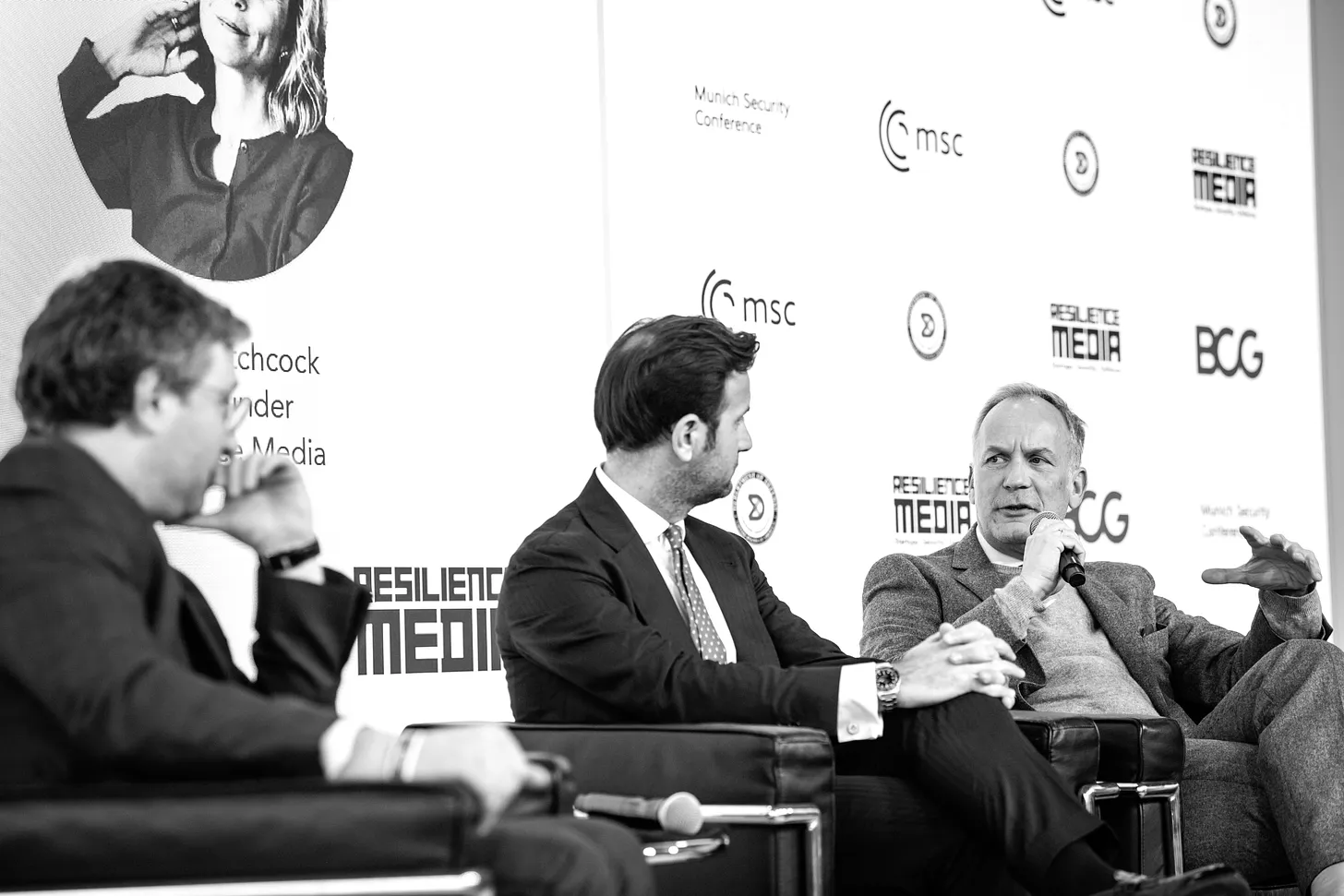
The Western defence industrial base is at a turning point. As the United States signals a reduced role in European security, and as new partnerships and manufacturing expansions emerge across the sector, defence leaders must confront a unanimous opinion: Western defence manufacturing is not ready for a major conflict. Industry leaders from Germany and Italy, with industry experts from the US gathered on our stage at Munich Security Conference to talk about what’s more important. How to fix it.
Watch the entire panel, Industry and the Incumbents on our Youtube Channel here.
Readiness Gaps and the Industrial Base
Marc Geisner from Boston Consulting Group (BCG) highlighted key findings from the latest Defence Innovation Readiness Gap report. Western militaries are not innovating fast enough, with a reported five per cent decline in readiness since 2022. Only 12 per cent of respondents believe the pace of innovation is sufficient. But the real problem isn’t just about innovation—it’s about knowing what to scale. “When we ask how to ramp production, the response we often get is: ‘We don’t even know what we could ramp to.’”
Fincantieri’s Enrico Della Gatta reinforced this, noting that “production is deterrence,” and yet the West has fallen behind in mass production capabilities. The challenge isn’t just about developing new technologies but integrating them into existing industrial bases and ramping up output at speed.
The Hesitation in European Industry
Karl Haeusgen of the Machinery and Equipment Manufacturers Association of Germany (VDMA) provided a stark reality check. With 90 per cent of German industrial manufacturers being small, family-owned businesses which have fewer than 200 employees, the risk appetite for pivoting into defence remains low. Many companies hesitate due to ESG financing concerns, regulatory uncertainty, and a deeply ingrained peacetime mindset.
Manufacturing capacities for defence technology are also insufficient. “How fast can we accelerate this?” Haeusgen asked. “Can companies ramp up fast enough? Are they willing to take the risk?”
The answer, at least partially, lies in government-backed risk-sharing mechanisms. Without state assurances, many manufacturers fear investing in expanded capacity only to see demand collapse once geopolitical tensions ease.
The Automation Imperative
One of the most pressing challenges is workforce shortages. Della Gatta pointed out that even in the U.S., one of the most powerful economies, there is a severe shortage of welders—a critical trade for shipbuilding. To address this, Fincantieri is investing in AI-driven manufacturing, automation, and digital transformation of shipyards. “We are integrating robots as welders and transforming shipyards into digital hubs,” he explained.
Haeusgen supported this push, sharing an example of pitching a defence OEM on a contract which required the company to scale from 25 systems in 2024 to 1,000 in 2026. The only feasible solution? “Heavily automate the entire supply chain.” Traditional workforce expansion simply won’t meet the demand.
Startups, Venture Capital, and the Changing Business Model
A major shift is occurring in how defence innovation is funded. Historically, military innovation was government-driven. Today, it is largely commercial innovation repurposed for military applications. “There’s an elephant in the room,” Della Gatta noted. “The defence business model is changing. We are moving from a cost-plus model to a fixed-price model. That means companies must deliver on time and on budget.”
The rise of venture capital in defence is a significant development. Private investors are now backing startups that challenge traditional defence primes with faster, more agile solutions. As Haeusgen illustrated, “A startup from our group is already delivering systems to Ukraine while the equivalent big OEM is still prototyping.” The lesson? Bureaucracy slows innovation. In crisis situations, the buyer prioritises what works—immediately.
Reducing Bureaucracy: The Next Battlefield
Procurement remains one of the biggest bottlenecks. Geisner revealed a staggering statistic: “40 per cent of MOD officials responsible for acquisitions do not engage with industry.” This disconnect is stifling progress. Haeusgen was blunt: “Procurement is the problem. In a crisis, standard processes are skipped, and things get done. How can we take bureaucracy out? How can we find lean and fast processes?”
One solution is closer collaboration between startups and traditional defence primes. Geisner proposed a “10-20-70 approach”:
- 10 per cent focused on disruptive innovation from startups
- 20 per cent on process improvements
- 70 per cent on cultural change and engagement
The 2035 Vision: An Open, Scalable Defence Ecosystem
Looking ahead, the panelists outlined key priorities for the future of Western defence manufacturing:
- Open markets and strong transatlantic partnerships: “No American tank or missile is built without German manufacturing equipment,” reminded the audience.
- An industrial ecosystem that scales: Delegata warned that without reshaping European defence production into a scalable, unified system, “we will remain too fragmented to compete globally.”
- Affordability and efficiency: Defence production must become leaner and more cost-effective to remain competitive.
- More players, more production: Geisner predicted that in a decade, “there will be more startups, more collaboration between government and industry, and more affordability in defence manufacturing.”
The Takeaway: Speed and Strategy
The West has the tools, the industrial base, and the technological expertise. What’s missing is the speed and willingness to act. As Della Gatta put it, “We are not starting from scratch. We have the know-how. Now we must execute—faster.”
For startups, this is an opportunity. The old defence industry is slow, bureaucratic, and risk-averse. Those who can navigate the regulatory maze while moving quickly will find governments and investors eager to support them. As the defence sector evolves, startups that master both agility and compliance will be the ones shaping the next generation of military capabilities.
The Future of Defence Tech Manufacturing & Innovation, from the US Defense Innovation Unit and Munich Security Conference Tech & Innovation Thursday, sponsored by Boston Consulting Group, and powered by Resilience Media.